
























Best Online Blackjack Games
Blackjack is the only mainstream casino game where your decisions change the mathematics. Played well at a table with favourable rules, it can offer one of the lowest house edges available — and an unremarkable one when either of those conditions is missing. Everything on this page exists to tell those two situations apart.
Which is why the table below does not carry a single house edge per variant. It cannot. The cost of a blackjack table is set by its rules, and two tables with the same name can run different ones. What the variant name tells you is which rule set to expect; what the table tells you is what it actually costs.
| Blackjack variant | Decks (typical) | Blackjack payout | Dealer on soft 17 | House edge | Best for |
|---|---|---|---|---|---|
| Classic / Vegas Strip | 4–8 | 3:2 on a good table, 6:5 on many | Usually stands | Depends on the rules — see below | The default. Check the payout before you sit. |
| European Blackjack | 2–8 | Usually 3:2 | Usually stands | Slightly higher than the US version, all else equal | Players who understand the no-hole-card rule below |
| Atlantic City | 6–8 | 3:2 | Stands | Among the lower sets, when the payout is 3:2 | Late surrender and double after split |
| Single & Double Deck | 1–2 | Very often 6:5 | Often hits | Fewer decks help, but 6:5 wipes that out several times over | Almost nobody, once the payout is 6:5 |
| Spanish 21 | 6–8 | 3:2, and always beats a dealer 21 | Varies | Depends heavily on the bonus payouts | Players who will learn a second strategy chart |
| Live Blackjack | 8 (usually) | Read the table rules | Varies by table | Depends on the table | A real dealer, and the only place you will find Arabic-dealt tables |

A blackjack paid at 6:5 instead of 3:2 adds roughly 1.39% to the house edge — more than doubling the cost of a well-ruled game, and more than the combined effect of the deck count, the soft-17 rule and the doubling restrictions put together. It is also the single easiest thing to check: it is printed on the table felt and in the game rules, before you bet anything. A table advertising “single deck” at 6:5 is worse than an eight-deck table at 3:2, which is the exact opposite of what the marketing implies.
What Is Online Blackjack?

Blackjack is a card game in which you play against the dealer and nobody else. The other players at the table are irrelevant to your result — their decisions do not change your odds, and you are not competing with them for a prize.
The goal is commonly stated as “get to 21”, and that is not quite right. The goal is to finish with a total closer to 21 than the dealer, without going over. Those are different objectives: a hand of 17 wins nothing on its own, but it wins everything if the dealer goes bust. In practice a large share of your winning hands are hands where the dealer broke, not hands where you made a high total.
Going over 21 is called a bust, and it loses immediately — before the dealer plays at all. That asymmetry is the entire house edge of blackjack. You and the dealer bust at roughly the same rate, but when you both bust in the same round, you have already lost. Everything basic strategy does is manage that one disadvantage.
Blackjack Card Values

| Card | Value |
|---|---|
| 2 to 10 | Face value |
| Jack, Queen, King | 10 |
| Ace | 1 or 11, whichever helps the hand |
Suits are irrelevant in blackjack. A card is worth its number, the picture cards are all worth ten, and the ace is worth whatever serves you better at that moment — it changes value during the hand, automatically.
Hard hands, soft hands and naturals
- A hard hand has no ace, or has an ace that must count as 1 because counting it as 11 would bust. A hard 16 is 10+6: taking a card can break it.
- A soft hand contains an ace counting as 11. A soft 17 is A+6: taking a card cannot break it, because the ace drops to 1 if needed. This is why soft hands are played far more aggressively.
- A blackjack, or natural, is an ace plus any ten-value card on the first two cards. It is not the same as reaching 21 with three cards — a natural is paid at the blackjack rate, a three-card 21 is paid as an ordinary win.
Players who do not separate hard from soft totals lose most of it on soft hands. A soft 18 (A+7) feels like a good hand and is routinely stood on — but against a dealer 9, 10 or ace it is a losing hand, and the correct play is to hit it. You cannot bust, and standing keeps a total that is beaten more often than not. The chart further down separates the two for exactly this reason.
The words you need before the first hand
| Term | What it means |
|---|---|
| Natural / blackjack | An ace plus any ten-value card on the first two cards. Paid at the blackjack rate, not as an ordinary win. |
| Hard hand | A hand with no ace, or with an ace forced to count as 1. Taking a card can bust it. |
| Soft hand | A hand with an ace counting as 11. Taking a card cannot bust it — the ace drops to 1. |
| Bust | Going over 21. You lose immediately, before the dealer plays. This is where the house edge comes from. |
| Push | A tie with the dealer. Your stake is returned; nothing is won or lost. |
| Upcard | The dealer’s face-up card. It decides your correct move as much as your own hand does. |
| Hole card | The dealer’s face-down card. European tables often do not deal one until you have finished. |
| Shoe | The container holding the decks in play. Four to eight decks is typical. |
| Stand-off / even money | Being offered a guaranteed 1:1 when you hold a blackjack and the dealer shows an ace. It is insurance under another name, and it costs the same. |
How to Play Blackjack Online
Place your bet
Chips go on the betting circle before any cards are dealt. Online, the table minimum and maximum are shown in the lobby before you open the game — worth reading, because the same variant often runs at four or five different limits and the cheap table and the expensive one are the identical game.
Receive your cards
You are dealt two cards face up. The dealer takes two: one face up (the upcard) and, in most American-style games, one face down (the hole card). European tables often deal the dealer a single card and take the second only after you have finished — a difference with real consequences, covered below.
Check the dealer’s upcard
This is the step players skip, and it decides everything. Your correct move depends on the dealer’s upcard at least as much as on your own hand. A hard 16 is a hit against a dealer 7 and a stand against a dealer 6 — the same cards in your hand, the opposite decision. Any strategy that ignores the upcard is not strategy.
Choose your action
- Hit — take another card. You can keep hitting until you stand or bust.
- Stand — take no more cards and pass play to the dealer.
- Double down — double your stake and take exactly one more card. The strongest move in the game when it is correct, and a table that restricts it is a more expensive table.
- Split — with two cards of the same value, separate them into two hands with a second bet of the same size. Always correct with aces and eights; never correct with tens.
- Surrender — where offered, forfeit half your stake and end the hand. It looks defeatist and it is mathematically correct on a small number of bad hands, notably hard 16 against a dealer 10.
- Insurance — offered when the dealer shows an ace. Covered in the side bets section, where it belongs, because that is what it is.
The dealer plays the hand
The dealer has no choices. They draw to a fixed total and stop, by a rule printed on the table — and that rule is part of what the game costs you.
- Dealer stands on all 17s — including soft 17 (A+6). Better for you.
- Dealer hits soft 17 — takes another card on A+6. This adds about 0.22% to the house edge. It is shown on the felt, usually abbreviated to H17 or S17.
- On 16 or less, the dealer must draw. On hard 17 or more, the dealer must stop. No table varies this part.
Because the dealer cannot choose, the dealer cannot play badly — and cannot play well either. The dealer busts about 28% of the time. Your entire edge over a careless player is in making the decisions the dealer is not allowed to make.
Blackjack Payouts
| Outcome | Pays | On a $10 bet you receive |
|---|---|---|
| Blackjack (natural 21) | 3:2 on a good table | $15 profit, plus your $10 back |
| Blackjack on a 6:5 table | 6:5 | $12 profit — $3 less, on the best hand in the game |
| Ordinary win | 1:1 | $10 profit, plus your $10 back |
| Push (tie with the dealer) | Stake returned | Your $10 back, no profit and no loss |
| Loss or bust | — | Nothing |
| Insurance (side bet) | 2:1 | $10 profit on a $5 insurance bet, when the dealer has blackjack |
You are dealt a blackjack roughly once every 21 hands. At 70 hands an hour that is about three naturals, and on a 6:5 table each one pays $3 less per $10 staked. The difference does not feel like much in a single hand, which is precisely why the 6:5 table exists.
3:2 vs 6:5 Blackjack: What the Difference Costs
Both tables are called blackjack. Both deal the same cards under the same rules. The only thing that changes is what the best hand in the game pays you — and it is the most expensive difference on a casino floor that almost nobody checks before sitting down.
On a $10 bet: a 3:2 table pays $15 profit for a blackjack. A 6:5 table pays $12. Three dollars, on one hand, once in every 21 hands or so. It sounds like nothing, which is exactly why the 6:5 table works.
| Your bet | Blackjack pays 3:2 | Blackjack pays 6:5 | You lose |
|---|---|---|---|
| $10 | $15 | $12 | $3 |
| $20 | $30 | $24 | $6 |
| $50 | $75 | $60 | $15 |
| $100 | $150 | $120 | $30 |
Now the same difference over an hour rather than a hand. At 70 hands an hour you are dealt roughly three blackjacks. Three times $3 is $9 — but the loss is not only in the blackjacks you are dealt. Spread across everything you stake, the 6:5 payout adds about 1.39 percentage points to the house edge.
| Table | House edge with basic strategy | Cost of one hour at $10, 70 hands |
|---|---|---|
| 3:2, otherwise identical rules | around 0.5% | about $3.50 |
| 6:5, otherwise identical rules | around 1.9% | about $13.30 |
The same game, the same stake, the same hour, at nearly four times the cost. That single rule is worth more than the deck count, the soft-17 rule, the doubling restrictions and the surrender option put together — and unlike all of those, it takes one glance to check.
The payout is printed on the table felt and repeated in the game rules panel, usually as “Blackjack pays 3 to 2” or “Blackjack pays 6 to 5”. Two habits worth having: read it every time, because operators run both side by side in the same lobby at the same limits; and be suspicious of anything advertising single deck or double deck, which is where 6:5 appears most often. Fewer decks are worth about half a point to you; the 6:5 takes back nearly three times that. The flattering headline is frequently attached to the worse table.
Blackjack Rules That Affect the House Edge
This is the most useful section on the page, and the one almost no guide puts in numbers. Below is what each rule is worth. Negative numbers are good for you. The figures are the standard mathematics of the game, read at Wizard of Odds on 15 September 2026, against a six-deck baseline.
| Rule | Effect on house edge | What it means in practice |
|---|---|---|
| Blackjack pays 6:5 instead of 3:2 | +1.39% | The single most expensive rule in blackjack. Worth more than everything else on this table combined. |
| Dealer hits soft 17 | +0.22% | Gives the dealer an extra chance to improve a weak 17. |
| Eight decks instead of one | +0.48% (approx.) | Real, but small next to the payout. A single-deck 6:5 game is far worse than an eight-deck 3:2 game. |
| No hole card (dealer takes second card last) | +0.11% | You can lose doubles and splits to a dealer blackjack. Common on European tables. |
| Doubling restricted to 9, 10, 11 only | +0.09% | Removes the correct double on soft hands and on low totals against a weak dealer. |
| No doubling after split | +0.14% | Takes away the most profitable follow-up to a correct split. |
| No resplitting | +0.05% (approx.) | Matters most with aces and eights. |
| Double after split allowed | −0.14% | Look for it. |
| Late surrender offered | −0.08% | Small, free, and almost never used by players who have it. |
| Resplitting aces allowed | −0.08% | Rare. A marker of a genuinely good table. |
Two tables both called “Blackjack” can differ by more than two percentage points. That is the whole point. In a game whose best version costs about half a percent, a two-point spread is not a detail — it is the difference between a genuinely cheap game and an ordinary one. The rules are shown in the game info panel before you bet. It takes twenty seconds to read them.
Blackjack House Edge and RTP
House edge is the share of each stake the casino expects to keep. RTP is the same number seen from the other side: what the game returns. They are not different measurements — a 0.5% house edge is a 99.5% RTP, and a guide that treats them as separate facts is padding.
What matters in blackjack is that neither figure is a property of the game. In slots the RTP is built into the title. In roulette it falls out of the number of pockets and cannot be changed. In blackjack it depends on two things that change hand to hand: the rules of the table, and whether the player plays correctly.
| Situation | Approximate house edge | Cost per hour at $10 a hand, 70 hands |
|---|---|---|
| Good rules, 3:2, basic strategy played accurately | ~0.5% | about $3.50 |
| Good rules, 3:2, played by instinct | ~2% to 2.5% | about $14 to $17 |
| 6:5 payout, otherwise decent rules, basic strategy | ~1.9% | about $13 |
| 6:5 payout, played by instinct | ~3.5% | about $24 |
| European roulette, for comparison | 2.70% fixed | about $10.80 at 40 spins |
Read that table as one sentence: the same game, at the same stake, for the same hour, costs between about $3.50 and about $24 depending on a rule you can read and a chart you can learn. Nothing else on a casino floor has that range. It is why blackjack is worth learning properly and why it is a poor game to play casually.
You will see “blackjack has a 0.5% house edge” repeated everywhere. It is true of one specific situation: a favourable rule set, played with accurate basic strategy, every hand. It is not true of the table you are about to open, and it is not true of how most people play. We give ranges tied to rules and to accuracy, because that is the honest form of the answer.
Blackjack Basic Strategy
Basic strategy is the mathematically optimal decision for every possible hand against every possible dealer upcard. It is not a betting system, it is not a tip, and it is not a matter of preference — it is the output of solving the game, and it has been settled for decades.
The charts below assume the most common online configuration: four to eight decks, dealer stands on soft 17, double after split allowed. A few cells change under other rules, and we say where.
H = hit · S = stand · D = double if allowed, otherwise hit · P = split · R = surrender if allowed, otherwise hit
Basic strategy changes when the table rules change. The three charts below are calculated for the most common online configuration: four to eight decks, dealer stands on soft 17, doubling allowed after a split, no surrender. Change any of those and a handful of cells move — single-deck games, tables where the dealer hits soft 17, and tables offering surrender each have their own chart. Read the rules panel of the table you are at before assuming these cells apply, and treat the chart as the correct play for a rule set rather than a universal answer.
Hard hands
| Your hand | 2 | 3 | 4 | 5 | 6 | 7 | 8 | 9 | 10 | A |
|---|---|---|---|---|---|---|---|---|---|---|
| 8 or less | H | H | H | H | H | H | H | H | H | H |
| 9 | H | D | D | D | D | H | H | H | H | H |
| 10 | D | D | D | D | D | D | D | D | H | H |
| 11 | D | D | D | D | D | D | D | D | D | H |
| 12 | H | H | S | S | S | H | H | H | H | H |
| 13 | S | S | S | S | S | H | H | H | H | H |
| 14 | S | S | S | S | S | H | H | H | H | H |
| 15 | S | S | S | S | S | H | H | H | R | H |
| 16 | S | S | S | S | S | H | H | R | R | R |
| 17 or more | S | S | S | S | S | S | S | S | S | S |
Soft hands (a hand containing an ace counted as 11)
| Your hand | 2 | 3 | 4 | 5 | 6 | 7 | 8 | 9 | 10 | A |
|---|---|---|---|---|---|---|---|---|---|---|
| A,2 – A,3 | H | H | H | D | D | H | H | H | H | H |
| A,4 – A,5 | H | H | D | D | D | H | H | H | H | H |
| A,6 | H | D | D | D | D | H | H | H | H | H |
| A,7 (soft 18) | S | D | D | D | D | S | S | H | H | H |
| A,8 – A,9 | S | S | S | S | S | S | S | S | S | S |
Pairs
| Your pair | 2 | 3 | 4 | 5 | 6 | 7 | 8 | 9 | 10 | A |
|---|---|---|---|---|---|---|---|---|---|---|
| A,A | P | P | P | P | P | P | P | P | P | P |
| 10,10 | S | S | S | S | S | S | S | S | S | S |
| 9,9 | P | P | P | P | P | S | P | P | S | S |
| 8,8 | P | P | P | P | P | P | P | P | P | P |
| 7,7 | P | P | P | P | P | P | H | H | H | H |
| 6,6 | P | P | P | P | P | H | H | H | H | H |
| 5,5 | D | D | D | D | D | D | D | D | H | H |
| 4,4 | H | H | H | P | P | H | H | H | H | H |
| 3,3 & 2,2 | P | P | P | P | P | P | H | H | H | H |
Three rules carry most of the value, and they are worth memorising even if you never learn the rest: always split aces and eights, never split tens or fives, and always stand on hard 17 or more. A player who does only those three things and guesses the rest is already playing a cheaper game than most of the table.
Blackjack Strategies Explained
Basic strategy
Covered above. It is the only approach on this list that changes your expected cost, and it changes it by roughly two percentage points — the difference between about $3.50 and about $17 for the same hour.
Card counting
Counting tracks the ratio of high cards to low cards left in the shoe. When the remaining cards are rich in tens and aces, the player’s odds improve — more blackjacks, better doubles — and a counter raises their stake at those moments. The concept is real and the mathematics are sound.
Online, it almost never applies. RNG tables shuffle a fresh virtual shoe every hand, so there is nothing to count — the composition resets before you can use it. Most live streamed tables use continuous or frequent shuffling for the same reason. Counting is a physical-casino technique that survives online only in narrow circumstances, and operators are free to restrict or close accounts that use it. We mention it because it is asked about, not as a method we are recommending.
Betting progression systems
Raising stakes after a loss, or after a win, in a fixed pattern. Martingale, Paroli, D’Alembert, Fibonacci — the names differ, the logic does not.
Martingale and blackjack
Doubling after every loss until a win recovers everything. It fails in blackjack for the ordinary reason — the table maximum and your bankroll both arrive before the losing run ends — and for two reasons specific to this game: doubles and splits require a second bet you may not be able to fund, and a blackjack paying 3:2 breaks the arithmetic the progression depends on.
Flat betting
The same stake every hand. It is not a strategy for winning and does not pretend to be. What it does is make your hourly cost predictable and equal to the house edge, which is the only honest thing a staking plan can offer.
The house edge is charged on every unit you stake, not on every hand you play. A system that stakes more units pays more edge — that is the whole of it. No arrangement of bet sizes changes the probability of the next card, because the shoe does not know what you bet. This is not a criticism of any particular system; it is what the word system cannot do.
Does Blackjack Have a Winning Strategy?
No strategy makes blackjack a winning game under ordinary online conditions. Basic strategy gets the house edge down to roughly half a percent on a good table; it does not get it to zero, and half a percent of everything you stake, over enough hands, is a loss.
That is a genuinely different answer from the one roulette gets, and worth being precise about. In roulette nothing you do changes the cost — the wheel is the wheel. In blackjack your decisions move the number by about two percentage points, which is a large amount in a game this cheap. Blackjack rewards skill. It just does not reward it enough to cross zero.
Card counting can, in principle, cross it — in a physical casino, with a shoe dealt deep, by someone who has trained for it and is prepared to be barred. Presenting that as an option available to someone opening a live table on a phone would be dishonest.
What actually changes your cost, in order of how much it is worth: play only 3:2 tables; learn the chart above; decline insurance every time; prefer tables where the dealer stands on soft 17 and doubling after split is allowed; and decide your stake before you sit rather than during. Those five things are worth more than every betting system ever devised, combined.
Can You Count Cards Online?
In practice, no. Card counting is a real technique with sound mathematics behind it, and it is the one approach that can, in principle, turn blackjack into a positive game. What it needs is a shoe that is dealt down over many hands, so that the cards already gone tell you something about the cards still to come. Online, that condition almost never exists.
| Where you are playing | Is there anything to count? | Why |
|---|---|---|
| RNG (software) blackjack | No | A fresh virtual shoe is generated every hand. Nothing carries over, so there is no composition to track. |
| Live streamed blackjack | Almost never | Most studios use continuous shuffling machines or reshuffle after a small fraction of the shoe. |
| Live table dealt deep | Theoretically | Requires trained accuracy, a large bankroll and many hours. Operators may restrict or close the account. |
There is also the part that has nothing to do with mathematics: counting is not illegal, but it is not protected either. Operators are free to change table limits, restrict play or close an account, and their terms generally say so. We cover it here because the question gets asked, not as a method we are putting forward.
If you want the cheapest possible game of online blackjack, the honest route is the unglamorous one and it is on this page already: a 3:2 table, favourable rules, and the chart above played accurately. That takes you to roughly half a percent. Counting is how people try to cross zero, and online it is not the tool for it.
Is Online Blackjack Rigged?
The honest answer has two halves, and most pages only give the reassuring one.
At a licensed operator running tables from a named studio, there is little incentive to interfere with the game — and it does not need to be. A blackjack table already keeps roughly half a percent of everything staked on it, without doing anything to the cards. Interfering with a game that profitable would risk a licence for a margin the operator already has. The software behind RNG tables is tested by independent laboratories, and live tables are filmed with physical cards precisely because that is verifiable.
The half nobody writes down is that this depends entirely on who is running the table. The protection is not the word “certified” in a footer; it is a licence number you can look up in the issuing register, and a game supplied by a studio with a name. That is why we check licence numbers in the register rather than reporting footer logos — and why several operators reviewed on this site publish no licence at all.
What is actually worth being suspicious of
The things that quietly cost players money are not rigged shuffles. They are rules and terms, in plain sight, that are legal and disclosed:
- A 6:5 payout on a table sitting next to a 3:2 one at the same limits.
- Side bets pushed at you with house edges of 4% to 17%, beside a main game at 0.5%.
- Insurance offered as protection, when it is a separate bet costing around 7%.
- Bonus terms where blackjack contributes 10% or less to wagering — at 888 Casino it is 10%, which means $10 staked on blackjack counts as $1 toward clearing a bonus.
- A licence logo in the footer that is an ISO certificate, or a number that does not appear in the register it names.
Every one of those is disclosed somewhere and none of them is cheating. They also cost far more, over a year of playing, than any rigged shoe would need to.
Blackjack Variants
The names below describe rule sets, not different games. What changes is the deck count, what the dealer does on soft 17, how freely you can double and split, and whether surrender exists — and each of those has a price you can read off the table in the rules section.
Classic Blackjack
The baseline: four to eight decks, dealer takes a hole card, stands on soft 17 at most tables, doubling on any two cards, splitting up to three or four hands. When the payout is 3:2 and you play accurately, the house edge on this rule set is among the lowest you will find on a casino floor.
European Blackjack
Two to eight decks and, crucially, no hole card: the dealer takes a second card only after you have finished your hand. If the dealer then turns a blackjack, you lose the extra money you committed to doubles and splits, not just your original bet. That costs about 0.11%, and it changes a handful of chart decisions against a dealer ten or ace.
Atlantic City Blackjack
Eight decks, dealer stands on soft 17, double after split, and late surrender — a rule set that is friendlier than most, when the payout is 3:2. If a lobby carries it alongside Classic at the same limits, it is usually the better table.
Vegas Strip Blackjack
Four decks, dealer stands on soft 17, hole card dealt, generous splitting including aces. Close to Classic in cost, and the deck count is a genuine if minor improvement over eight.
Single and Double Deck Blackjack
Fewer decks genuinely help the player — by roughly half a percent between eight decks and one. Which is exactly why these tables are where the 6:5 payout appears most often. The marketing offers you a half-point and the payout quietly takes back nearly three times as much. Check the payout first; if it is 6:5, the deck count is irrelevant.
Spanish 21
Played with a 48-card deck: all four tens are removed, though picture cards stay. That sounds ruinous and is compensated by bonuses — a player 21 always wins, five-card 21s and suited combinations pay extra, late surrender and doubling are generous. It is a genuinely different game with its own strategy chart, and playing it with the standard chart is expensive.
Pontoon
The British and Australian relative, with its own vocabulary: twist for hit, stick for stand, buy for double. Both dealer cards are face down, and a five-card hand under 21 pays a bonus. Different enough that the standard chart does not transfer.
Live Blackjack
Not a rule set but a delivery format: a physical table filmed in a studio, with a human dealer and real cards. Rules vary table to table and are printed in the game info. It is also the only place you will find a dealer speaking Arabic, which we counted operator by operator further down.
VIP and high-limit tables
The same games at higher minimums, sometimes with a dedicated dealer. Higher limits do not buy better rules — a VIP table can run 6:5 exactly like any other. The rules panel is the only thing worth reading.
European vs American Blackjack
The distinction is one rule, and it only bites on the hands where you have put extra money down.
One qualification before the table: the figure below is the cost of the hole-card rule in isolation. It is not a house edge for «European blackjack» as a category. A European table with a 3:2 payout and a dealer standing on soft 17 is a cheaper game than an American table paying 6:5, and by a wide margin. The variant name tells you which rule to expect; the rules panel tells you what the table costs.
| Feature | American style | European style |
|---|---|---|
| Dealer hole card | Dealt face down with the upcard | Not dealt until you finish |
| Dealer peeks for blackjack | Yes, on a ten or ace upcard | No — there is nothing to peek at |
| What you lose to a dealer blackjack | Your original bet only | Your doubles and splits as well |
| Decks (typical) | 4 to 8 | 2 to 8 |
| Doubling | Usually any two cards | Often restricted to 9, 10 and 11 |
| Effect on house edge | Baseline | About +0.11%, before other differences |
Practically: against a dealer showing a ten or an ace at a no-hole-card table, doubling and splitting carry an extra risk that the chart above does not price in. The American peek settles the question before you commit the money; the European table does not.
Live Blackjack vs RNG Blackjack
| Feature | Live blackjack | Software (RNG) blackjack |
|---|---|---|
| Dealer | A person, filmed in a studio | None — software resolves the hand |
| Cards | Physical cards, real shoe | A random number generator, reshuffled every hand |
| Speed | Dealer’s pace, roughly 40–70 hands an hour | As fast as you click — easily 200+ hands an hour |
| Minimum stake | Higher — often $1 to $5 | Lower — frequently $0.10 to $1 |
| Table limits | Wide range, VIP tables available | Usually capped lower |
| Counting cards | Theoretically possible, practically prevented by shuffling | Impossible by design |
| On a phone | Works well, dealer sets the pace | Works well, and you set the pace — which is the cost |
| Demo / free play | No | Yes at most operators |
| Arabic-speaking dealer | Available at some operators — we counted them | Not applicable |
| Hands per hour, and therefore cost per hour | Lower | Much higher at the same stake |
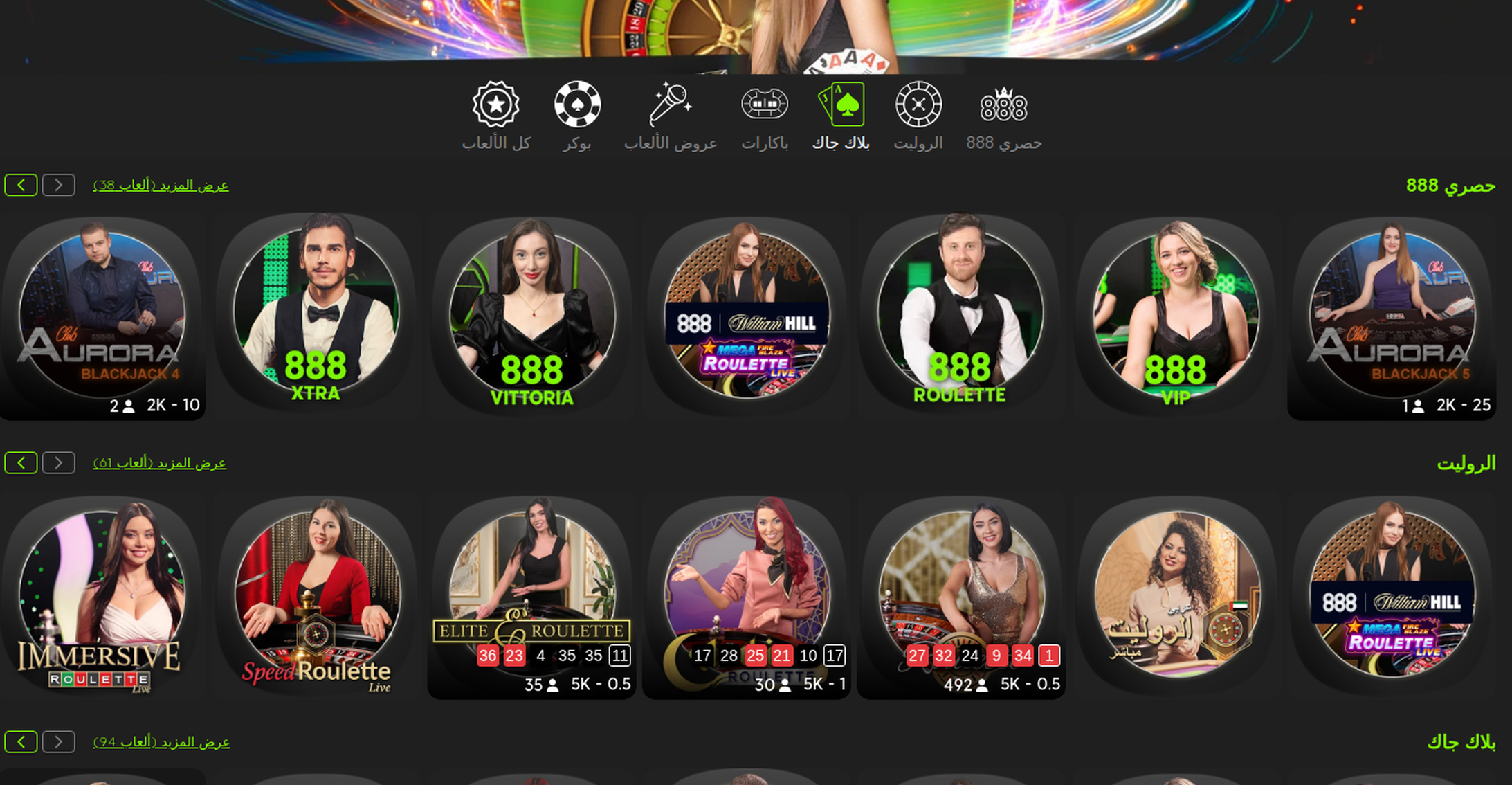
The mathematics are identical — same rules, same chart, same house edge. What differs is the rate at which you meet it. Speed is a cost. A 0.5% edge at 70 hands an hour and $10 a hand costs about $3.50; the identical game at 200 hands an hour costs about $10. Nothing changed except how fast you clicked.
Blackjack on a phone
Blackjack survives the small screen better than most casino games, because the decisions are five buttons and the table is not full of numbers. Two things are worth knowing before you play on a phone.
Speed. On a phone an RNG table is the fastest gambling there is — the deal button is under your thumb and there is no shoe to wait for. Since the house edge is charged on every unit staked, hands per hour is a cost, and a phone raises it. The same $10 hand at 200 hands an hour costs roughly three times what it costs at 70.
The strategy chart. The three tables above scroll sideways on a narrow screen rather than shrinking to nothing. On a phone it is worth keeping them open in a second tab while you learn them, which is allowed, ordinary and what most players do.
Arabic-Dealt Blackjack Tables: What We Counted
“Arabic blackjack” is a real product, not a figure of speech: a set of live tables staffed by Arabic-speaking croupiers, named as such in the lobby. Most guides to this market use the phrase without ever saying which operators carry them. We counted, operator by operator, from a connection inside this region, and every figure below is in the linked review with its date.
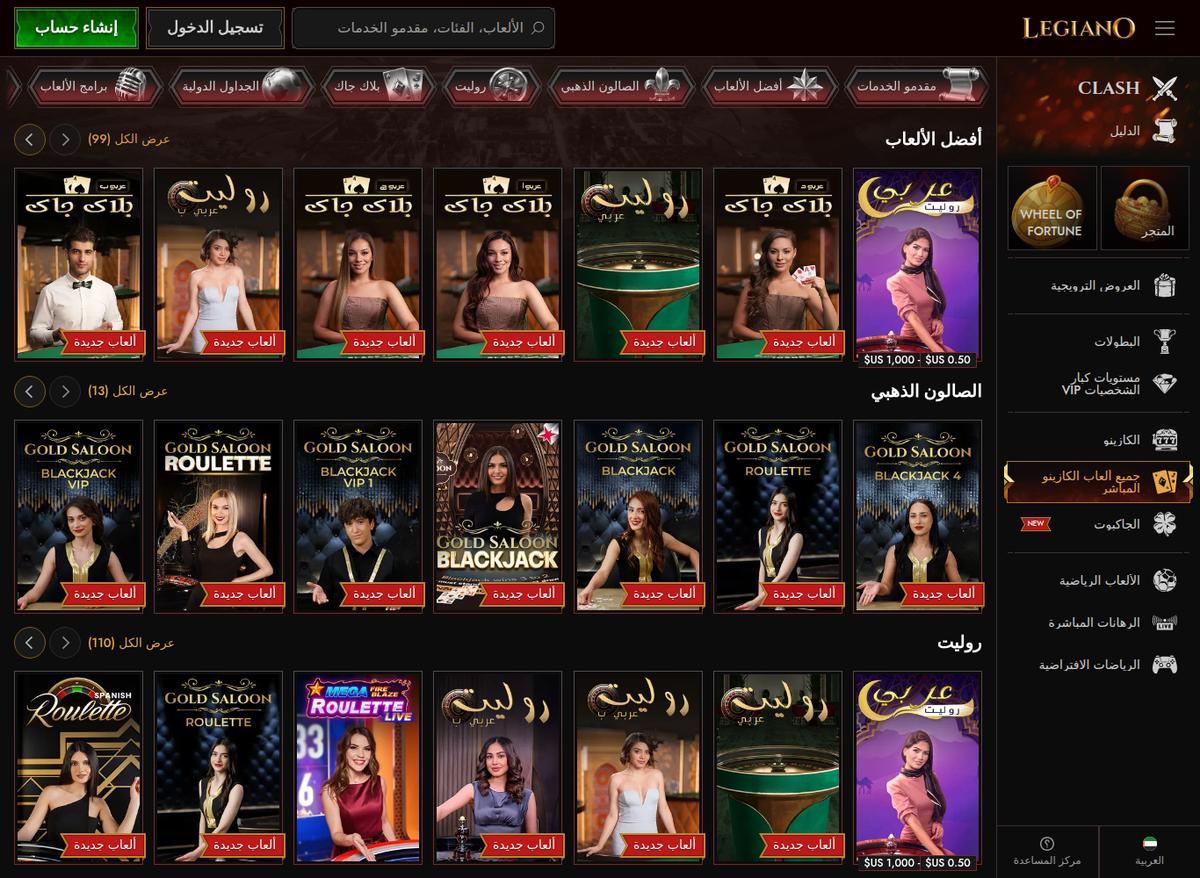
| Operator | Arabic blackjack tables | Which ones | Arabic tables in total | Review |
|---|---|---|---|---|
| Nomini | 5 | BlackJack Arabic A, B, C, D and E (Creedroomz Live) | 11 | Nomini |
| BassBet | 5 | BlackJack Arabic A to E (Creedroomz Live) | 10 | BassBet |
| Legiano | 5 | The same five — it is the same platform as BassBet | 10 | Legiano |
| StoneVegas | 5 | BlackJack Arabic A to E | 10 | StoneVegas |
| Betfinal | 2, plus Kurdish | BlackJack Arabic A and B, with BlackJack Kurdish A as a separate table | Arabic and Kurdish | Betfinal |
| 888 Casino | Within a Playtech floor | 65 blackjack tables of 167 live, all Playtech Live | — | 888 Casino |
| Roobet | None found | No Arabic-speaking dealer table at all | 0 | Roobet |
| RollingSlots | None found | No Arabic-speaking live table | 0 | RollingSlots |
| BDMBet | None found | No Arabic live tables, no Arabic support | 0 | BDMBet |

The finding worth keeping: on every platform that serves Arabic tables at all, blackjack is the best-served category — five of the ten or eleven Arabic tables are blackjack, against four roulette. If you want a dealer who speaks Arabic, blackjack is where you will find one, and the same five table names recur because four of these operators run the same Creedroomz feed.
Advertised Tables vs Tables That Reach You
A lobby figure is not a promise. Live studios withhold tables by country, and blackjack is hit harder than most categories because the big studios license their table floors regionally.
| Operator | Blackjack tables from outside the region | From a connection here | Difference |
|---|---|---|---|
| Spinanga | 343 | 138 | 205 tables withheld — a 60% cut |
| Spinanga, all live tables | 780 | 450 | 330 withheld, a 42% cut overall |
Read those two rows together: the whole live floor loses 42% of its tables, but blackjack alone loses 60%. The category is cut nearly half again as hard as the average. Nobody publishes that, and it is most of the gap between the table count a casino advertises and the one that opens for you. The figures are from our Spinanga review, measured on the date shown there.
Blackjack Side Bets
Side bets are optional extra wagers settled separately from your hand. They are the most expensive thing on a blackjack table, and they exist because the main game is cheap. A game with a 0.5% house edge accompanied by a 7% side bet is not a 0.5% game if you take the side bet.
Side bets are settled on their own mathematics, not on the blackjack table’s. The house edge on the bets below is calculated separately from the main game and is typically several times higher — and it varies with the paytable, which differs between studios and between tables carrying the same side bet name. Where we give a range, that is why.
| Side bet | What it needs | Typical house edge | Worth taking? |
|---|---|---|---|
| Insurance | Dealer shows an ace; you bet they have blackjack | About 7% on six decks | No. See below — not even with a blackjack. |
| Perfect Pairs | Your first two cards are a pair | Roughly 4% to 11% depending on paytable | No |
| 21+3 | Your two cards plus the dealer upcard make a poker hand | Roughly 3% to 8% depending on paytable | No |
| Lucky Ladies | Your first two cards total 20 | Frequently above 17% | No — among the worst bets in any casino |
| Royal Match | Your first two cards are suited | Roughly 3% to 6% | No |
| Match the Dealer | Your card matches the dealer upcard | Roughly 3% to 6% | No |
Insurance, and why “even money” is the same trap
When the dealer shows an ace you are offered insurance: half your stake, paying 2:1 if the dealer has blackjack. It is presented as protection. It is a separate bet on whether the dealer’s hole card is a ten, and with six decks that happens about 30.9% of the time against odds paying as though it were 33.3%. The house edge is around 7%.
Holding a blackjack yourself does not change this. “Even money” — taking a guaranteed 1:1 instead of risking the 3:2 — is insurance wearing a different name, and it costs the same. Over enough hands, declining it and occasionally pushing beats taking it every time. For a basic-strategy player without a card-counting advantage, insurance is a poor-value side bet — and that does not change because of what you are holding.
What an Hour of Blackjack Actually Costs
House edge is a percentage of everything you stake, not of what you bring. The number that matters is stake per hand multiplied by hands per hour multiplied by the edge — and the middle term is the one players never think about.
These are long-run mathematical expectations, not a forecast for your hour. The house edge describes the average outcome over a very large number of hands; a single session can finish well ahead or well behind any of the figures below, and most do. What the table shows is the direction and the scale of the difference between the choices, which is the part you control.
| How you play | Stake | Hands/hour | Total staked | Edge | Expected cost |
|---|---|---|---|---|---|
| Live table, 3:2, basic strategy | $10 | 70 | $700 | 0.5% | $3.50 |
| Live table, 6:5, basic strategy | $10 | 70 | $700 | 1.9% | $13.30 |
| Live table, 3:2, playing by instinct | $10 | 70 | $700 | 2.5% | $17.50 |
| RNG table, 3:2, basic strategy, clicking fast | $10 | 200 | $2,000 | 0.5% | $10.00 |
| RNG table, 6:5, playing by instinct | $10 | 200 | $2,000 | 3.5% | $70.00 |
The top row and the bottom row are the same game at the same stake for the same hour. The difference is twenty times, and it is made entirely of three things you control: the payout on the table you chose, whether you learned the chart, and how fast you click.
How to Choose an Online Blackjack Game
In the order that matters. The first item is worth more than the rest combined.
- 1. Does a blackjack pay 3:2? If it pays 6:5, close the table. Nothing further down compensates for it.
- 2. Does the dealer stand on soft 17? Shown as S17 (better) or H17 (+0.22%).
- 3. Can you double after a split? Worth −0.14% when allowed.
- 4. Can you double on any two cards, or only on 9, 10 and 11?
- 5. Is surrender offered? Small, free, and rarely present.
- 6. How many decks? Fewer is better — but only after the payout question is settled.
- 7. What are the limits? The same game often runs at five different minimums.
- 8. Live or RNG? A speed decision, and therefore a cost decision.
- 9. Are side bets pushed at you? They are optional. Leave them.
- 10. Does the operator publish a licence you can check in the issuing register, rather than a logo in the footer?
Blackjack in the UAE: Availability, Arabic Tables & What We Check
Everything above applies from here. Four things do not appear in the international guides to this subject, and they are the reason this page exists.
Which tables actually open
Blackjack is cut harder by country filtering than any other live category we have measured — 60% of the tables on one operator, against 42% for the live floor as a whole. A lobby that advertises three hundred blackjack tables may open with a hundred and thirty from here.
Arabic, and the dealer
Three grades that are easily confused: no Arabic at all; an Arabic interface with the game terms still in English; and terms genuinely published in Arabic. Separate from all three is whether the dealer speaks Arabic, which on a live table is the part you actually experience. Five operators we reviewed carry Arabic-dealt blackjack; three carry none at all.
The currency is a cost paid twice
Of the operators we reviewed, only BC.GAME displayed a balance in dirhams; at the others there is a conversion going in and another coming out. On a game whose whole appeal is a half-percent house edge, a currency spread applied to every deposit and withdrawal is not a footnote — it can exceed the cost of the game itself.
Available from here is not licensed here
The General Commercial Gaming Regulatory Authority was created in 2023 and issues real licences in the Emirates. The international operators reachable from here are almost all licensed elsewhere, usually Curaçao or Anjouan, and holding one of those licences says nothing about being licensed by the GCGRA to offer commercial gaming inside the UAE. That a blackjack table opens from here is a fact about access, not about regulation. We keep the two apart everywhere on this site.
UAE Blackjack Checklist
What we verify on every operator before it appears in a table on this site. Last checked: September 2026.
| Check | What we verify |
|---|---|
| GCGRA licence | Whether the operator holds a licence from the UAE regulator. Of the operators we have reviewed, none published one |
| International licence | The number, and whether it appears in the issuing register |
| UAE availability | Whether the site and its blackjack tables open from an Emirates connection |
| Blackjack payout | Whether the tables pay 3:2 or 6:5 |
| Dealer on soft 17 | S17 or H17, read from the table rules |
| Deck count | Read from the game info panel, not from the game name |
| Double and split rules | Double after split, resplitting, doubling restrictions |
| Surrender | Offered or not, and early or late |
| Side bets | Which are pushed, and at what paytable |
| Live blackjack | Number of tables reaching this region, counted from here |
| Arabic-dealt tables | Counted by name in the lobby, not taken from a claim |
| Arabic interface | Interface, game terms and contract treated as three separate findings |
| AED support | Whether a balance can be held in dirhams |
| Payment methods | Which routes work from here, and the fees and limits published for each |
| Mobile experience | Whether the tables and the strategy tables hold up on a phone |
| Minimum and maximum stake | Read from the lobby before opening the game |
What Makes a Good Blackjack Table?
A table carrying all of these is a genuinely cheap game. One carrying the first and none of the others is still a decent one; one missing the first is not, whatever else it offers.
- Blackjack pays 3:2. Everything else is secondary to this.
- Dealer stands on soft 17.
- Double after split allowed.
- Doubling permitted on any two cards, not only 9, 10 and 11.
- Late surrender available.
- Resplitting allowed, including aces where offered.
- No side bets pushed at you — they are optional and carry house edges of 4% to 17%, beside a main game at around half a per cent. A table that makes them hard to ignore is telling you something.
- Fewer decks — genuinely helpful, and genuinely the smallest item on this list.
Rules interact, and a table advertises the flattering ones. Single deck sounds better than eight and is worth about half a percent — but single-deck tables are where 6:5 lives, and 6:5 costs 1.39%. The table with the good headline is frequently the expensive one. Judge the rule set as a whole, and start with the payout.
How We Evaluate Online Blackjack
Every figure about an operator on this site was read from that operator, from a connection in this region, on a date recorded in the review. We do not take table counts, catalogue sizes or language claims from press material.
- We open the live lobby from an Emirates connection and count the blackjack tables that actually return, then compare against the same lobby from outside the region.
- We search the catalogue by name for Arabic-dealt tables and list them individually, rather than reporting a total.
- We read the rules panel of the tables themselves: payout, soft 17, deck count, doubling and splitting rules, surrender.
- We record the minimum and maximum stake as shown in the lobby before the game opens.
- We check the licence number in the issuing register, and record the status and the date we read it — not the footer logo.
- We treat the interface, the game terms and the contract as three separate findings on Arabic support, because operators routinely have one and not the others.
- We record whether a balance can be held in dirhams, and what it costs when it cannot.
- Where a figure could not be read, we say so and leave it out, rather than presenting an absence as a fault.
Frequently Asked Questions
The one whose rules cost least, which is rarely the one with the most attractive name. Look for a table paying 3:2 where the dealer stands on soft 17 and doubling after a split is allowed. Atlantic City rule sets are usually among the better ones on an online floor. A table paying 6:5 is a worse game than any of them regardless of what else it offers.
Place a bet, receive two cards, look at the dealer’s upcard, then choose to hit, stand, double or split. The dealer plays last by a fixed rule and cannot make choices. You win by finishing closer to 21 than the dealer without going over, or by the dealer going over while you have not.
Basic strategy, which is the mathematically correct decision for every hand against every dealer upcard. It is printed in full on this page. Playing it accurately on a 3:2 table takes the house edge to roughly 0.5%; playing by instinct on the same table costs around 2.5%. No betting system changes either figure.
A table, not a theory. For each combination of your hand and the dealer’s upcard it gives one correct move: hit, stand, double, split or surrender. It was solved decades ago and does not vary by player, by session or by luck — only slightly by table rules such as the deck count and the soft-17 rule.
There is no single figure, and anyone quoting one is describing a specific situation. On a table paying 3:2 with favourable rules, played with accurate basic strategy, it is around 0.5%. Change the payout to 6:5 and it rises by about 1.39%. Play by instinct instead of by the chart and it rises by roughly two points more.
RTP is the house edge seen from the other side: a 0.5% house edge is a 99.5% RTP. Unlike slots, where the figure is built into the game, blackjack’s return depends on the table rules and on whether the player plays correctly. A blackjack RTP quoted without both of those is not telling you anything.
Yes, decisively. A 6:5 payout adds about 1.39% to the house edge — more than every other common rule difference combined, and enough to turn the cheapest game in the casino into an ordinary one. On a $10 bet a 3:2 blackjack pays $15 and a 6:5 blackjack pays $12. It is printed in the table rules before you bet.
The hole card. American tables deal the dealer a face-down card immediately and check it for blackjack; European tables take the second card only after you have finished. On a European table a dealer blackjack therefore also takes the money you added by doubling or splitting, which costs about 0.11% and changes a few chart decisions against a ten or an ace.
Essentially no. RNG tables reshuffle a fresh virtual shoe every hand, so there is nothing to track, and most live streamed tables shuffle continuously or frequently for the same reason. Counting is a physical casino technique, it requires training and bankroll, and operators may restrict accounts that use it. It is not a practical route to beating online blackjack.
Yes, but less than people think. Going from eight decks to one is worth roughly 0.48% in your favour. That is real — and it is less than a third of what a 6:5 payout takes away. Since single and double-deck tables are where 6:5 appears most often, the deck count is the second question to ask, never the first.
A physical blackjack table filmed in a studio and streamed to you, with a human dealer, real cards and bets placed through an overlay. The mathematics are identical to software blackjack. What differs is the pace (slower, and therefore cheaper per hour at the same stake), the minimum stake (usually higher), and the fact that only live tables have dealers who speak Arabic.
Yes, and they are named in the lobby as BlackJack Arabic A through E. We counted them from a connection in this region rather than taking the claim on trust: five such tables at Nomini, five at BassBet, five at Legiano and five at StoneVegas — four operators running the same Creedroomz feed. Betfinal carries two plus a Kurdish table. At Roobet, RollingSlots and BDMBet we found none.
Offshore sites carrying blackjack do open from an Emirates connection, and we verified which ones from here. But availability is not authorisation: those operators are licensed in Curaçao or Anjouan, not by the GCGRA, and the fact that a table loads says nothing about its regulatory standing in the UAE. Treat access and licensing as two separate questions, because they are.
In order of value: blackjack paying 3:2, dealer standing on soft 17, doubling after split allowed, doubling on any two cards, late surrender, resplitting allowed, and fewer decks. The first item outweighs all the others combined, which is why it is the first thing to check on any table.
At a licensed operator running a known studio’s tables, no — and it would make little sense, because a blackjack table already keeps around half a percent of everything staked without touching the cards. RNG software is tested by independent laboratories and live tables are filmed with physical cards. What that depends on is the operator: the protection is a licence number you can find in the issuing register, not a logo in the footer. What genuinely costs players money is disclosed and legal — 6:5 payouts, insurance, side bets, and bonus terms where blackjack counts 10% or less.
Essentially no. RNG tables generate a fresh shoe every hand, so nothing carries over to count. Most live streamed tables use continuous shuffling or reshuffle early for the same reason. Counting also is not protected: operators may change your limits or close the account, and their terms usually say so. The realistic way to get the cost down online is a 3:2 table and accurate basic strategy.
It works well — the decisions are a few buttons and the table is uncluttered. The catch is speed: on a phone an RNG table can run 200 hands an hour against about 70 at a live table, and since the house edge is charged on every unit staked, that multiplies the cost of the same session by roughly three at the same stake per hand.
Usually at a heavily reduced rate, and this is the detail that catches people. At 888 Casino, for example, slots contribute 100% while blackjack, roulette, baccarat and live casino contribute 10% — so $10 staked on blackjack counts as $1 towards clearing the bonus. Some operators exclude it entirely. It is in the bonus terms, and it is worth reading before taking an offer you intend to clear at the tables.
Yes, and in two different ways depending on the table. Software blackjack deals from a virtual shoe produced by a random number generator, reshuffled every hand and tested by independent laboratories. Live blackjack is not random in that sense at all — it uses physical cards dealt by a person in front of a camera, which is a different kind of assurance and the reason the format exists. What neither is is predictable: previous hands tell you nothing about the next one, and no online format lets you track the shoe well enough to change that.
You can win individual hands and sessions, and plenty of people do. Over enough hands the house edge is charged on everything you stake, so the expected result is a loss — around 0.5% of total stakes on a 3:2 table played with accurate basic strategy, and several times that on a 6:5 table or played by instinct. What you genuinely control is the size of that number, and the gap between the best and worst versions is roughly twenty times. No betting system changes it, and card counting is not practical online.
This page is part of our online casino games hub, alongside our guides to online slots and online roulette and online baccarat.
For what is and is not licensed in this market, see our guide to online casinos in the UAE, and for the operators themselves, the reviews linked from the table above.