





















Best Online Plinko Games
Plinko is a board of pegs, a ball, and a row of multipliers at the bottom. You set a stake, drop the ball, and it bounces left or right at every peg until it lands in a slot. Whatever that slot says, your stake is multiplied by it.
It looks like the simplest game in a casino, and in one sense it is: there is nothing to decide after the drop. But it is also the only casino game whose odds you can calculate exactly, by hand, with no inside information — and this page does that, because it is the honest answer to why a board that looks perfectly symmetrical is still a game the house wins.
We read the return figures on the studios’ own game pages, by looking at them. Last checked: September 2026.
| Plinko game | Provider | Published RTP | Max multiplier | Risk levels | Where we read it |
|---|---|---|---|---|---|
| Plinko | BGaming | 99% | x1000 | Low / Normal / High | “Details” panel on the BGaming game page |
| Plinko | Spribe | 97% | Varies by risk and rows | Green / Yellow / Red | “Return to Player” panel on the Spribe game page |
| Plinko | Stake Originals | Not published on a public game page | Varies by risk and rows | Low / Medium / High | Listed among Stake’s Originals with provable fairness, in our own review |

BGaming publishes 99% for its Plinko; Spribe publishes 97% for its own. Two percentage points is a large gap in this business — it is triple the house edge of the first game. And BGaming’s page says something more useful still: it offers operators “a completely new game with an upgraded design, RTP, features and game settings”. The studio sells the return as a configurable parameter. So the 99% is the figure BGaming publishes for its own build — and the figure that applies to you is the one in the game’s info panel at the casino you are playing at.
What Is Plinko?
The game comes from an American television show, where a disc was dropped down a pegged board into cash slots. The online version keeps the board and adds the settings:
- The board — a triangle of pegs, widest at the bottom.
- The ball — released from the top centre.
- The pegs — at each one, the ball goes left or right. That is the entire mechanic, and everything else on this page follows from it.
- The slots — a row of multipliers at the bottom, symmetrical: the largest at the two edges, the smallest in the middle.
- Your settings — the stake, the number of rows, and the risk level.
There is no skill component and no decision after the drop. What you choose is not whether you win but the shape of the distribution you are betting into — which is a more interesting choice than it sounds, and the sections below take it apart.
How Does Online Plinko Work?
Choose Your Bet
The stake per ball. Plinko is played in fast repetition, so the figure that matters is not the stake but the stake multiplied by how many balls you drop in a session — which is usually far more than people intend.
Select Rows
Most implementations offer somewhere between 8 and 16 rows. The number of rows changes the number of slots, the multiplier values and the shape of the distribution. It is not a difficulty setting and it does not make the game more generous — see the rows section below.
Choose the Risk Level
Low, medium and high — or green, yellow and red at Spribe. This redistributes the multipliers without changing the published return: higher risk pushes value from the middle slots out to the edges.
Drop the Ball
The only action in the game. Many versions offer auto-play, which drops balls continuously until you stop it, and that is worth knowing before you enable it.
The Ball Moves Through the Pegs
At every peg the ball goes one way or the other. With 16 rows that is sixteen decisions, each one independent, which produces 65,536 possible paths through the board. The next section shows what that number does to your odds.
The Ball Lands on a Multiplier
Your stake is multiplied by the value of the slot. On a $10 stake: a 2x slot returns $20, a 0.5x slot returns $5, and on some high-risk boards a centre slot returns nothing at all.
Plinko Board Explained
The board is symmetrical and the physics are fair. That is precisely why it needs explaining, because a fair board and a fair bet are not the same thing.
The ball starts at the top centre. To reach an edge slot, it must go the same direction at every single peg — sixteen lefts in a row, or sixteen rights. To reach the centre, it needs eight of each in any order, and there are a great many ways to do that. The multipliers are laid out to match: enormous at the edges, tiny in the middle.
| Slot | Paths that reach it | Chance per ball | |
|---|---|---|---|
| 0 (or 16) | 1 | 0.0015%% | Edge — the biggest multiplier on the board |
| 1 (or 15) | 16 | 0.0244%% | |
| 2 (or 14) | 120 | 0.1831%% | |
| 4 (or 12) | 1,820 | 2.78% | |
| 6 (or 10) | 8,008 | 12.22% | |
| 8 (or 8) | 12,870 | 19.64% | Centre — the smallest multiplier, often below 1x |
That table is not an estimate and it is not from another website: it is C(16,k) ÷ 65,536, the binomial distribution, which is what a board of pegs physically is. Every Plinko board with 16 rows has these probabilities, whoever built it.
On a 16-row board there are 65,536 possible paths and exactly one of them ends in the far-left slot. That is a chance of 0.0015% per ball — one ball in 65,536. At $1 a ball, reaching that slot once costs, on average, about $65,500 in stakes. Meanwhile the centre slot has 12,870 paths into it and lands 19.6% of the time, which is why it is the slot that pays least — and on high-risk boards, sometimes nothing. The board is perfectly fair and the bet still is not, and that is the whole answer to why Plinko is a casino game.
Plinko Multipliers Explained
The multiplier is the number in the slot your ball lands in. The arithmetic is trivial — on a $10 stake, 2x returns $20 and 0.5x returns $5 — and the arithmetic is not the point. What matters is which multipliers sit where.
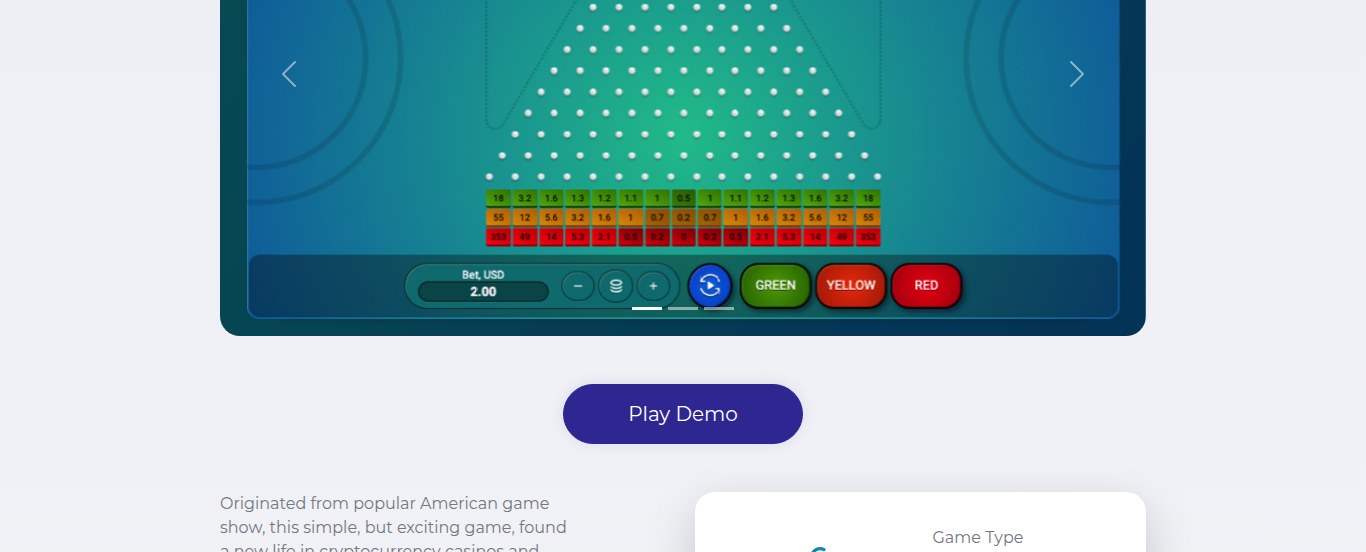
These are the real values from the Spribe board we captured, at each risk level, reading from the edge inwards:
| Risk level | Multipliers from the edge inwards | Centre slot |
|---|---|---|
| Green (low) | 18 · 3.2 · 1.6 · 1.3 · 1.2 · 1.1 · 1 | 0.5x — you lose half |
| Yellow (medium) | 55 · 12 · 5.6 · 3.2 · 1.6 · 1 · 0.7 | 0.2x — you lose 80% |
| Red (high) | 353 · 49 · 14 · 5.3 · 2.1 · 0.5 · 0.2 | 0x — you lose everything |
Read the last column against the previous section and the game becomes clear. The centre is the most likely slot on the board — and at every risk level it pays less than the stake. On red it pays nothing at all. The 353x at the edge is real, and it is one of the least likely outcomes in the game.
Plinko Risk Levels
Low risk
Multipliers close together, the largest edge value modest, the centre still below 1x. Most balls return something near the stake. Long sessions drift slowly rather than swinging.
Medium risk
A wider spread. The edges pay several times more than on low, and the centre pays less. The middle ground in every sense.
High risk
The largest edge multipliers in the game and the harshest centre — on the Spribe board, a centre slot that pays zero. Most balls lose most of the stake, and the losses are funded entirely by the rare balls that reach the edges.
It redistributes the money; it does not add any. A game published at 99% returns 99% at low risk and 99% at high risk — the setting moves value between the middle slots and the edge slots, changing how your results are shaped and not what they average. High risk is not more profitable and it does not have a better RTP; it has a wider distribution, which means longer losing runs punctuated by rarer, larger wins. Anyone telling you to “play high risk for bigger profits” is describing variance and calling it value.
Plinko Rows Explained
More rows means more pegs, more slots, and a different distribution. Here is what actually changes, calculated rather than asserted:
| Rows | Slots | Possible paths | Chance of an edge slot | Chance of the centre slot |
|---|---|---|---|---|
| 8 | 9 | 256 | 0.39% | 27.34% |
| 12 | 13 | 4,096 | 0.024% | 22.56% |
| 16 | 17 | 65,536 | 0.0015% | 19.64% |
Two things follow, and both are routinely got wrong. Adding rows makes the edge slots dramatically rarer — from 1 ball in 256 at eight rows to 1 in 65,536 at sixteen — which is why the multipliers there grow as the board grows. And it flattens the centre slightly, spreading the common outcomes across more slots.
What adding rows does not do is change the return. More rows is not better odds, and it is not worse odds — it is a different shape at the same published RTP. Any page telling you that a particular row count “pays better” is guessing.
Plinko RTP and House Edge
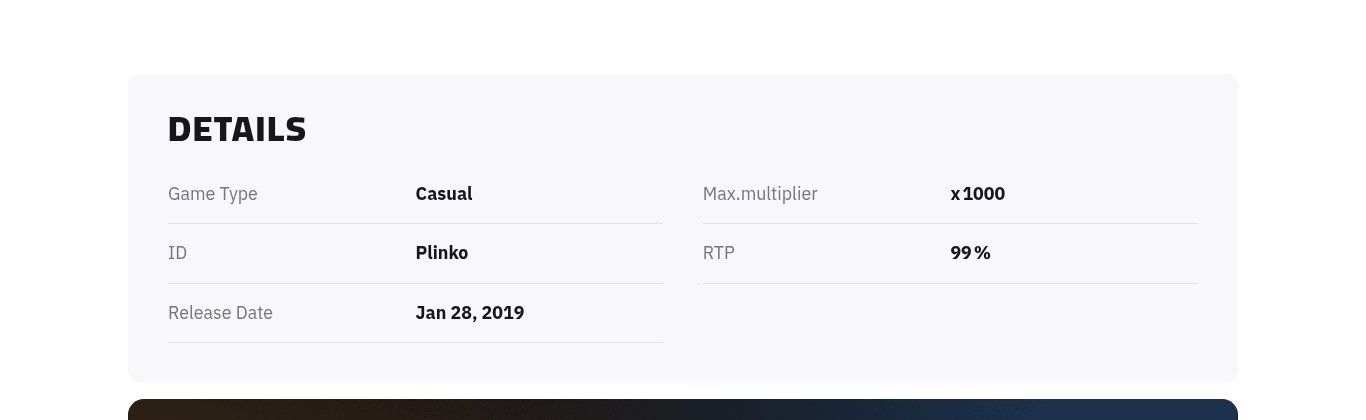
RTP is what the game returns over a very long run; house edge is the remainder. A Plinko at 99% has a 1% edge — among the lowest figures published for any casino game, and the reason the format has the reputation it has.
- There is no single Plinko RTP. BGaming publishes 99%; Spribe publishes 97% for the same game concept. That gap is three times the entire house edge of the first.
- The studio sells the RTP as configurable. BGaming’s own page offers operators a build with an “upgraded design, RTP, features and game settings”. The published figure is the studio’s default, not a guarantee about the version in front of you.
- Risk level and row count do not change it. They redistribute the same return.
- A 1% edge is still an edge. At 99%, a hundred balls at $1 return $99 on average. The game is cheap per ball and it is played very fast, which is how a 1% edge collects a real amount of money.
Plinko Probability and Odds
This is the section the rest of the internet does not write, and it is the easiest one to write honestly, because Plinko is the one casino game whose probabilities are fully determined by its shape. A ball passing sixteen pegs is sixteen independent left-or-right events. That is a binomial distribution, and it has an exact answer.
The full distribution for a 16-row board, calculated from C(16,k) ÷ 65,536:
| Slot (counting from the edge) | Paths | Chance per ball | Frequency |
|---|---|---|---|
| 0 or 16 | 1 | 0.0015% | 1 ball in 65,536 |
| 1 or 15 | 16 | 0.0244% | 1 ball in 4,096 |
| 2 or 14 | 120 | 0.1831% | 1 ball in 546 |
| 3 or 13 | 560 | 0.8545% | 1 ball in 117 |
| 4 or 12 | 1,820 | 2.7771% | 1 ball in 36 |
| 5 or 11 | 4,368 | 6.665% | 1 ball in 15 |
| 6 or 10 | 8,008 | 12.2192% | 1 ball in 8 |
| 7 or 9 | 11,440 | 17.4561% | 1 ball in 6 |
| 8 (centre) | 12,870 | 19.6381% | 1 ball in 5 |
Three readings of that table. The two edge slots together account for 2 balls in 65,536 — 0.003% of drops, which is where the headline multipliers live. The five central slots account for about 78% of all balls, and on most boards every one of them pays less than the stake. And the distribution is identical at every risk level and at every casino, because it is a property of the board and not of the operator: what the risk selector changes is only what each slot pays.
The message the industry usually gives — that higher multipliers are rarer — is true and useless without the numbers. The numbers are the point: the biggest multiplier is not somewhat rarer than the small ones, it is 12,870 times rarer than the centre.
Plinko Volatility
Volatility in Plinko is not a property of the game you chose; it is a setting you move. That makes it unusually easy to describe honestly.
| Setting | Most balls | Rare balls | What a session feels like |
|---|---|---|---|
| Low risk | Return close to the stake | A modest edge multiplier | Slow drift, few surprises in either direction |
| Medium risk | Return below the stake | Multipliers in the tens | Recognisable swings, still readable |
| High risk | Lose most or all of the stake | Multipliers in the hundreds | Long stretches of losing, funded by an outcome that may not arrive |
| More rows | Similar centre outcomes | Edge slots far rarer, and far larger | Same shape, stretched |
Note that none of the rows above says “better”. Volatility is not quality, and a board advertising x1000 is describing the top of its range, not what it returns.
Different Types of Online Plinko
Classic Plinko
A single board, fixed multipliers, one ball at a time. The version closest to the television original, and the rarest online.
Casino Plinko with risk and row settings
The standard implementation today: you choose rows and risk before each drop. BGaming and Spribe both build this version, and it is what almost every operator carries.
Provably fair Plinko
The same game with a cryptographic commitment you can verify after each ball. Standard on crypto-first operators — Stake lists its Plinko among the Originals with provable fairness — and the section below explains what the claim does and does not cover.
Auto-play and multi-ball Plinko
Drops balls continuously, or several at once. The mechanic is unchanged; the exposure per minute is not, and that is the entire difference.
Feature-based Plinko
Boards with bonus slots, jackpots or collectable layers on top. The features are funded from the same published return — they redistribute it rather than add to it.
Popular Online Plinko Games
What we found at the operators we reviewed for this market. Last checked: September 2026.
| Game | Provider | Published RTP | Risk levels | Where we found it |
|---|---|---|---|---|
| Plinko | BGaming | 99% | Low / Normal / High | The most widely distributed Plinko in this market |
| Plinko | Spribe | 97% | Green / Yellow / Red | Alongside Aviator wherever Spribe is carried — 4 of the 29 operators we reviewed |
| Plinko | Stake Originals | Not published publicly | Low / Medium / High | In Stake’s Originals shelf with Dice, Mines, Limbo and Crash |
| Plinko variants | Multiple studios | Varies | Varies | StoneVegas alone lists 75 Plinko variants |
Plinko Game Providers
Only studios we verified, with what each one publishes. Not a ranking.
| Provider | What it publishes for Plinko | Notable |
|---|---|---|
| BGaming | RTP 99%, max x1000, released January 2019 | Offers operators a build with customisable RTP and settings — in its own words |
| Spribe | RTP 97%, three risk levels by colour | The same studio that makes Aviator; present at 4 of the 29 operators we reviewed |
| Stake Originals | No public game page; provable fairness stated | In-house title, verifiable per round rather than documented per figure |
| Various instant studios | Varies widely | The long tail behind counts like StoneVegas’s 75 variants |
Plinko Strategy
This section is short, and it is short for a reason. The studio that makes the most widely distributed Plinko in the world says it itself, on its own product page: “Plinko, in fact, is extremely elementary and random. There are no specific betting strategies.” We agree, and what follows is about managing exposure rather than beating anything.
Choosing a risk level
The one genuine choice. It sets the shape of your results: narrow and slow at low risk, wide and lumpy at high. It does not change the return.
Choosing a row count
The same, with a different lever. More rows makes the edges rarer and larger. Also does not change the return.
Flat betting
The same stake every ball. The only approach on this page that reliably does what it claims: it makes the bankroll last a predictable number of drops.
Bankroll management
Decide the total and the stake per ball before you start. Plinko is played fast — auto-play makes it faster — so the number of balls per session is the variable that actually decides what the session costs.
Multiple balls and multiple bets
Several balls at once spreads your stake across independent drops. It does not reduce the edge; it multiplies the amount the edge is applied to, per minute.
BGaming’s page says there are no betting strategies — and then, in the very next sentence, suggests “tracking the live payout performance of the game… find the luckiest time to bet there!” Those two sentences cannot both be true. If the game is random, there is no lucky time, and past payout performance tells you nothing about the next ball. The first sentence is the accurate one. The second is the gambler’s fallacy, printed by the studio that built the game.
Martingale and Plinko
Double the stake after a loss, so one win recovers everything. It is applied to Plinko constantly, usually at low risk where a large share of balls return something.
It fails here for the same three reasons it fails everywhere, plus one specific to this game:
- The stake ceiling. Every board has a maximum, and the doubling sequence reaches it long before a bankroll does.
- The bankroll arithmetic. Ten consecutive losses require a stake 1,024 times the first, and more than 2,000 times the first staked in total — to recover one unit.
- The edge is unchanged. Every ball is dropped into the same distribution at the same RTP. A staking pattern changes the order and size of bets, never what each returns.
- And a Plinko-specific trap: at low risk most balls return something, but often less than the stake — a 0.5x is a loss of half, not a win. A Martingale that treats “returned something” as a win never resets, and the sequence keeps climbing while the balance falls.
Do Plinko Patterns Work?
No, and Plinko makes the reason unusually easy to see.
| The claim | What is actually true |
|---|---|
| “It has landed centre five times, an edge is due” | Each ball is an independent set of left-right events. The board has no memory of the last ball |
| “I can see a pattern in the recent results” | Random sequences contain clusters. With 19.6% of balls landing centre, several in a row is ordinary, not remarkable |
| “Dropping from a different position changes the odds” | In the standard implementation the ball always starts at the top centre; there is no drop position to choose |
| “This predictor knows where the ball will land” | In a provably fair game the outcome is committed before the ball is released, and nothing observable from outside reveals it beforehand |
The Reddit thread that ranks for this game asks exactly the right question — how is Plinko a valid gambling option when the board is symmetrical? The answer is the probability table above, not a pattern. The board is fair; the paytable is where the edge lives.
Is Plinko Random?
In a licensed game, yes — and there are two different mechanisms behind that word, which the lobby will not distinguish for you.
- RNG-based Plinko. A random number generator decides the path or the outcome. At a licensed operator the generator is submitted to independent laboratory testing, and it is the licence that obliges them to submit it.
- Provably fair Plinko. The result is committed cryptographically before you drop, and you can verify afterwards that it was not altered. Common on crypto-first operators.
- The animation is not the game. In many implementations the outcome is determined first and the ball is animated to match. That is not a flaw — it is how a verifiable result gets displayed — but it does mean that watching the bounce tells you nothing.
Is Plinko Provably Fair?
Some implementations are. It is not a property of the game and it is not a property of crypto casinos — it is a specific, checkable mechanism, and here is how to run the check:
- Before the drop, copy the hash the game displays. That is the commitment.
- Set your own client seed where the game allows it — this is what proves the result was not chosen knowing your input.
- Drop the ball and note the nonce, the round counter.
- After the drop, the server seed is revealed. Hash it yourself with any SHA-256 tool and compare with what you copied. If they match, the seed was not swapped.
- Recompute the result from the seed pair and nonce, using the formula the game publishes.
If any step is missing — no hash in advance, no client seed, no published formula — then the game is not provably fair in any useful sense, whatever badge the lobby shows. And note what it proves: that the round was not tampered with, not that the game is generous. The house edge sits in the paytable, and you can read it in the probability table above.
Is Online Plinko Rigged?
The interesting thing about this question in Plinko is that you can check the maths yourself — which you cannot do in any other casino game. The distribution is fixed by the board, the paytable is printed on screen, and the two together give you the return.
- The operator’s licence, by number, in the regulator’s own register.
- The studio — a named provider whose published RTP you can look up, as we did above for BGaming and Spribe.
- The published RTP in the game info panel, which may differ from the studio default, since the studio sells it as configurable.
- The paytable against the probabilities — the one verification available to you in this game and no other.
- Provably fair verification, where offered, and whether you can actually run it.
Demo vs Real Money Plinko
| Feature | Demo | Real money |
|---|---|---|
| Money at risk | None | Yes |
| Board and paytable | The same | The same |
| Probabilities | Identical — they are fixed by the board | Identical |
| Provably fair verification | Often disabled in demo | Available where offered |
| What it teaches | The interface and the pace of auto-play | The same, plus how quickly a 1% edge collects when balls drop every second |
Both BGaming and Spribe offer a free demo from their own pages, which is the cheapest way to see the distribution work: drop a hundred balls at high risk and watch how many land in the centre.
Plinko vs Crash Games
The two sit side by side in every lobby and they are not the same game. The difference is where the decision lives.
| Plinko | Crash games | |
|---|---|---|
| Mechanic | A ball falls through pegs into a slot | A multiplier climbs until it stops |
| Your decision | Before the drop: stake, rows, risk | During the round: when to cash out |
| After you act | Nothing — the outcome is already in motion | Everything — the decision is the game |
| Outcome | The multiplier of the slot it lands in | The multiplier standing when you cashed out |
| Cash out | No | Yes, and it is the only skill element |
| Probabilities | Exactly calculable — binomial, fixed by the board | Set by the game’s own model, not publicly derivable |
| Published RTP | 99% (BGaming), 97% (Spribe) | 97% Aviator, 95% Spaceman, 96.2–98.9% JetX |
The practical consequence: in Plinko you can verify the maths yourself before you play, and in a crash game you cannot. Full detail in our crash games guide.
Plinko vs Slots
| Plinko | Slots | |
|---|---|---|
| Mechanic | One ball, one slot | Reels, paylines, bonus rounds |
| Round length | Seconds, or continuous with auto-play | Seconds, longer with features |
| Published RTP | 97%–99% on the two studios we checked | Typically 92%–97% |
| Who sets the return | The studio, and it sells configurability to operators | The studio, and the operator picks from a range |
| Volatility | You choose it per drop | Built into the title |
| Probabilities | Public and calculable | Not published per symbol |
| Bonus weighting | Usually 10% or excluded | Usually 100% |
The last row is the one that costs money. See our online slots guide for how returns are set there.
Plinko on Mobile
- Browser, no app needed. Plinko runs at full functionality in a mobile browser at essentially every operator.
- It suits a small screen well — one button, a vertical board, no betting grid to mis-tap. Better than roulette, better than live tables.
- The board shrinks, the pegs do not matter. At 16 rows on a phone the animation is small, which is cosmetic: the outcome is decided by the maths, not by what you can see.
- Auto-play is the real mobile risk. Continuous drops on a phone means dozens of balls a minute, and the stake per ball stops being the number that matters.
- Connection. Less critical than in a crash game, because there is no decision to make during the round.
Plinko for UAE Players
Three things change when the question is asked from the Emirates.
What is actually available
Plinko is one of the best-served categories in this market, alongside the other instant formats. It is in the instant shelf at operator after operator, and StoneVegas alone lists 75 Plinko variants. Which studio reaches you is the variable: BGaming appears at 10 of the 29 operators we reviewed, Spribe at only 4 — so the 99% build and the 97% build are not equally easy to find.
Bonuses — and this is the catch
Across the operators whose terms we read, Plinko counts 10% towards wagering at BassBet, Legiano, Nomini and StoneVegas, and some operators exclude the category outright. A 99% RTP game that contributes a tenth of its stake to a wagering requirement is not the bonus-clearing tool it looks like — read the game weighting table first.
Accessible from the UAE is not licensed in the UAE
The General Commercial Gaming Regulatory Authority (GCGRA) was created in 2023 and issues real licences in the Emirates under Federal Decree-Law 25 of 2025. An operator accepting players from the UAE is not the same as an operator licensed in the UAE. Almost every site carrying Plinko holds an offshore licence — Curaçao or Anjouan — and an international licence does not mean the operator holds a GCGRA licence. Full picture in our UAE casino guide.
UAE Plinko Checklist
What we verify before an operator appears in a Plinko context here. Last checked: September 2026.
| Check | What we verify |
|---|---|
| GCGRA licence | Whether a UAE licence exists at all — almost none do |
| International licence | The number, looked up in the regulator’s own register |
| UAE availability | Whether the instant shelf opens from a connection here |
| Which Plinko | The studio behind it — BGaming at 99%, Spribe at 97%, or another |
| Published RTP | Read in the game info panel, which may differ from the studio default |
| Risk levels and rows | Which options the build actually offers |
| Max multiplier | From the game rules, not a promotional page |
| Minimum and maximum stake | Read from the game |
| Provably fair | Whether verification is offered, and whether it can be run |
| Auto-play | Whether it exists and whether it can be limited |
| AED | Whether a dirham balance is held, or a conversion applies |
| Arabic interface | Interface, and separately whether the terms are in Arabic |
| Mobile | Usable on a phone, not merely present |
| Bonus weighting | What Plinko contributes to wagering — usually 10% or nothing |
How We Evaluate Online Plinko
We are an affiliate site and earn commission from some operators named here. That funds the testing; it does not buy a rating. Last checked: September 2026.
- We read the RTP on the studio’s own game page, visually — not by scraping HTML, which is how we got a figure wrong on a neighbouring page and had to correct it in public. Both figures on this page were read by looking at the panel.
- We calculate the probabilities rather than describe them. Plinko is a binomial distribution; the table on this page is C(16,k) ÷ 65,536 and can be checked by anyone.
- We record the paytable per risk level from the board itself, including the centre slot — which is the number that decides what most balls do.
- We identify the studio, because a 99% build and a 97% build of the same game are not the same product.
- We note that the studio sells RTP as configurable, and therefore treat a published figure as a default rather than a guarantee.
- We record the bonus weighting from the game contribution table.
- We check the licence in the regulator’s register, not the site footer.
- We publish no strategy we cannot support — and where the studio itself says there are no betting strategies, we quote it.
How to Choose an Online Plinko Game
| Step | What to check | Why |
|---|---|---|
| 1 | Which studio built it | BGaming publishes 99%, Spribe 97% — for the same game concept |
| 2 | The RTP in the game info panel | The studio sells configurability; the panel is what applies to you |
| 3 | The paytable, especially the centre slot | It decides what most balls return — on some high-risk boards, nothing |
| 4 | Rows and risk levels offered | They set the shape of your results, not the return |
| 5 | Stake limits | Minimum and maximum, read from the game |
| 6 | Auto-play controls | This is the setting that decides what a session costs |
| 7 | Provably fair | Whether you can run the verification, not whether the word appears |
| 8 | Bonus weighting | Usually 10% or excluded |
| 9 | UAE availability | Whether that specific studio reaches you |
| 10 | The licence | In the register — and whether it is a UAE licence or offshore |
One thing deliberately not on that list: the maximum multiplier. An x1000 badge describes one slot that, on a 16-row board, takes one ball in 65,536 to reach. It is the least informative number on the screen.
Plinko Terminology
| Term | Meaning |
|---|---|
| Board | The triangle of pegs the ball falls through |
| Peg | Each obstacle; at every one the ball goes left or right |
| Row | A level of pegs. More rows means more slots and rarer edges |
| Slot | A landing position at the bottom, each with its own multiplier |
| Multiplier | The value applied to your stake |
| Risk level | A setting that redistributes multipliers between centre and edges |
| Drop | Releasing one ball — one round |
| Auto-play | Continuous drops until stopped |
| RTP | The theoretical long-run return of that specific build |
| House edge | The remainder — 1% on a 99% game |
| Binomial distribution | The maths of the board: C(rows, slot) ÷ 2^rows |
| Provably fair | A system letting you verify afterwards that the result was fixed before the drop |
| Server seed / client seed / nonce | The three inputs of that verification |
Plinko sits with the rest of the floor in our online casino games guide, next to crash games, slots, roulette, blackjack, baccarat, poker and live casino.
Frequently Asked Questions
A board of pegs with multipliers along the bottom. You set a stake, choose the number of rows and a risk level, and drop a ball. At every peg it goes left or right, and it lands in a slot whose multiplier is applied to your stake. There is nothing to decide after the drop.
The ball starts at the top centre and makes one left-or-right move per row. On a 16-row board that is 16 independent moves, producing 65,536 possible paths. Reaching an edge slot requires the same direction 16 times in a row; reaching the centre requires eight of each in any order, which can happen 12,870 different ways. That is why the edges pay most and the centre pays least.
Your stake is multiplied by the value of the slot the ball lands in. On a $10 stake, 2x returns $20 and 0.5x returns $5. Multipliers are symmetrical, largest at the edges and smallest in the middle, and on high-risk boards the centre slot can pay 0 — on the Spribe board we captured, the red centre slot pays nothing at all.
Low, medium and high — green, yellow and red at Spribe. They redistribute the multipliers between the centre and the edges without changing the published return. Higher risk means bigger edge multipliers and a harsher centre, so results are more spread out. It is not a better bet and it does not have a higher RTP.
Rows are levels of pegs, usually 8 to 16. More rows means more slots and far rarer edges: the edge slot goes from 1 ball in 256 at eight rows to 1 in 65,536 at sixteen. The multipliers grow to match. More rows is not better odds or worse odds — it is a different distribution at the same return.
It depends on the build, and the difference is material. BGaming publishes 99% for its Plinko and Spribe publishes 97% for its own, both read on their game pages in September 2026. BGaming also offers operators a version with customised RTP, so the figure that applies to you is the one in the game info panel at the casino you are playing at.
Exactly calculable, unlike most casino games, because the board is a binomial distribution. On 16 rows: the centre slot lands 19.6% of the time, and each edge slot lands 0.0015% of the time — one ball in 65,536. The centre is 12,870 times more likely than the edge. These probabilities are identical at every casino and at every risk level; only the payouts change.
At a licensed operator, yes. Either a tested random number generator decides the outcome, or a provably fair system commits it cryptographically before the drop. Note that in many builds the result is determined first and the ball is animated to match — so watching the bounce tells you nothing about anything.
Some implementations are, and it is not a property of the game or of crypto casinos. A provably fair build shows you a hash before the drop, lets you set a client seed, and reveals the server seed afterwards so you can recompute the result. If any of those is missing, the claim is not meaningful. And it proves the round was not tampered with — not that the game is generous.
Plinko is the one casino game where you can check the maths yourself: the distribution is fixed by the board, the paytable is on screen, and the two together give the return. Beyond that, verify the operator licence in the regulator’s register, the studio and its published RTP, the figure in the game info panel, and whether provably fair verification can actually be run.
No. Each ball is an independent set of left-right events and the board has no memory. With 19.6% of balls landing in the centre on a 16-row board, several centre results in a row is ordinary rather than a signal. And there is no drop position to choose in the standard implementation — the ball always starts at the top centre.
No, and the studio behind the most widely distributed Plinko says so on its own product page: “there are no specific betting strategies”. What you can control is exposure — stake per ball, number of balls, and whether auto-play is running. Risk level and row count change the shape of your results, not the return.
No. It runs into the stake ceiling, the bankroll arithmetic and an unchanged house edge, like everywhere else. Plinko adds a trap of its own: at low risk most balls return something, but often less than the stake — a 0.5x is a loss of half. A progression that treats that as a win never resets, and the stakes keep climbing while the balance falls.
On published return, the BGaming build at 99% is ahead of the Spribe build at 97% — but check the game info panel at your operator, because BGaming sells a customisable-RTP version to operators. Beyond the figure, compare the paytable (especially the centre slot), the row and risk options, the stake limits, and whether provably fair verification can be run.
BGaming publishes a maximum of x1000. On the Spribe board we captured, the highest red-level multiplier is 353x. Both are edge slots, which on a 16-row board take about one ball in 65,536 to reach. A maximum multiplier describes the top of a range and tells you nothing about what the game returns.
Yes, in a mobile browser at essentially every operator, and it suits a phone better than most casino games: one button, a vertical board, nothing to mis-tap. The thing to watch on mobile is auto-play, which can drop dozens of balls a minute.
Plinko is among the best-served categories in this market — StoneVegas alone lists 75 variants. Which studio reaches you varies: BGaming appears at 10 of the 29 operators we reviewed and Spribe at 4, so the 99% build and the 97% build are not equally easy to find. Note also that Plinko counts only 10% towards wagering at several operators. And licensed commercial gaming exists in the Emirates under the GCGRA, created in 2023 — an operator accepting players from the UAE is not the same as an operator licensed in the UAE.