
























Best Online Crash Games
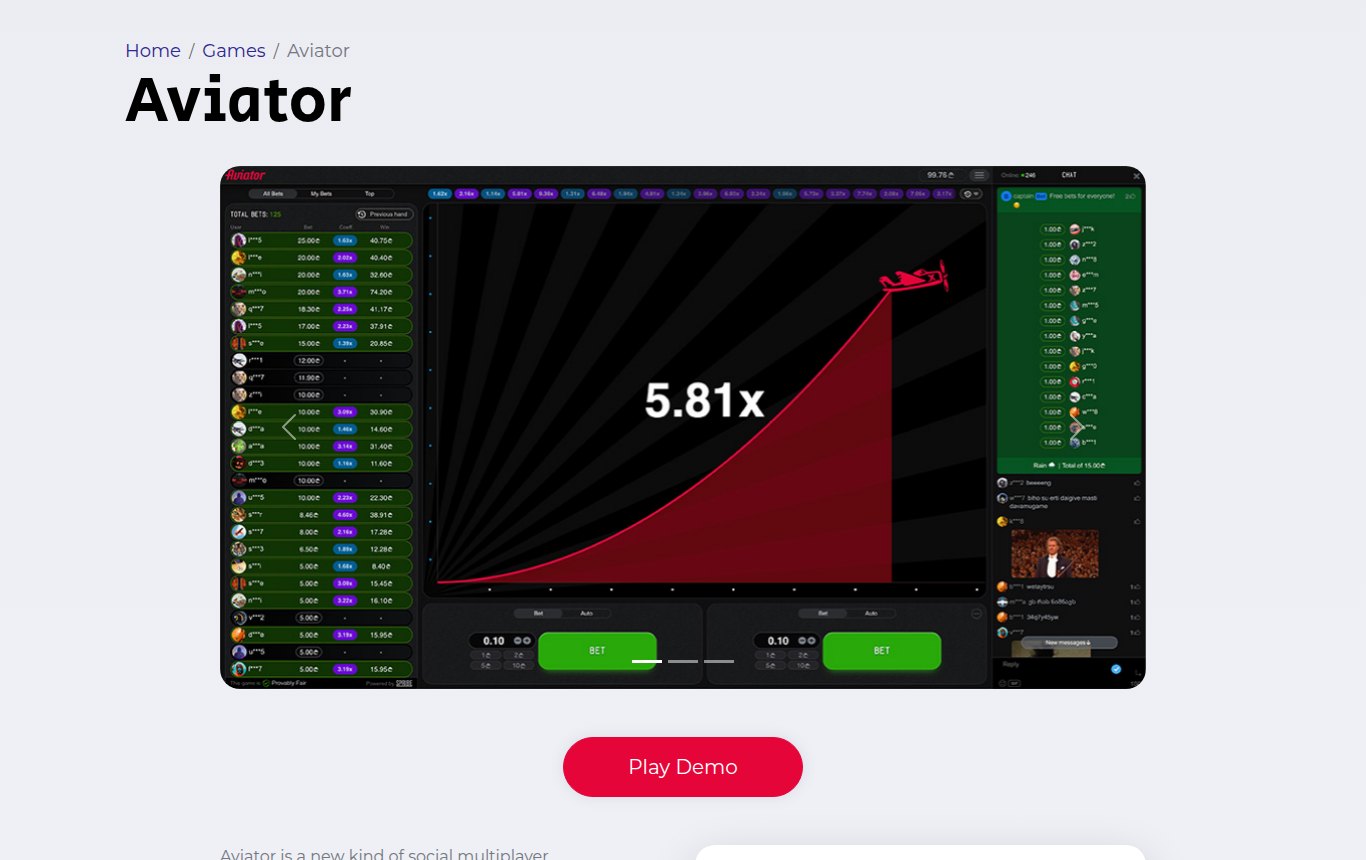
A crash game is one number going up. A multiplier starts at 1.00x and climbs; at a moment you cannot predict, it stops — it crashes. Cash out before that and your stake is multiplied by whatever the number showed. Cash out after, and there is nothing to cash out.
Almost every guide to this category quotes one return figure for crash games as a whole, usually 97%. We opened each studio’s own game page and read the number there instead, and the result settles the question: the three biggest titles publish three different figures, and one of them is not a figure at all but a range. Last checked: September 2026.
| Crash game | Provider | Main feature | Published RTP | Where we read it |
|---|---|---|---|---|
| Aviator | Spribe | The title that created the category; live bets and chat | 97% | Game info panel on the Spribe game page, September 2026 |
| JetX | SmartSoft Gaming | Rocket format with a longer round | 96.2% – 98.9% — a range, not one figure | SmartSoft’s own game page, September 2026 |
| Spaceman | Pragmatic Play | Astronaut format, two simultaneous bets | 95% | “Basic Game Info” on the Pragmatic Play game page, September 2026 |
| Aviatrix | Aviatrix | Customisable plane with a collectable layer | No per-game figure published | aviatrix.bet is a corporate site with no public game sheet |
| Plinko | Multiple studios | A ball through pegs — adjacent category, not a crash game | Varies by studio and risk level | See our separate guide when it is published |

Read that column again. Spaceman returns 95%. Aviator returns 97%. JetX publishes a range of 96.2% to 98.9%. Those are the studios’ own figures, read on their own pages in September 2026 — not copied from another guide. Two points follow. First, there is no such thing as “the RTP of crash games”: the gap between Spaceman and the top of JetX’s range is nearly four percentage points, which is larger than the entire house edge of most of these games. Second, JetX publishing a range rather than a number is the more important fact: it means the same title can be configured differently, so the figure that applies to you is the one in the game’s own info panel at the operator you are playing at.
What Are Crash Games?

A crash game has one mechanic and no reels, cards or wheel:
- A round opens and you place a bet before it starts.
- A multiplier begins at 1.00x and rises — slowly at first, then faster.
- At an unpredictable point the round ends. That point is the crash point.
- If you cash out before the crash, you are paid your stake multiplied by the value showing when you pressed.
- If the crash happens first, the stake is lost. There is no partial result.
That is the whole game. What makes it feel different from a slot is that you choose when to stop, and what makes it the same as a slot is that choosing when to stop does not change what the game returns over time. The section on RTP explains why, and it is the single most misunderstood point in this category.
The format arrived here fast. As we wrote in one of our operator reviews, Aviator and Aviatrix are “the crash games that have taken over this region faster than they took over Europe” — and our counts bear that out: one operator we reviewed lists 1,561 instant-win titles, another 219, and a third carries 36 Mines variants and 75 Plinko variants on its own.
How Do Crash Games Work?
Place Your Bet
Betting is open for a few seconds between rounds. You set a stake and, if you want, an automatic cash-out target. Once the round starts, the bet cannot be changed or withdrawn — only cashed out.
The Multiplier Starts
The round begins at 1.00x. At exactly 1.00x a cash-out returns your stake and nothing more, which is why the value has to climb before there is anything to win.
The Multiplier Increases
The number rises continuously. In most implementations the rise accelerates, so the visual distance between 1x and 2x is far larger than between 9x and 10x — a design choice that makes waiting feel longer than it is.
Cash Out
Pressing cash out ends your bet at the value showing at that instant. The round continues for everyone else. This is the only decision in the game.
The Crash
The round ends. Every bet still open is lost, at once. The crash point is then displayed and added to the history strip.
Result
A worked example, as arithmetic and not as a forecast. Stake $10:
| What happens | Your result |
|---|---|
| You cash out at 2.50x | $25 returned — a $15 profit on a $10 stake |
| You cash out at 1.20x | $12 returned — a $2 profit |
| The round crashes at 1.80x and your target was 2.50x | $0 — the target was never reached, so nothing was cashed out |
| The round crashes at 1.00x | $0 — this happens, and it happens more often than people expect |
Note the third row, because it is the one that catches people. An automatic cash-out at 2.50x pays nothing at all on a round that crashes at 1.80x. A higher target does not mean a bigger win; it means a smaller chance of any win.
What Is a Crash Point?
The crash point is the multiplier at which a round ends. It is generated for that round and it is the only thing in the game you cannot influence.
- A low crash point — anything close to 1.00x — ends the round before almost anyone can act. These are common, not rare.
- A high crash point — 10x, 50x, 100x and beyond — is what the format is famous for and what makes the history strip exciting to look at. It is also, by construction, rare.
- Your cash-out target and the crash point are independent. The game does not know what you selected, and selecting a number does not make it more or less likely to be reached.
The crash point of a round cannot be predicted from previous rounds. This is not a disclaimer; it is how a properly randomised game works, and the section on patterns below deals with the tools that claim otherwise.
What Is a Multiplier?
The multiplier is the number your stake is multiplied by when you cash out. The table below is arithmetic on a $10 stake — gross return, before any conditions the operator applies, and not a statement about how often each value occurs.
| Multiplier | Return on a $10 stake | Profit |
|---|---|---|
| 1.00x | $10 | $0 — your stake back |
| 1.20x | $12 | $2 |
| 1.50x | $15 | $5 |
| 2.00x | $20 | $10 |
| 5.00x | $50 | $40 |
| 10.00x | $100 | $90 |
| 100.00x | $1,000 | $990 |
Two things the table does not say, and both matter more than the numbers in it. It says nothing about how likely each row is — that is the probability section. And it says nothing about what the game returns over time, because a return figure already accounts for every round you lose on the way to the rare large one.
How Cash Out Works
There are two ways to end a bet, and one of them is a setting rather than an action.
| Method | How it works | What to watch |
|---|---|---|
| Manual cash out | You press the button during the round | Reaction time and connection latency both sit between your decision and its execution |
| Auto cash out | You set a target before the round; the game cashes out when it is reached | Removes reaction time from the equation — it does not remove anything else |
| Partial cash out | Some games let you cash out part of a bet and let the rest ride | Available in some titles only; check the game rules |
| Two simultaneous bets | Several titles allow two bets per round with separate targets | Doubles your exposure per round, which is the part players forget |
Auto cash out removes your reaction time from the equation, and that is genuinely useful. It is not a guarantee of execution at exactly the number you chose. If the round crashes below your target, nothing executes at all — the target was simply never reached. And where network conditions, a dropped session or the game’s own rules interfere, execution can fail or settle differently from what you expected. Read the rules of the specific game: what happens on a disconnection mid-round is written there, and it differs between titles.
Crash Game RTP and House Edge
RTP is the share of everything staked that a game returns over a very long run. House edge is the same number from the other side: the two add to 100%. A game at 97% has a 3% edge.
Three things are specific to this category and are routinely got wrong:
- There is no single RTP for “crash games”. The figure belongs to the individual title, and often to the version of that title running at a particular operator. Any guide giving one percentage for the whole category is describing a genre, not a game.
- Cashing out early does not raise the RTP. A lower target wins more often and wins less; a higher target wins rarely and wins more. Over enough rounds the two converge on the same return, because that is what a return figure measures. What your target changes is the shape of the results, not their average.
- And the published figure can itself be a range. As the table at the top of this page records, SmartSoft publishes 96.2% to 98.9% for JetX rather than a single number — which means the same title ships in more than one configuration. The figure that applies to you is the one in the game info panel inside the game, at the operator you are playing at.
Crash Game Probability
The relationship between a multiplier and its likelihood is the core of the format, and it is simple to state and impossible to shortcut: higher multipliers are rarer, and they are rarer in proportion to how much they pay. That is what keeps the return figure roughly constant across targets.
The exact distribution is set by the individual game. We do not publish a universal equation, because there is not one — but we can show you what the arithmetic looks like for a stated return, which is more useful than either a formula presented as universal or no numbers at all.
| Cash-out target | Chance of reaching it | Roughly | What it means over 100 rounds |
|---|---|---|---|
| 1.00x (instant crash) | — | about 3% | About 3 rounds end before anyone can cash out |
| 1.20x | 80.8% | about 4 in 5 | Wins often; each win adds 20% of the stake |
| 1.50x | 64.7% | about 2 in 3 | The common “safe” target |
| 2.00x | 48.5% | just under half | Feels like a coin flip, and is slightly worse than one |
| 3.00x | 32.3% | about 1 in 3 | |
| 5.00x | 19.4% | about 1 in 5 | |
| 10.00x | 9.7% | about 1 in 10 | Long losing runs are normal at this target |
| 50.00x | 1.9% | about 1 in 50 | |
| 100.00x | 0.97% | about 1 in 100 | The round everyone remembers seeing |
Read that table as the shape of the trade, not as a forecast for a specific title. It assumes the standard crash model at a 97% return, which is what Spribe publishes for Aviator. A game at 95%, like Spaceman, produces slightly lower figures in every row; JetX, publishing a range of 96.2% to 98.9%, does not have one table at all. And note the first row: roughly 3 rounds in 100 end at 1.00x, before anyone can act. That is not a glitch — in this model it is precisely where the house edge lives.
A target of 2.00x feels like a coin flip, and a target of 10.00x feels like a long shot worth taking because it pays five times more. Both feelings are describing the same trade at different points on the same line: whatever you gain in size you give back in frequency, and the game is built so that the exchange rate between the two is set against you by the house edge. The 10x target is not better value than the 2x target. It is the same value, arriving less often and in bigger pieces — which is a description of volatility, not of an advantage.
Crash Game Volatility
Volatility describes how results are distributed, not how large they are. It is the part of a crash game you actually feel, and it is decided far more by your cash-out target than by the title you pick.
| How you play | Frequency of a win | Size of a win | What a session feels like |
|---|---|---|---|
| Low targets, around 1.2x–1.5x | Often | Small | Long runs of small gains, punctuated by losses that erase several of them at once |
| Medium targets, around 2x–3x | Roughly sometimes | Moderate | The most familiar rhythm, and the one most guides assume |
| High targets, 10x and above | Rarely | Large | Long losing runs that a single round can reverse — or not |
Note what the table does not do: it does not rank the rows. Volatility is not a measure of quality and a higher maximum multiplier does not make a game better. A title advertising 10,000x is telling you about the top of its range, not about what it returns.
Popular Types of Crash Games

The genre has real sub-formats, and it also has a lot of invented taxonomy. Below are the distinctions that correspond to an actual difference in how the game works.
Classic crash
One multiplier, one cash-out, one round. Aviator and JetX are the reference implementations. Everything else on this list is a variation on it.
Multi-bet crash
Two bets per round with separate targets, so you can take a low target on one and let the other run. It is a genuinely different decision — and it doubles the amount staked per round, which is the half of it that rarely gets mentioned.
Multiplayer and social crash
Rounds shared by everyone at once, with a visible list of other players’ bets and cash-outs, plus chat. The result is identical to playing alone; what changes is that you can watch other people cash out above you, which is a design decision aimed squarely at your patience.
Instant crash
Single-player rounds you start yourself, with no shared timer. Faster, and the speed is the point: more rounds per hour means more total stake at the same bet size.
Feature-based crash
Titles that add bonuses, free bets, side wagers or collectable elements on top of the core mechanic. The features are funded from the same return figure as everything else — they redistribute it rather than add to it.
Adjacent formats
Mines, Limbo, Chicken Road and similar are usually filed alongside crash games and share the risk-and-cash-out feel without the rising multiplier. Plinko sits in the same corner of the lobby and works differently again: a ball through pegs, with risk levels and a board rather than a round that ends.
Popular Online Crash Games
What we found on the operators we reviewed for this market, with the studio named. These are introductions, not reviews. Last checked: September 2026.
| Game | Provider | How it works | Found on operators we reviewed | Published RTP |
|---|---|---|---|---|
| Aviator | Spribe | A plane climbs and flies off; live bets and chat alongside the round | The most widely carried crash title in our set | 97% |
| JetX | SmartSoft Gaming | A jet climbs until it explodes; longer rounds | Present at several, including StoneVegas | 96.2%–98.9%, a range |
| Aviatrix | Aviatrix | Customisable plane with a collectable layer | Named alongside Aviator in our reviews as the pair driving the format here | No per-game sheet published |
| Spaceman | Pragmatic Play | An astronaut rises; two bets per round | Carried where Pragmatic Play is available — which is not everywhere here | 95% — the lowest of the three |
| Mines | Multiple studios | A grid where you reveal tiles and cash out before hitting one | StoneVegas alone lists 36 variants | Varies by studio |
| Limbo | Multiple studios | You pick a target multiplier and the game resolves instantly | Common on crypto-first operators | Varies by studio |
Crash Game Providers
Only studios we verified on operators we reviewed, with the number of reviews each appears in. This is a record of what is actually carried in this market, not a ranking.
| Provider | Known for | Verified on |
|---|---|---|
| Hacksaw Gaming | Instant-win and crash-adjacent titles, heavy presence in lobbies | 17 of 29 reviews |
| Evoplay | A broad instant and crash catalogue | 12 of 29 |
| BGaming | Crash, Plinko and provably fair instant titles | 10 of 29 |
| Elbet | Crash and instant formats aimed at emerging markets | 6 of 29 |
| Spribe | Aviator, the title that created the category | 4 of 29 |
| InOut Games | Instant and crash titles | 2 of 29 |
| Turbo Games, Onlyplay, Galaxsys | Smaller crash and instant catalogues | 1 of 29 each |
Note that Spribe appears in only four of the twenty-nine, despite Aviator being the best-known title in the genre by a wide margin. Availability of a studio and fame of a game are different things, and in this market the gap between them is large.
Crash Games vs Slots
| Feature | Crash games | Slots |
|---|---|---|
| Main mechanic | A rising multiplier and a cash-out | Reels, paylines or clusters |
| Your decision | When to stop — the only one | Which game, and the stake; nothing during the spin |
| Round length | Seconds, and you can end it early | Fixed by the spin and any bonus round |
| Shared rounds | Often — other players visible | Almost never |
| Return figure | Belongs to the title, often unpublished by the studio | Belongs to the title, and set by the operator from a range |
| Volatility | Largely chosen by you, through the target | Built into the game |
| Bonus weighting | Frequently 10% or excluded | Usually 100% |
The row that matters is the last one but two. In a slot, volatility is a property of the game you chose. In a crash game, you set it yourself every round by picking a target — which is the genuine appeal of the format, and also why it is easy to talk yourself into thinking the choice is doing more than it does. Choosing when to cash out changes how your results are distributed. It does not remove the house edge.
For the other side of the comparison, our online slots guide covers how returns are set and why the same title can pay differently at two operators.
Crash Games vs Casino Table Games
Not a ranking — a description of what is different, because the mechanics genuinely are.
| Crash games | Table games | |
|---|---|---|
| Return figure | Per title, and sometimes a range rather than one number | Well documented and stable — roulette 97.30% on a single-zero wheel, baccarat 98.94% on Banker |
| Your decisions | One: when to stop | None after the bet in baccarat; several that move the maths in blackjack |
| Round length | Seconds | Slower, particularly at a live table |
| Rounds per hour | Very high — which raises total stake at the same bet size | Lower, and lower again with a live dealer |
| Where the maths is written | In the game info panel, when it is there at all | In published rules that have not changed in decades |
| What you can verify | Often a provably fair seed, per round | The rules of the table, and the licence behind it |
The practical difference is documentation. Roulette has returned 97.30% on a single-zero wheel for as long as the wheel has existed, and you can look it up. A crash title may return something similar — but you have to find the number first, and as the table at the top of this page shows, that is not always possible.
Crash Game Strategies
There are real approaches here and there is a great deal of nonsense. The difference is that a real approach changes how your results arrive, and none of them changes what the game returns.
Fixed cash out
Pick a target and use it every round. The most common approach, and the most honest one: it makes your results predictable in shape — a known win rate at a known size — without pretending to change the arithmetic.
Auto cash out
The same thing, executed by the game instead of by your reflexes. Genuinely useful, because human reaction time is worth real money in a game measured in tenths of a second. It does not improve the odds; it stops you losing to your own hesitation.
Multiple bets
Two bets per round with different targets — one low to bank something, one high to let run. It is a legitimate way to split your exposure between two volatilities. It also means staking twice as much per round, which doubles the amount the house edge is applied to.
Flat betting
The same stake every round, regardless of what just happened. Not exciting, and the only approach on this page that reliably does what it claims: it keeps your exposure constant and makes a bankroll last a predictable number of rounds.
Bankroll management
Decide the total you are prepared to lose and the stake per round before you start, and let the arithmetic of those two numbers decide how long the session lasts. This is the only part of crash strategy that has any control over your outcome, and it works by limiting exposure rather than by beating anything.
Martingale and Crash Games
Double the stake after every loss, so that one win recovers everything and adds a unit. It is the oldest betting system there is, it is applied to crash games constantly, and it is worth understanding precisely — not because it works, but because the way it fails is not the way people expect.
Why it looks attractive: at a 2.00x target, a win doubles the stake, so a single win after a run of losses recovers them all. On paper, the sequence only needs one win to reset.
| Losing run | Stake that round (from $1) | Total staked so far |
|---|---|---|
| 1st loss | $2 | $3 |
| 3rd loss | $8 | $15 |
| 5th loss | $32 | $63 |
| 7th loss | $128 | $255 |
| 10th loss | $1,024 | $2,047 |
| 13th loss | $8,192 | $16,383 |
Three things kill it, and any one is enough:
- The table maximum. Every game has one, and the sequence reaches it long before your bankroll does. When it does, the recovery mechanism stops and the losses stay.
- The bankroll. Recovering a $1 unit after thirteen losses requires having staked more than $16,000 to win $1. The risk and the reward are not in the same universe.
- The edge does not move. Every one of those rounds is played at the same house edge as the first. A betting system changes the order and size of your bets; it cannot change what each of them returns. The long sequence of small wins is real — and it is paid for, in full, by the rare sequence that ends it.
Martingale does not increase your chance of winning. What it does is reshape your results: it converts a normal mix of wins and losses into a long run of small wins followed by one very large loss. Many players never see the large loss and conclude the system works. That conclusion is the system’s main product. It is not a winning strategy, it is not risk-free, and no sequence of stakes has ever removed a house edge from any game.
Do Crash Game Patterns Work?
Every crash game shows a strip of recent crash points, and an industry has grown around reading it. The short answer is the one nobody selling a predictor wants to give: previous results do not make the next crash point predictable in a properly randomised game.
| The claim | What is actually true |
|---|---|
| “It has crashed low ten times, a big one is due” | Each round is generated independently. Nothing is ever due — this is the gambler’s fallacy with a new interface |
| “There is a pattern in the history strip” | Random sequences contain runs and clusters that look like patterns. Finding one in past data says nothing about future data |
| “This predictor app reads the algorithm” | In a provably fair game the result is fixed by a server seed committed before the round. Nothing observable from outside can reveal it in advance |
| “After a 100x it always crashes early” | The game has no memory of the previous round. There is no mechanism by which it could |
There is real, measurable demand for these — people search for an Aviator predictor in this region every month, and we would rather meet that search with the truth than leave it to whoever is selling the app. No tool can predict a crash point in a properly randomised game, and in a provably fair one the result is committed cryptographically before the round begins, which is precisely what makes it verifiable afterwards and impossible to read beforehand. What these tools reliably do is ask for a deposit, an account login, or both. Treat a request for your casino credentials as what it is.
Are Crash Games Provably Fair?
Some are. It is not a property of the genre, and the phrase is used loosely enough that it is worth knowing what it actually describes.
A provably fair system lets you verify, after the round, that the result was fixed before you bet. It works like this:
| Element | What it is | Why it matters |
|---|---|---|
| Server seed | A secret value the operator generates for the round or series | It is committed in advance as a hash, so it cannot be changed afterwards |
| Hash | A one-way fingerprint of the server seed, shown to you before you bet | This is the commitment — the operator is locked in before your bet exists |
| Client seed | A value from your side, which you can usually change | Ensures the operator cannot have chosen the outcome knowing your input |
| Nonce | A counter that increments with each round | Lets one seed pair generate a sequence of independent rounds |
| Verification | Recomputing the result from the revealed seeds | You can confirm the round was not altered — after it happened |
And here is how you actually run the check, which is the part most guides describe and never explain:
- Before the round, copy the hash the game shows you. This is the operator’s commitment, and it exists before your bet does.
- Set your own client seed if the game allows it. Changing it is the step that proves the result was not chosen with knowledge of your input.
- Play the round, and note the nonce — the round counter.
- After the round, the game reveals the server seed. Hash it yourself with any SHA-256 tool and compare with the hash you copied at the start. If they match, the seed was not swapped.
- Recompute the crash point from the seed pair and the nonce using the formula the game publishes. If it matches the result you saw, the round is verified.
If any of those steps is unavailable — no hash shown in advance, no client seed you can change, no formula published — then the game is not provably fair in any meaningful sense, whatever the lobby badge says.
Two limits worth stating plainly. Provably fair proves the round was not tampered with; it does not prove the game is generous — the house edge is built into the paytable, not into the seed. And it is a different assurance from an independently tested RNG, where an outside laboratory examines the generator and the operator’s licence obliges them to submit it. A game can have either, both, or neither, and the lobby will not tell you which.
Are Crash Games Rigged?
The accusation usually follows a bad run rather than anything observed, and a flat “no” would be as unhelpful as a flat “yes”. What is actually checkable:
- The operator’s licence — found by number in the regulator’s own register, not in the site footer.
- The studio behind the game — a named provider you can look up, rather than an unbranded title built in-house.
- A provably fair system, where offered, and whether you can actually run the verification rather than just read about it.
- Independent testing of the RNG, where published, with the laboratory named.
- The game rules, including what happens to an open bet if you disconnect mid-round.
- The published return figure, read on the studio’s own game page — and whether it is a single number or a range, because a range tells you the title is configurable.
A licensed operator running a named studio’s title with a verification you can perform yourself is checkable. An unlicensed one is not, however good the animation looks.
Demo vs Real Money Crash Games
| Feature | Demo | Real money |
|---|---|---|
| Money at risk | None | Yes |
| Game mechanics | Usually the same title and rules | The same |
| Provably fair verification | Often unavailable in demo mode | Available where the game offers it |
| Live bet feed and chat | Usually disabled | Active |
| What it teaches | The interface, the pace, where the buttons are | The same, plus how you behave when it is your money |
Demo mode is genuinely useful for learning where the cash-out button is and how fast the number moves. What it cannot teach is the part that matters, because the decision to hold for another half-second is a different decision when the stake is real. And a good run in demo is not evidence of anything about a future session: it is the same game, and the same arithmetic, sampled a few dozen times.
Crash Games on Mobile
Crash games are the format best suited to a phone, and the one where connection quality has the most immediate consequence.
- Browser, not apps. Essentially every crash title runs in a mobile browser at full functionality. Few operators ship a native app, and where they do the game is the same.
- The interface is built for a thumb. A single large cash-out button, which is why the format translates to a small screen better than roulette ever will.
- Connection matters more here than in a slot. A slot resolves on the server whatever your signal does; a crash game asks you to act during the round. Latency sits between your press and its execution.
- Auto cash out is the mobile answer to exactly that problem — set the target before the round and the connection has one less thing to ruin.
- Check the disconnection rule. What happens to an open bet if the session drops is in the game rules, and it differs between titles.
Crash Games for UAE Players

Four things change when the question is asked from the Emirates.
What is actually available
Crash and instant titles are among the best-served categories in this market, which makes them unusual: where live casino floors get cut by 40% or more for this region, the instant corner largely survives. Our counts from operators we reviewed: one lists 1,561 instant-win titles, another 219, and StoneVegas alone carries 36 Mines variants and 75 Plinko variants alongside Aviator and JetX. As we put it in one review, Aviator and Aviatrix are the crash games that took over this region faster than they took over Europe.
Which studios reach you, and which do not
Availability of a studio is not the same as fame of a game. Spribe, which makes Aviator, appears on only four of the twenty-nine operators we reviewed, while Hacksaw appears on seventeen. And Pragmatic Play — which makes Spaceman — is the single most frequently blocked studio in this region in our measurements. The title you came for may simply not be there.
Bonuses, and why crash rarely helps
This is the practical catch. Across the operators whose terms we read, Plinko and similar instant titles count 10% towards wagering at BassBet, Legiano, Nomini and StoneVegas, and some operators exclude the category outright. A casino welcome bonus is built for slots; clearing one on crash games ranges from slow to impossible. Read the game weighting table before accepting an offer you intend to play this way.
Accessible from the UAE is not licensed in the UAE
The General Commercial Gaming Regulatory Authority (GCGRA) was created in 2023 and issues real licences in the Emirates under Federal Decree-Law 25 of 2025. An operator accepting players from the UAE is not the same as an operator licensed in the UAE. Almost every site carrying these games holds an offshore licence — Curaçao or Anjouan — which gives you a regulator to complain to, but not a UAE one, and an international licence does not mean the operator holds a GCGRA licence. The full position is in our UAE casino guide.
UAE Crash Games Checklist
What we verify on every operator before it appears in a crash games context on this site. Last checked: September 2026.
| Check | What we verify |
|---|---|
| GCGRA licence | Whether the operator holds a UAE licence at all — almost none do |
| International licence | The offshore licence number, looked up in the regulator’s own register |
| UAE availability | Whether the instant and crash lobby opens from a connection here |
| Crash titles carried | Which specific games, counted, rather than a category label |
| Providers | Which studios reach this region — and which are blocked |
| Published RTP | Read from the game info panel; recorded as unpublished where it is absent |
| Maximum multiplier | From the game rules, not from a promotional page |
| Auto cash out | Whether the feature exists and whether partial cash-out is offered |
| Minimum and maximum stake | Read from the game itself |
| Provably fair | Whether verification is offered, and whether you can actually run it |
| Disconnection rule | What happens to an open bet if the session drops mid-round |
| AED | Whether a dirham balance is held, or a conversion applies |
| Arabic interface | Interface, and separately whether the terms are in Arabic |
| Mobile | Whether the game is usable on a phone, not merely present |
| Bonus weighting | What crash and instant titles contribute to wagering — often 10% or nothing |
How We Evaluate Crash Games
We are an affiliate site and earn commission from some of the operators named here. That funds the testing; it does not buy a rating. This category needs a stricter method than most, because it is full of content built on prediction claims. Last checked: September 2026.
- We read the return figure at source, and where the studio does not publish it we record that instead of copying a number from another guide. The table at the top of this page is the result of doing exactly that.
- We count the titles actually carried at each operator rather than accepting a category label in a menu.
- We identify the studio, because studio availability in this region differs sharply from a game’s fame.
- We read the game rules, including maximum multiplier, stake limits and what happens on a disconnection mid-round.
- We check whether provably fair verification can actually be run, not merely whether the phrase appears.
- We record the bonus weighting for crash and instant titles from the game contribution table.
- We test on a phone, because this is a format played on phones.
- We check the licence in the regulator’s register rather than in the footer.
- We do not publish strategy claims we cannot support, and we do not publish a universal RTP, a universal probability formula or a universal maximum multiplier, because none of the three exists.
How to Choose a Crash Game
| Step | What to check | Why |
|---|---|---|
| 1 | Where the return figure is | In the game info panel. If it is nowhere, that is information too |
| 2 | The studio | A named studio you can look up, and one that actually reaches this region |
| 3 | Stake limits | Minimum and maximum, read from the game — they cap any betting approach you had in mind |
| 4 | Auto cash out | Whether it exists, and whether partial cash-out is offered |
| 5 | The disconnection rule | What happens to an open bet if your session drops |
| 6 | Provably fair | Whether you can run the verification yourself, not whether the words appear |
| 7 | Mobile behaviour | This format is played on phones; test it on one |
| 8 | Bonus weighting | Crash titles typically count 10% or are excluded |
| 9 | UAE availability | Whether the specific title opens from here, not the category |
| 10 | The licence | Verified in the register — and whether it is a UAE licence or offshore |
One step that is not on this list: the maximum multiplier. A title advertising 10,000x is describing the top of its range, and a range top tells you nothing about what the game returns or how often. A higher maximum does not make a better game.
Crash Game Terminology
| Term | Meaning |
|---|---|
| Auto cash out | A target set before the round, executed automatically if reached |
| Cash out | Ending your bet during the round to take the current multiplier |
| Client seed | A value from the player side, used in generating a provably fair result |
| Crash point | The multiplier at which the round ends |
| Hash | A one-way fingerprint of the server seed, published before the round as a commitment |
| House edge | The mathematical advantage retained by the game; the complement of RTP |
| Instant game | A single-player round you start yourself, with no shared timer |
| Multiplier | The value applied to your stake when you cash out |
| Nonce | A counter that increments each round, so one seed pair produces many results |
| Partial cash out | Taking part of a bet and letting the remainder continue |
| Provably fair | A system letting you verify, afterwards, that the result was fixed before you bet |
| RNG | The random number generator producing the result |
| RTP | The theoretical long-run return of a specific game |
| Server seed | The operator’s secret value for the round, committed in advance as a hash |
| Volatility | How results are distributed — in this format, largely set by your target |
Crash games sit alongside the rest of the floor in our online casino games guide. The categories they are most often compared with have their own: slots, roulette, blackjack, baccarat and live casino.
Frequently Asked Questions
A crash game is a round in which a multiplier starts at 1.00x and rises until it stops at an unpredictable point — the crash. If you cash out before that, your stake is multiplied by the value showing when you pressed. If the crash comes first, the stake is lost. There are no reels, cards or wheel, and the only decision is when to stop.
You place a bet while betting is open between rounds, optionally setting an automatic cash-out target. The round starts at 1.00x and the multiplier climbs. You cash out manually or the auto target triggers; if neither happens before the crash point, the bet is lost. The crash point is then shown and added to the history strip.
The multiplier at which a round ends. It is generated for that round independently of every previous one, and it is the only element of the game you cannot influence. It cannot be predicted from earlier results in a properly randomised game.
It is the number your stake is multiplied by if you cash out at that moment. On a $10 stake, 2.00x returns $20 and 10.00x returns $100 — gross, before any conditions the operator applies. The multiplier says nothing about how likely it is to be reached; higher values are rarer in proportion to what they pay.
Pressing cash out ends your bet at the value showing at that instant, while the round continues for everyone else. Some titles also allow partial cash-out, taking part of the bet and letting the rest ride, and several allow two separate bets per round with different targets.
A target you set before the round, which the game executes for you if the multiplier reaches it. It removes your reaction time from the equation, which is worth real money in a game measured in tenths of a second. It does not guarantee anything: if the round crashes below your target, nothing executes, and network conditions or the game’s own rules can still interfere.
There is no single figure for the category, and the studios’ own pages prove it. We read them in September 2026: Spribe publishes 97% for Aviator, Pragmatic Play publishes 95% for Spaceman, and SmartSoft publishes a range of 96.2% to 98.9% for JetX. That last one matters most: a range means the same title ships in more than one configuration, so the figure that applies to you is the one in the game info panel at the operator you are playing at.
In a licensed, tested game, yes — each round is generated independently of the last. That is precisely why previous crash points carry no information about the next one, and why nothing is ever “due”.
Some are, and it is not a property of the genre. A provably fair system publishes a hash of a server seed before you bet, combines it with a client seed and a nonce, and lets you recompute the result afterwards to confirm it was not altered. It proves the round was not tampered with; it does not prove the game is generous, because the house edge sits in the paytable, not in the seed. It is also a different assurance from an independently tested RNG.
The checkable answer is better than a flat yes or no. Verify the operator’s licence number in the regulator’s own register, the named studio behind the title, whether provably fair verification can actually be run rather than merely mentioned, independent RNG testing where published, and the game rules including what happens on a disconnection. A licensed operator running a named studio’s game with verification you can perform is checkable; an unlicensed one is not.
No. Each round is generated independently, so a run of low crash points does not make a high one more likely — that is the gambler’s fallacy with a new interface. Random sequences naturally contain runs and clusters that look like patterns after the fact, and finding one in past results says nothing about future results.
No strategy changes what a crash game returns over time. What a cash-out target does change is the shape of your results: low targets win often and small, high targets win rarely and large, and over enough rounds both converge on the same return. Flat betting and bankroll management are the only approaches that reliably do what they claim, and they work by limiting exposure rather than by beating the game.
No. Doubling after each loss converts a normal mix of results into a long run of small wins followed by one very large loss. Three things end it: the table maximum, which the sequence reaches before your bankroll does; the bankroll itself, since recovering a $1 unit after thirteen losses means having staked more than $16,000; and the house edge, which is applied identically to every round regardless of its size. A betting system changes the order and size of bets, never what each returns.
There is no single answer, and be wary of any page that gives one. The useful comparison is between what each title publishes: the return figure in its info panel, the stake limits, whether auto and partial cash-out are offered, whether provably fair verification can be run, and whether the studio reaches your region at all. A well-known name is not the same as a well-documented game.
Several titles advertise maximum multipliers in the thousands, and the figure is close to meaningless on its own. A maximum describes the top of a range, not what the game returns or how often anything is reached. A higher maximum does not make a better game, and it does not raise the RTP by a single point.
Yes, and it is the format best suited to a phone: a single large cash-out button and short rounds. Essentially every crash title runs in a mobile browser without an app. Connection quality matters more here than in a slot, because you have to act during the round — which is exactly what auto cash out is for.
Crash and instant titles are among the best-served categories in this market, unlike live casino floors, which get cut heavily for this region. Operators we reviewed list as many as 1,561 instant-win titles, and StoneVegas alone carries 36 Mines variants and 75 Plinko variants alongside Aviator and JetX. But note that Spribe, which makes Aviator, appears on only four of the twenty-nine operators we reviewed. And licensed commercial gaming in the Emirates exists under the GCGRA, created in 2023 — an operator accepting players from the UAE is not the same as an operator licensed in the UAE.