
























The Short Answer
Cryptocurrency is the funding method that works most consistently from the Emirates, because it does not pass through a UAE bank and no card issuer can decline it. It is not the safest method and it is not free — it carries three costs that cards do not, and one mistake on it is unrecoverable. This page is about what it actually costs and how long it actually takes, measured rather than repeated.
If you want to know which brands take which methods, that is the parent page: the UAE payments hub. This one is about the mechanics of the crypto rail itself.

Every guide to crypto casinos, including an earlier version of our own, tells you to use Tron (TRC20) because it is cheap. Measured on 9 October 2026, TRC20 was the most expensive network in this comparison at about $2.15 per transfer, while Ethereum ERC20 — the one everybody calls expensive — cost about $0.02. That is not a permanent reversal, and further down we give you the threshold at which it flips back.
What a Crypto Casino Payment Actually Is
A crypto casino deposit is a transfer on a public ledger from a wallet you control to an address the casino gives you. There is no bank in the middle, no authorisation to be declined, and no chargeback afterwards. Those three facts are the whole of the advantage and the whole of the risk, in that order.
Three things decide what the transfer costs you and how long it takes, and none of them is the casino:
- The coin. Bitcoin, Ethereum, a stablecoin or something else. This decides whether you carry exchange-rate risk between deposit and withdrawal.
- The network. The same coin often exists on several chains. Tether runs on ERC20, TRC20, BEP20, Solana and Polygon, and the chain decides the fee — by a factor of a hundred or more, as the table below shows.
- The confirmations the casino requires. Not the block time. A chain with 3-second blocks that needs 19 confirmations is slower than one with 12-second blocks that needs 12.
The three things that decide the cost
A fourth thing decides whether any of it is possible: whether you already hold the coin. For a reader in the Emirates that is rarely a given, and it is the step where the bank you were avoiding reappears. We come back to it.
Network Fees: What We Measured
These are the costs of moving funds on each chain, read from the networks themselves at 9 October 2026, 08:05 UTC. The fee is paid to the blockchain, not to the casino — a casino that advertises “no fees” is telling you about its own charge, not about this one.
| Network | Typical coin | Fee per transfer | Block time | Confirmations | Wait | Round trip on $200 |
|---|---|---|---|---|---|---|
| Solana | USDC | $0.0006 | 0.27 s | 32 | 9 s | $0.001 |
| Base | USDC | $0.0010 | 2.00 s | 10 | 20 s | $0.002 |
| Polygon | USDT | $0.0023 | 1.50 s | 128 | 3 min | $0.005 |
| BNB Chain (BEP20) | USDT | $0.0024 | 0.45 s | 15 | 7 s | $0.005 |
| Arbitrum | USDC | $0.0033 | 0.30 s | 20 | 6 s | $0.007 |
| Litecoin | LTC | $0.0064 | 108.90 s | 6 | 11 min | $0.013 |
| Ethereum (ERC20) | USDT | $0.0221 | 12.00 s | 12 | 2 min | $0.044 |
| Bitcoin | BTC | $0.2328 | 735.20 s | 2 | 24 min | $0.466 |
| Tron (TRC20) | USDT | $2.1541 | 3.00 s | 19 | 57 s | $4.308 |
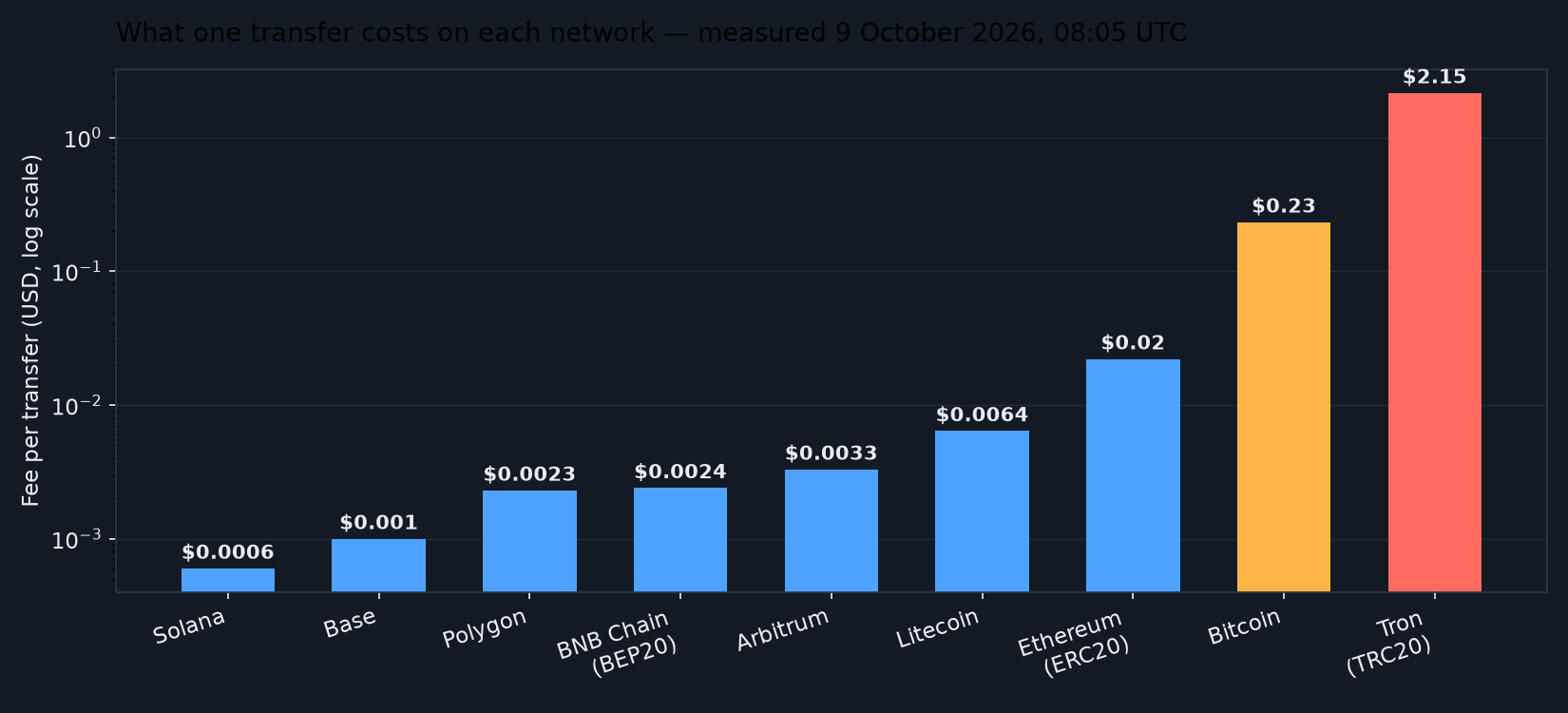
Three things in that table are worth stopping on.
Tron is the expensive one, and almost nobody says so
TRC20 cost $2.15 per transfer when we measured it — 2.15% of a $200 round trip, which is in the same range as the card conversion spread this whole market exists to avoid. The reason is structural rather than congestion: a Tron token transfer burns about 65,000 units of energy, and the network charges a fixed 100 sun per unit. At a TRX price of $0.33 that is 6.5 TRX. If the receiving address has never held that token the cost roughly doubles, to about $4.32.
That fixed price is also why Tron is predictable: it does not spike. It is the expensive-but-steady option, which is the opposite of how it is usually sold.
Ethereum Was the Cheap One, and That Will Not Last
An ERC20 transfer cost $0.02 at a gas price of 0.136 gwei. That is historically very low. Ethereum gas is the most volatile number on this page — it has spent long periods between 20 and 100 gwei, where the same transfer costs $3 to $16. Do not take $0.02 as a standing figure. Take the rule in the next section instead.
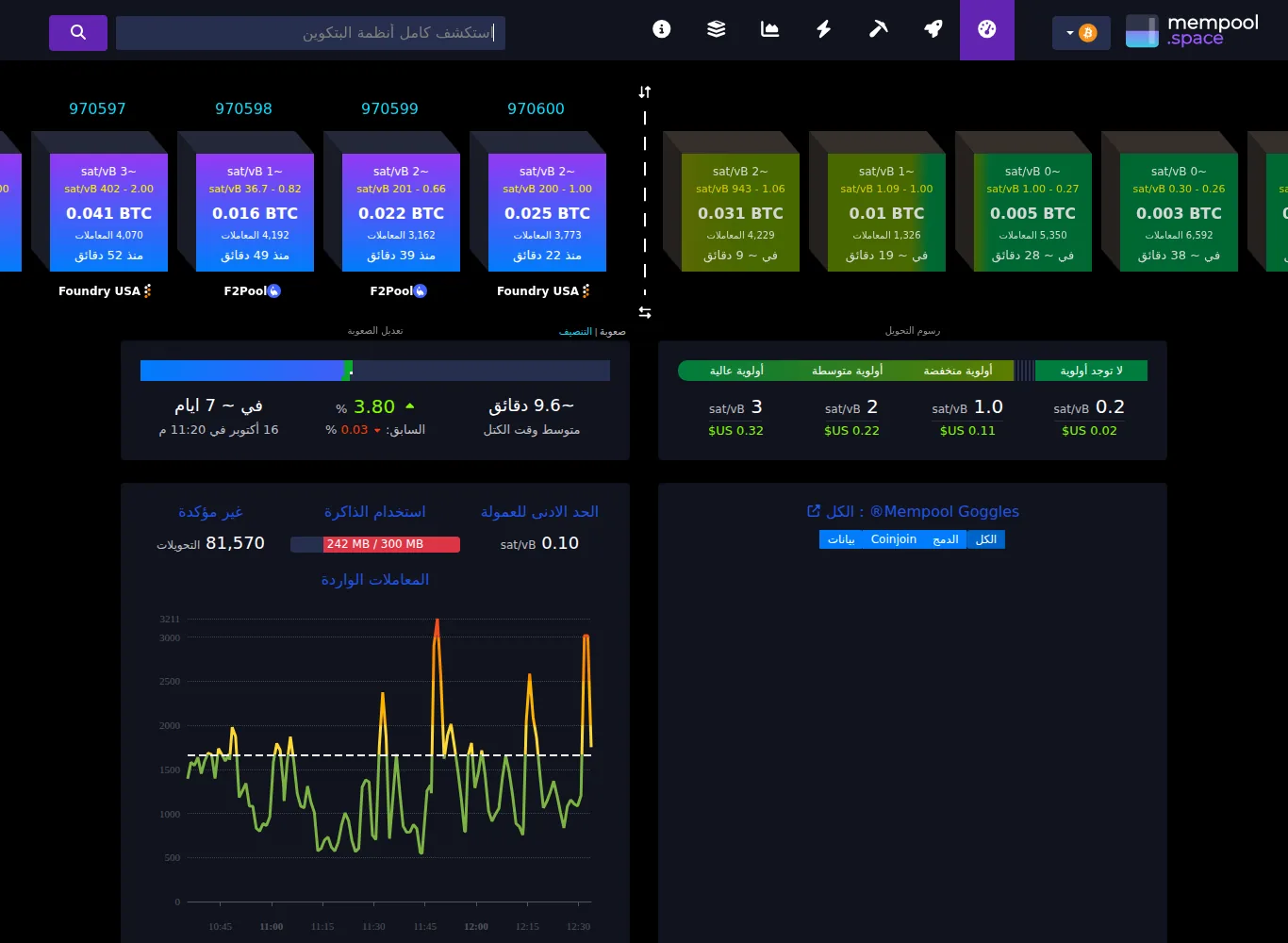
The Bitcoin figures are confirmed by the network’s own fee estimator, read at the same time: 3 sat/vB priced at $0.32, 2 at $0.22 and 1 at $0.11, against our calculated $0.23 for a standard transaction at the middle tier. The same screen put the average block time at 9.6 minutes and 81,570 transactions waiting in the mempool.
The Layer Twos and Solana Are Close to Free
Base, Arbitrum, Solana, Polygon and BNB Chain all came in under half a cent, with waits between 6 and 20 seconds. Fewer casinos support them, which is the catch — Roobet takes Ethereum on Base and Arbitrum, Stake runs stablecoins on Polygon, and most of the rest do not. Where they exist, they are the cheapest route in this table by two orders of magnitude.
The Rule That Survives the Volatility
A fee table measured on one morning is worth little three months later, so here is the part that keeps working: a threshold rather than a price.
Tron costs about $2.15 and barely moves. Ethereum costs 65,000 gas, whatever gas happens to be. Setting the two equal gives the point where the usual advice flips:
Below roughly 13 gwei, an Ethereum ERC20 transfer is cheaper than the same transfer on Tron. Above it, Tron is cheaper. Check the current gas price before you choose the network — it takes five seconds on any gas tracker, and on a small withdrawal it is most of the cost.
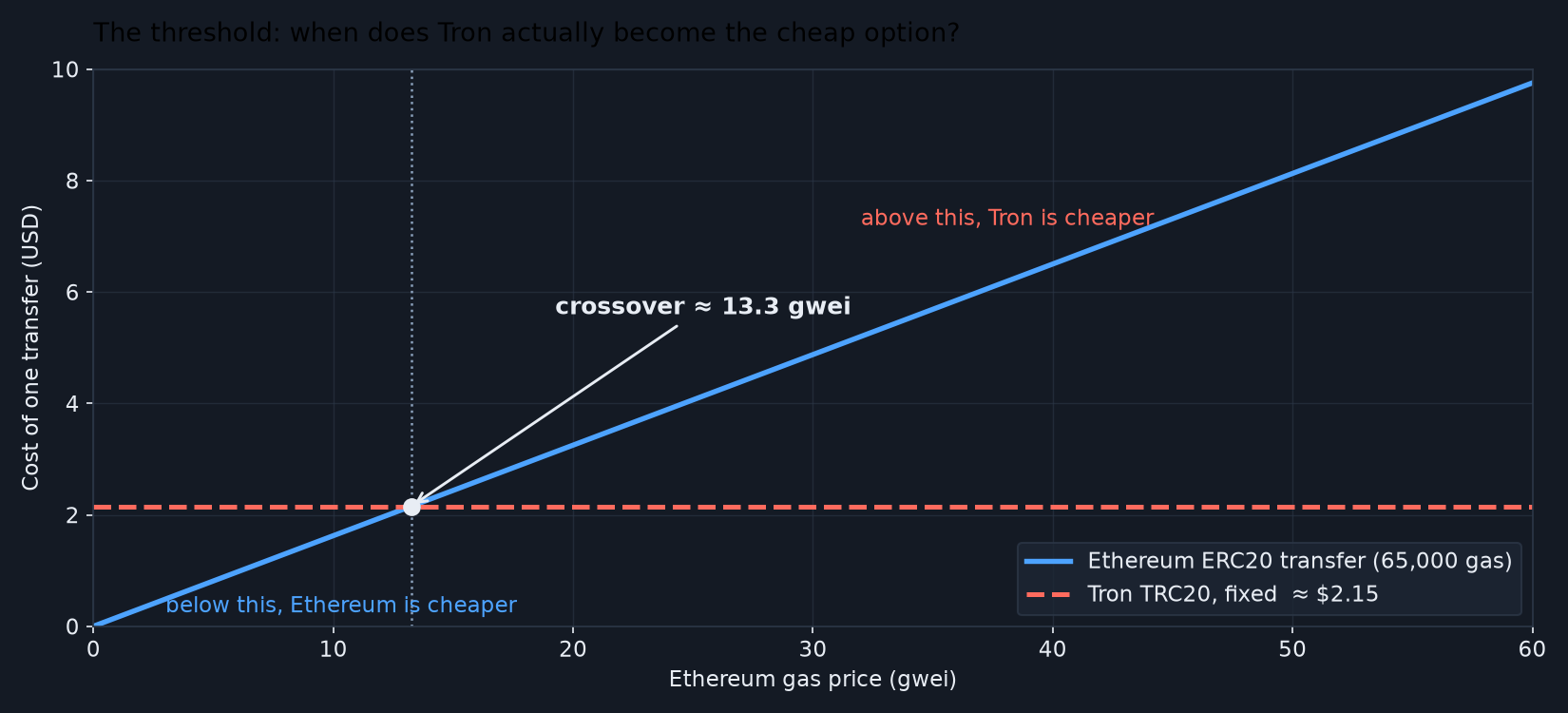
The arithmetic, so you can redo it rather than trust us: 65,000 gas × 13.25 gwei × the ETH price of $2,500 comes to about $2.15, which is what Tron charges. The threshold moves with the ETH price — if ETH doubles, the crossover halves to about 6.6 gwei. The method does not move.
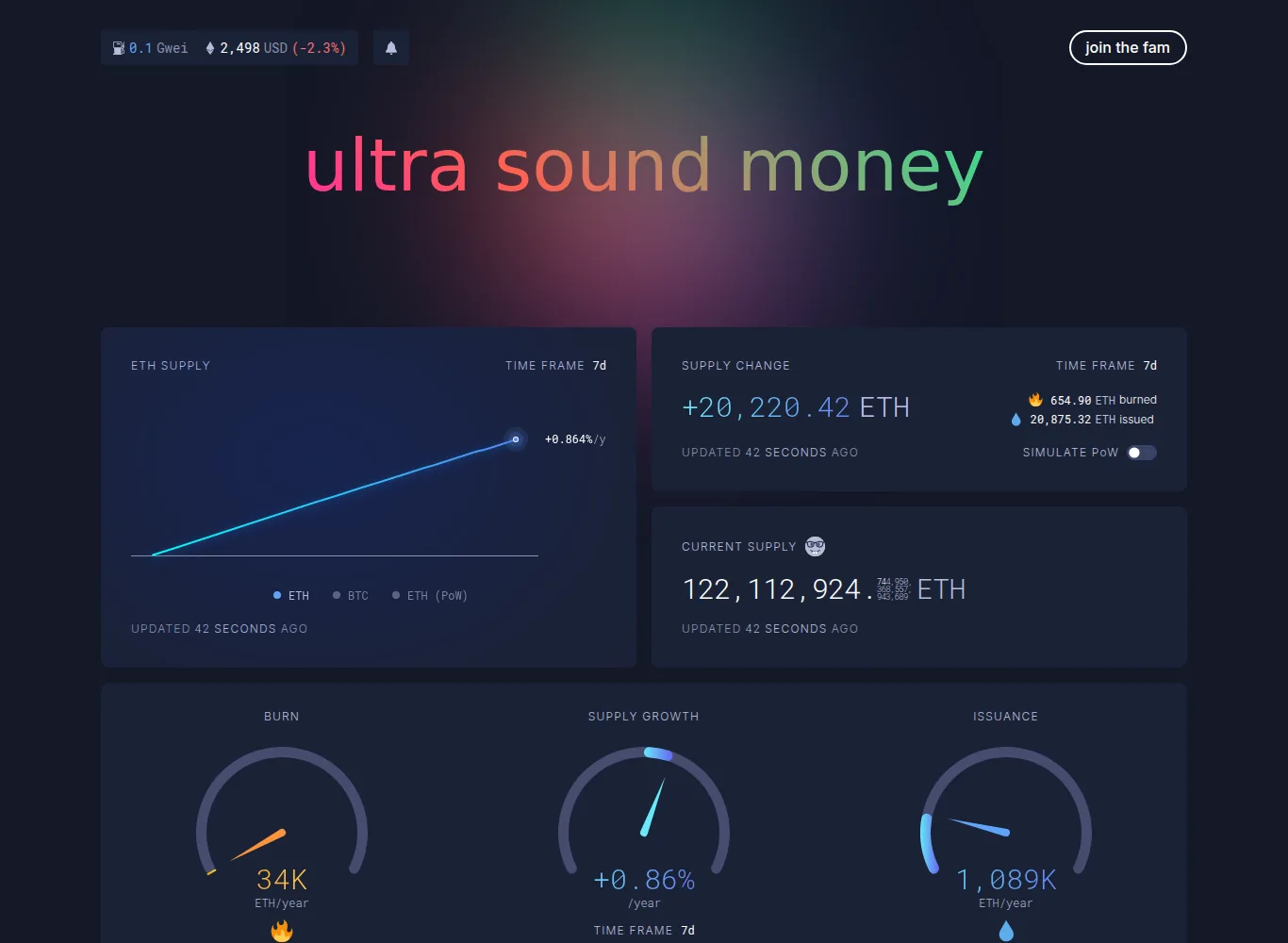
Why the Ethereum number was so low that morning
Worth saying plainly, because a reader checking today will likely see something else. Gas sat at 0.1 gwei when we measured, which is near the floor of what the network charges. There is no mystery to it — demand for block space was low that morning. It has been above 20 gwei for long stretches in the past and will be again, and at 20 gwei the same ERC20 transfer costs about $3.25 rather than two cents. The threshold is the durable part; the price is not.
And the rule that beats both when it is available: if the cashier offers a layer two or Solana, use it. At well under a cent, the comparison stops mattering.
Confirmation Times
The wait is not the block time. It is block time × the number of confirmations the casino requires, and the second number is set by the operator, not by the chain. Two chains with near-identical block times can leave you waiting very different amounts.
From the table above: Bitcoin at 2 confirmations is about 25 minutes — and our own reading showed blocks arriving every 12.3 minutes rather than the nominal 10, which is normal variance and is why Bitcoin estimates are always soft. Polygon has 1.5-second blocks but commonly needs 128 confirmations, which puts it at about 3 minutes — slower than Ethereum, despite blocks eight times faster. Solana, Arbitrum and BNB Chain all land inside 10 seconds.
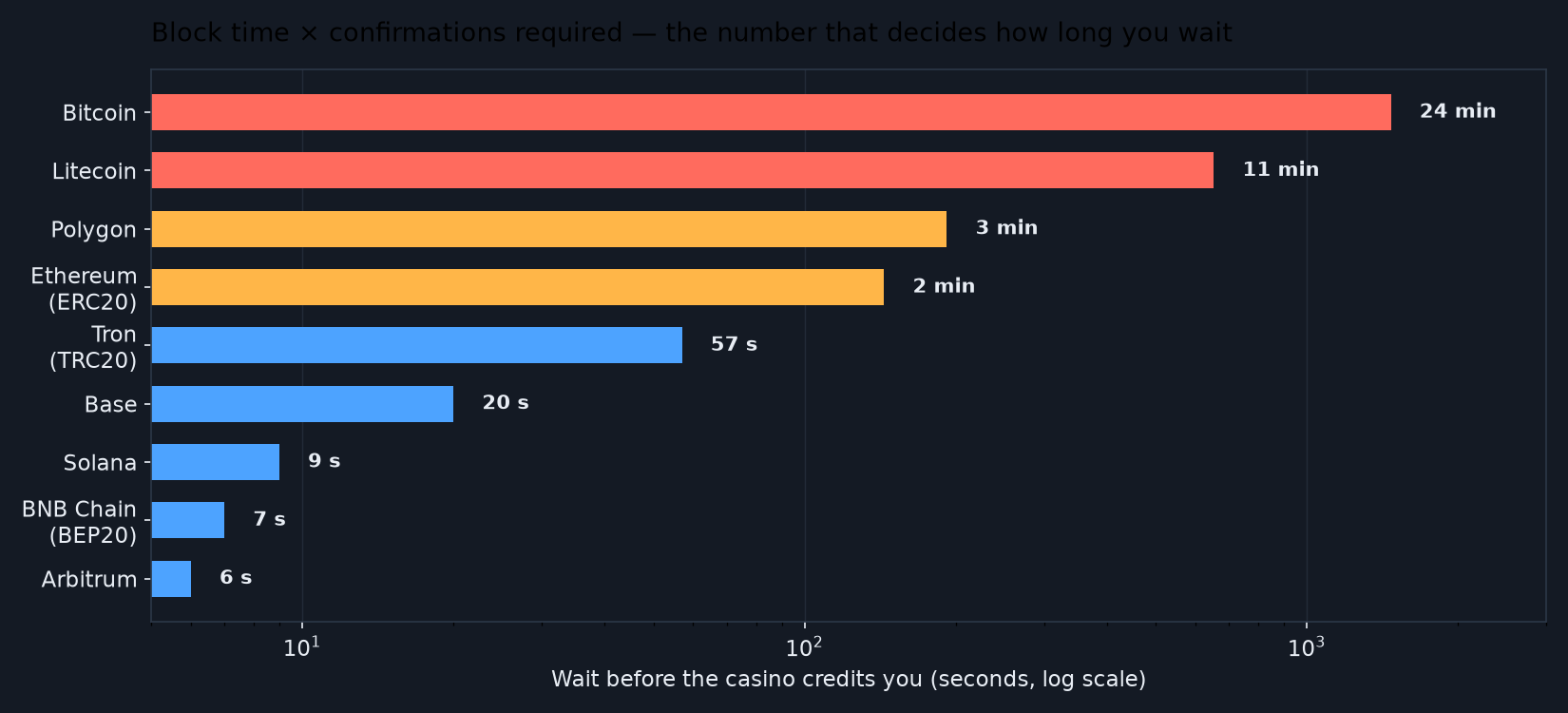
Two practical consequences. First, a deposit that has not appeared is usually waiting for confirmations, not lost — check the transaction hash on a block explorer before opening a support ticket, because the explorer will tell you how many confirmations it has and the ticket will not. Second, the operator’s own queue sits on top of all of this on withdrawals: the chain may settle in seconds while the casino takes days to approve the request. Spinrollz publishes a three-business-day window restricted to 06:00–17:00 GMT weekdays; most brands publish nothing.
Bitcoin
Accepted at every crypto cashier in this comparison, and rarely the right choice for a casino balance.
The fee is the smaller problem — we measured $0.23 at the fast rate and $0.12 at the economy rate, which is cheap by Bitcoin’s own history. The real costs are the wait, at roughly 25 minutes for two confirmations, and the volatility: a balance held in BTC moves while you sleep, and over a week that movement will exceed every fee on this page.
There is also a minimum problem. Casinia, Nomini and StoneVegas all start crypto deposits at $15 except Bitcoin, which starts at $30, and Horus Casino caps Bitcoin Cash between €20 and €10,000. If you are moving small amounts, Bitcoin is the coin most likely to have a floor above what you wanted to send.
Where Bitcoin makes sense: you already hold it, you are moving a larger sum where a quarter of a dollar is noise, and you are withdrawing rather than parking a balance.
Ethereum
Universally accepted, and the network whose cost you have to check rather than assume. At the 0.136 gwei we measured, an ERC20 transfer was $0.02; at 50 gwei it would be about $8; at 100 gwei about $16. Same transfer, same chain, a 700-fold range.
The layer twos are the answer to that, where your cashier supports them. Roobet accepts Ethereum on Base and Arbitrum; we measured both under half a cent, settling in 6 to 20 seconds. Stake runs its stablecoins on ERC20, BEP20 and Polygon. If the cashier offers a layer two and your wallet supports it, the saving on a small transfer is essentially the entire fee.
The trap, and it is the expensive one on this page: a layer two is a different network. Ether on Arbitrum sent to a mainnet deposit address does not arrive. The address format is identical, which is exactly why the mistake is easy.
Stablecoins: USDT and USDC
A stablecoin is a token pegged to a fiat currency, in practice the US dollar. For a casino balance that single property removes the risk that makes the other coins awkward: deposit $200 of USDT, play nothing, withdraw a week later, and you have about $200. Do the same with Bitcoin and you have something else.
That is why USDT dominates these cashiers rather than Bitcoin. Casinia and Spinrollz both run Tether on four separate networks; Stake, Roobet, BC.GAME, 10Bet, Megapari, BDMBet, PlayFina and BassBet all carry it, and Megapari goes as far as assigning Tether as the base account currency to an Emirati visitor.
USDC does the same job with a different issuer and is carried at Stake, Roobet, BC.GAME, Casinia and Spinrollz, with Spinrollz running it on two chains. If your exchange holds one and not the other, use the one you hold rather than converting — the conversion costs more than the difference between them.
The thing to understand about a stablecoin is that it is not one asset, it is one asset on five networks, and the fee you pay has nothing to do with the coin and everything to do with the chain. The same $200 of USDT costs $2.15 to move on Tron and $0.02 on Ethereum today, and under half a cent on BNB Chain or Polygon. Reading “USDT” in a cashier tells you almost nothing until you read the network next to it.
And the peg is a design, not a law. Both USDT and USDC have briefly traded off a dollar in the past. For money passing through in minutes that is irrelevant; for a balance you intend to leave sitting for months it is a small risk worth knowing you are taking.
The Other Coins, and What They Are For
| Coin | What it is good for | The catch |
|---|---|---|
| Litecoin (LTC) | Small withdrawals. We measured $0.006 per transfer, about 11 minutes for 6 confirmations. | Volatile, like Bitcoin. Fine for moving money, poor for holding it. |
| Tron (TRX) | Carrying USDT when Ethereum gas is high. | The TRX coin itself is volatile, and the TRC20 fee is the highest in our table. |
| Solana (SOL) | The cheapest and fastest in our reading — $0.0006 and under 10 seconds. | Volatile, and carried by fewer cashiers than Tether. |
| BNB | BEP20 transfers at $0.002 with 0.45-second blocks. | Tied to one exchange ecosystem. |
| XRP and Dogecoin | Fast and cheap, carried at the crypto-first brands. | Both volatile; neither offers anything a stablecoin does not. |
| The long tail | Stake carries 22 coins, BC.GAME 251 assets. | Past the top ten this is a signal about the cashier, not a menu you need. Nobody needs to deposit in SHIB. |
Binance Pay deserves a line of its own. Betfinal and Horus Casino both carry it, and it moves funds between Binance accounts without touching a public blockchain — no network fee and no address to mistype, which removes both of the costs this page keeps returning to. If you already hold a Binance account it is the cheapest and least error-prone crypto route here. If you do not, it is one more account to open and verify.
Deposits, Step by Step
A crypto deposit takes the same steps at every cashier we opened, and the order you do them in is what saves money.
The order that saves money
The sequence is the same at every cashier we opened, and the two steps people get wrong are the third and the fourth.
- Open the withdrawal tab first. Before you put money in, see what can take it out. This costs nothing and it is the single most useful minute on this page.
- Pick the coin in the deposit tab. For most readers that is USDT or USDC.
- Pick the network — and read it twice. The cashier will show USDT ERC20, USDT TRC20, USDT BEP20 and USDT Solana as four separate lines. They are four different destinations. Funds sent on the wrong one do not arrive.
- Copy the address with the copy button, never by hand, and check the first four and last four characters against what your wallet shows before confirming.
- Send a small test amount the first time you use any new address or network. The fee on a test transfer is a rounding error against what it protects.
- Wait for the confirmations from the table above rather than refreshing the balance. If it has not arrived after the expected wait, check the transaction hash on a block explorer before contacting support.
Withdrawals
Where the differences between operators actually show, because the chain is the fast part and the casino is the slow part.
The operator fee, where there is one
Roobet charges no operator fee on crypto withdrawals — you pay the network fee only, and it is displayed at the bottom of the cashier before you confirm, which is the behaviour this page would like to see everywhere. BC.GAME charges 1%, waived for VIP members, and it is the only percentage fee we found in this market: on a $2,000 withdrawal that is $20, against two cents of network cost on a cheap chain.
The playthrough that applies whether or not you took a bonus
An AML minimum turnover, required before any withdrawal. Roobet sets it at 100% of the deposit, 10Bet at one times deposits, RollingSlots at three times. At Nomini, StoneVegas, BoaBoa, Spinrollz and Betfinal the same rule is charged as a fee instead: 10% of the deposit kept if you withdraw without wagering it once, 15% if you funded by card or transfer. Deposit $500 in crypto, change your mind, and $50 is gone. Full detail in our guide to casino bonuses.
The limit that is unusual enough to name
Stake states plainly that there is no maximum withdrawal — you can withdraw as much as you hold. No other brand in this comparison says that. Spinrollz runs a five-level ladder from $500 a day to $1,500; 10Bet caps at €20,000 a month; BC.GAME publishes no limit at all, which is a different thing from no maximum and worse, because you cannot plan against a number that does not exist.
Wallets
The casino never holds your keys, so the wallet is yours to choose and yours to lose. Three kinds, and the trade-off is the same one every time: convenience against control.
| Type | Examples | Trade-off |
|---|---|---|
| Exchange account | Binance, Bybit, OKX | Easiest if you already have one, and the exchange holds the keys. Withdrawals to gambling merchants are allowed by some and restricted by others — check before you rely on it. |
| Self-custody software wallet | MetaMask, Trust Wallet, Phantom | You hold the keys and the recovery phrase. Free, fast, and nobody can help you if you lose the phrase. |
| Hardware wallet | Ledger, Trezor | The safest place to hold a balance and the most cumbersome for frequent small transfers. Overkill for a casino float; sensible for what you are not playing with. |
Two practical points that matter more here than the choice of wallet. The wallet must support the network you are using — a wallet that holds USDT on Ethereum will not necessarily show you USDT on Tron, and funds sent to the right address on an unsupported network are recoverable only with technical work. And the name on the payment method must match the casino account: operators that route withdrawals back to the deposit method in the account holder’s own name, which includes 10Bet and Megapari, will refuse a payout to somebody else’s wallet after you have already passed verification.
On the “anonymity” that crypto casinos are often sold on: it is not what most readers assume. A public blockchain is a permanent public record of every transfer between addresses, and the casino still runs identity verification before your first withdrawal. What crypto removes is your bank from the transaction, not your name from the account.
Volatility: the Cost Nobody Puts in a Table
Every fee on this page is small next to the movement of the coin itself while your money sits in it.
Why it outweighs every fee on this page
Every fee on this page is measured in cents. The exchange-rate movement on a volatile coin is measured in percent, and it is the larger number by a wide margin.
Deposit $200 of Bitcoin, play nothing, and withdraw a week later: the dollar value of what you take out will differ from what you put in by whatever Bitcoin did that week. A 5% week — unremarkable for BTC — is $10, which is forty times the round-trip network fee and more than any operator charge in this comparison. It can go either way, which is precisely the point: you have taken a currency position you did not intend to take.
The fix costs nothing: hold the balance in a stablecoin. USDT and USDC exist for this, they are carried by every crypto cashier here, and they reduce the exposure to approximately zero. Use a volatile coin to move money if that is what your exchange holds; do not use one to park money.
The Risks, Stated Plainly
Crypto is the method that works most reliably from here, which is not the same as the safest. These are the risks it carries that a card does not.
What it costs you that a card does not
Crypto is the method that works most consistently from here. That is a statement about availability, not about safety, and the two get conflated constantly. These are the risks it carries that a card does not.
| Risk | What it means | What reduces it |
|---|---|---|
| Irreversibility | There is no chargeback and no reversal. A transfer confirmed on-chain is final. | A small test transfer the first time you use any address. |
| Wrong network | The most expensive avoidable mistake here. Betfinal’s terms state in writing that the wrong network on a withdrawal loses the funds, with no recovery offered. | Confirm the network in the cashier before you confirm the amount. Five seconds. |
| Mistyped address | Funds go to an address nobody controls and are gone. | Copy button, never manual entry. Verify first four and last four characters. |
| Custody | You hold the keys. Lose the recovery phrase and there is no bank to call. | Write the phrase down offline. Never photograph it. |
| Exchange-rate exposure | A volatile balance moves while you sleep. | Hold stablecoins. |
| Getting the coin in the first place | The chain starts at an exchange — with its own verification, its own fees and the same bank relationship that declined your card. | Roobet’s in-cashier Buy Crypto tab, or Binance Pay where it is offered. Both collapse the chain. |
That last row is the one most guides leave out, and in this market it is the one that bites. Buying crypto with an AED card can fail for exactly the reason a casino deposit fails, and then you have two problems instead of one. It is why Roobet’s Buy Crypto tab is worth more here than it would be in Europe, and why Binance Pay at Betfinal and Horus is worth more than its profile suggests.
What Is Actually Available from the UAE
Opening the cashiers from an Emirati connection, this is what carries crypto and what does not.
| Brand | Crypto | Networks published? | Note |
|---|---|---|---|
| BC.GAME | 251 assets | Partly | Also holds the dirham, among 151 national currencies. 1% withdrawal fee. |
| Stake | 22 coins | Yes, by chain | Stablecoins on ERC20, BEP20 and Polygon; TRX on TRC20; Solana and Bitcoin native. No maximum withdrawal. |
| Roobet | 11 coins | Yes | Ethereum on Base and Arbitrum. No operator fee. Buy Crypto tab inside the cashier. |
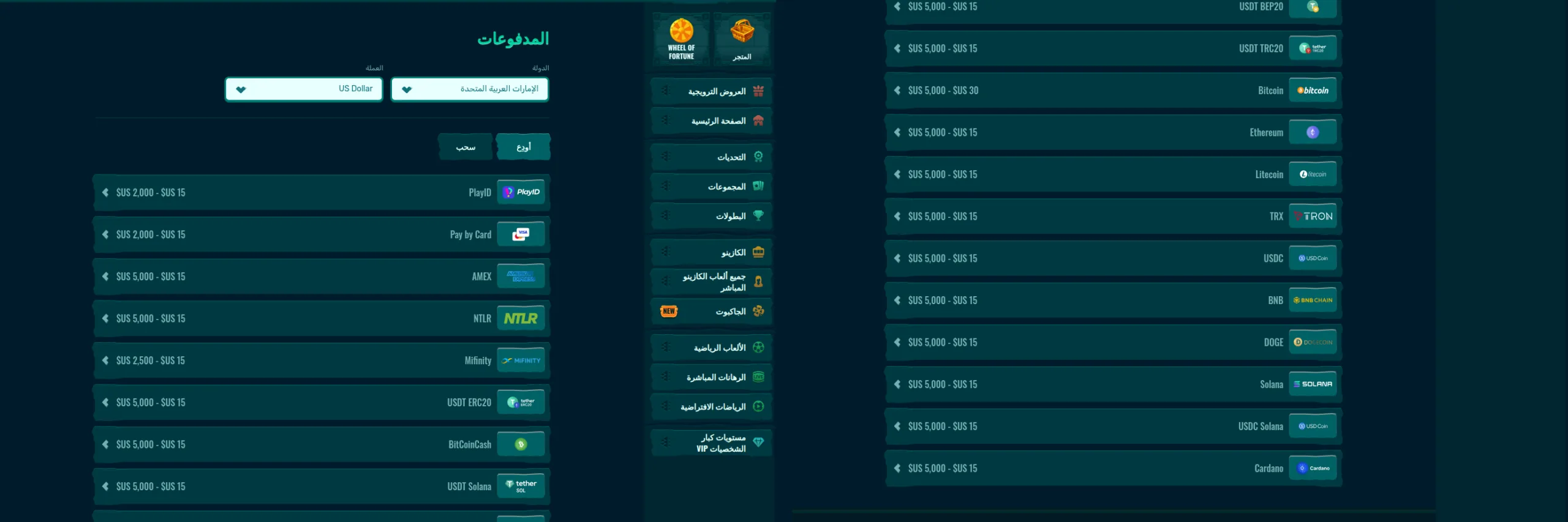
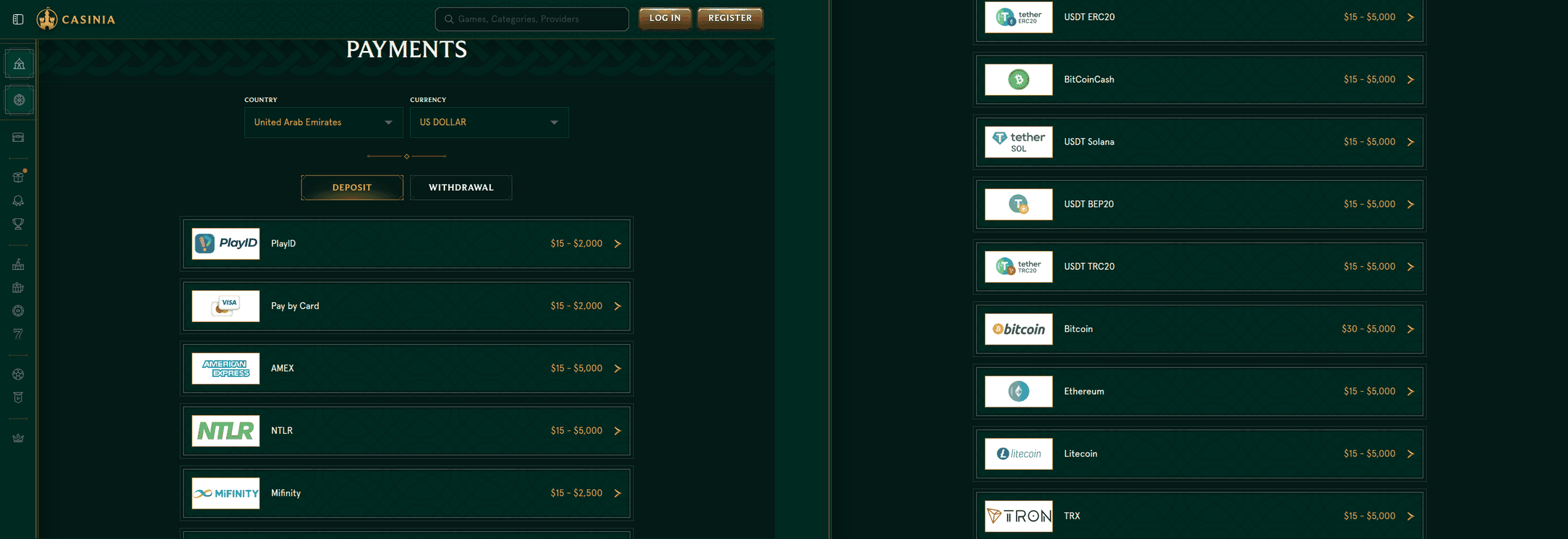
| Casinia | 15 of 20 methods | Yes, when the page loads | Tether on four separate networks. See the section below. |
| Spinrollz | 15 of 19 methods | Yes, when the page loads | Tether on four chains, USD Coin on two. |
| Nomini / StoneVegas | Yes | Yes, when the page loads | Bitcoin from $30, everything else from $15. |
| 10Bet | 4 coins | No | LTC, USDT, ETH, BTC. Cashier behind registration. |
| Megapari | 4 coins | No | An Emirati visitor is assigned Tether as the base account currency. |
| Betfinal | Yes, plus Binance Pay | No | Terms warn in writing that the wrong network loses the funds. |
| Horus Casino | 13 lines | Yes, with per-coin caps | The best disclosure in this market — and nine of eleven requests from Dubai were blocked. |
| RollingSlots | A badge only | No | Its own AML section lists the methods it accepts and cryptocurrency is not among them, while the footer advertises a crypto mark. |
| EmirBet | None at all | — | Thirteen payment routes and not one crypto, which is unusual for a 2026 offshore brand. |
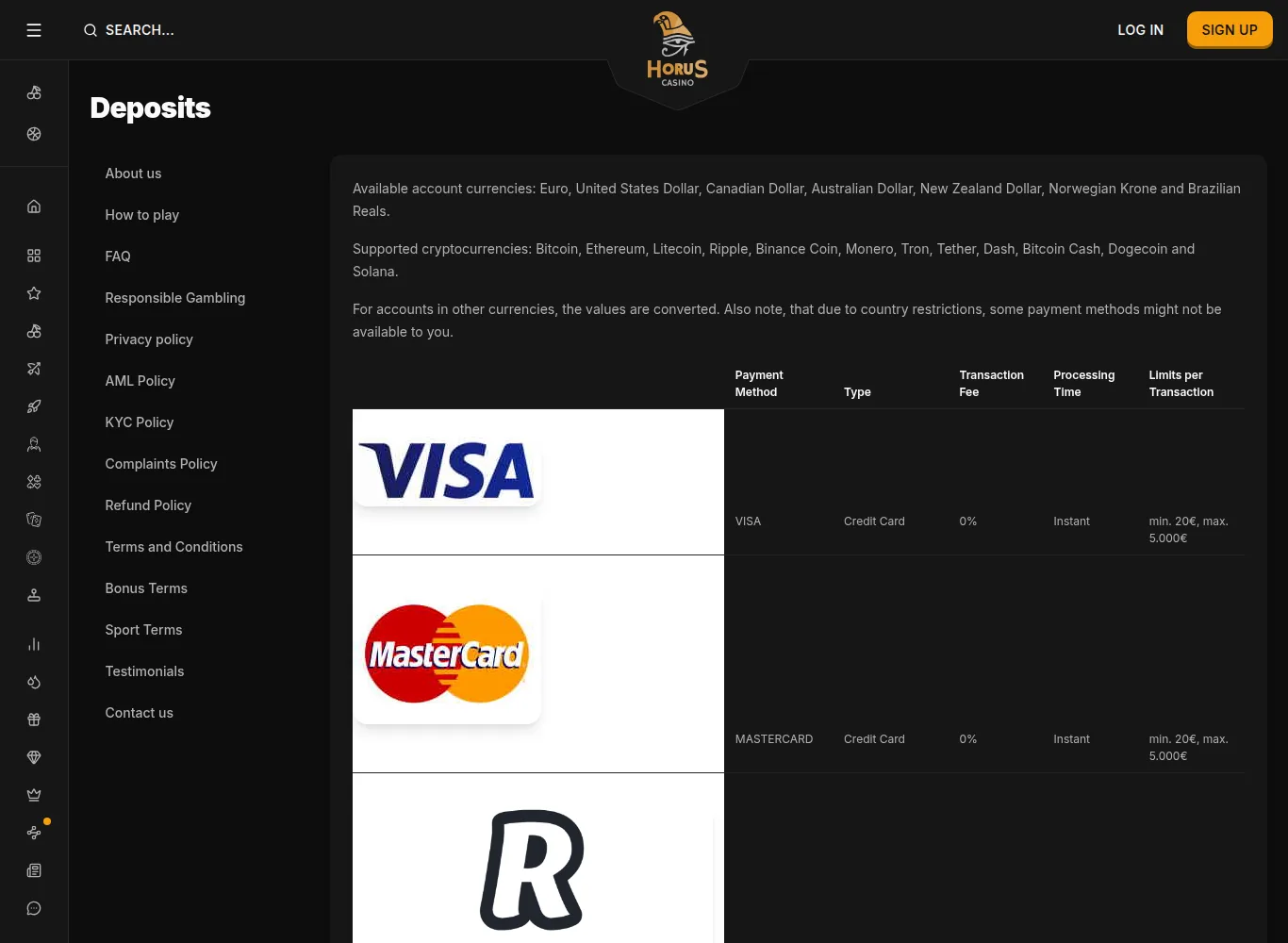
The Horus line in that table deserves its own note, because it is the best and the most useless disclosure in this comparison at the same time. Forty-six methods in one table before registration, with the fee, the processing time and the minimum and maximum for every one, thirteen of them crypto with per-coin caps almost nobody else prints — and nine of eleven requests from Dubai were blocked. The best payments page here belongs to a site most readers cannot reach.
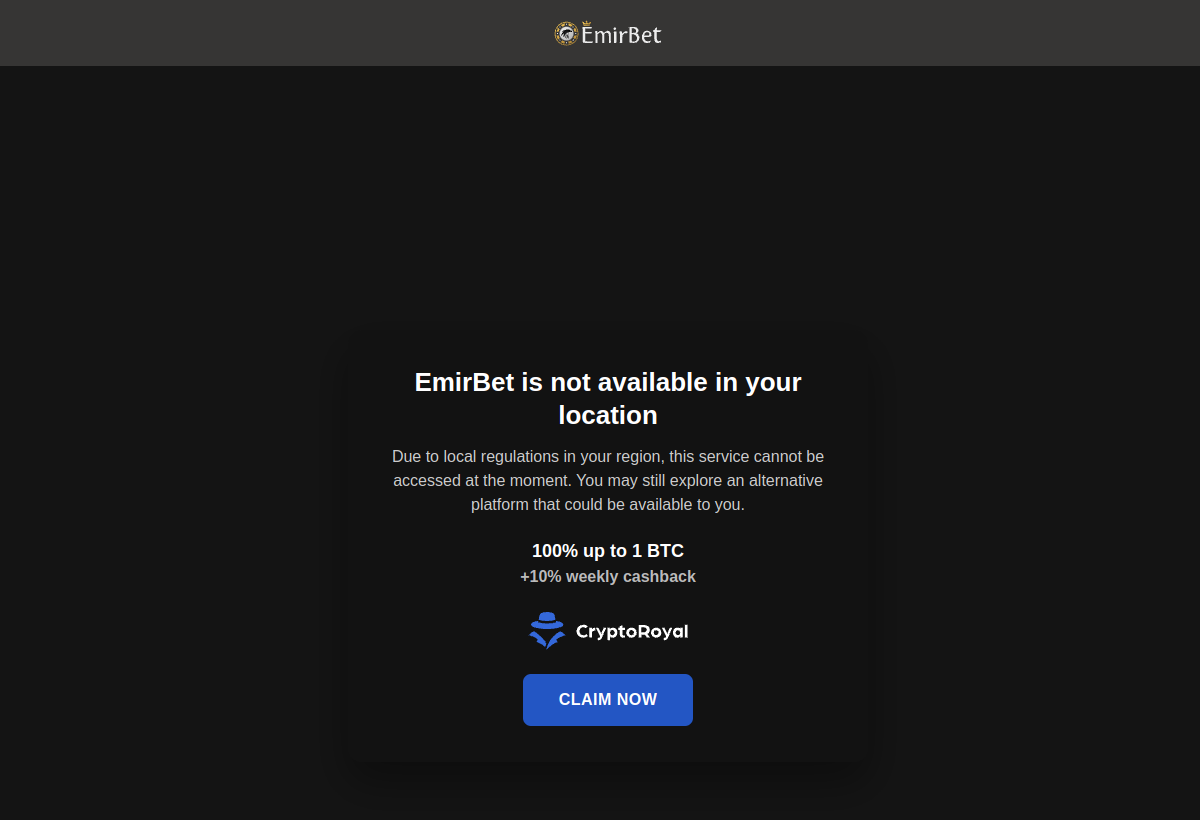
The EmirBet line is worth a sentence because it runs against the assumption this page is built on. A brand aimed at this region, with thirteen payment routes, carries no cryptocurrency whatsoever — leaving an Emirati player with cards and wallets in the one market where cards are routinely declined.
What a Cashier Publishes Today It May Not Publish Tomorrow
This section exists because of something we found while writing this page, and it changes how the rest of it should be read.
In August and September we recorded the published cashiers of Casinia, Spinrollz, Nomini, StoneVegas, Rabona and Legiano: full method lists with exact minimums and maximums per route, Tether on four networks, limits in dollars. On 9 October 2026 we opened the same six public pages from an Emirati connection, with the country selector reading United Arab Emirates and the currency US Dollar, and all six returned the same thing: “No payments found.”
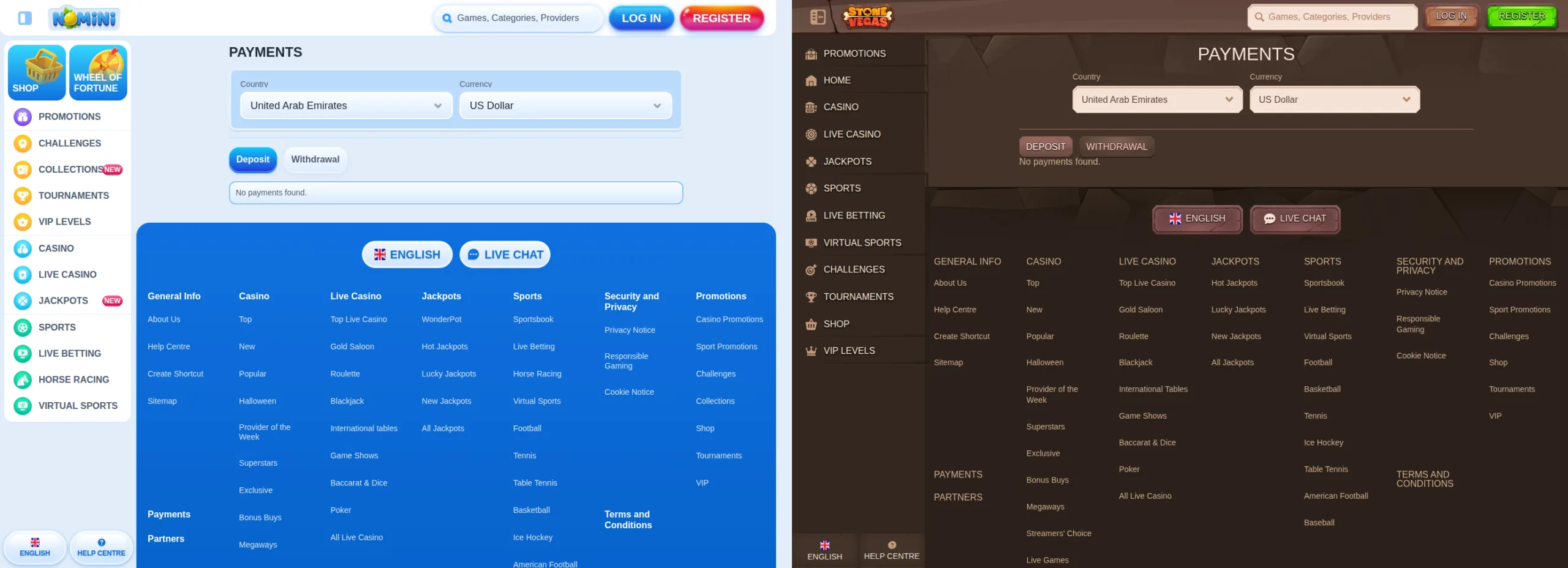
And here is the part that keeps us honest. The obvious conclusion was that the platform had pulled payment support for the Emirates, which would have been a significant finding. So we tested it: we opened the same Casinia page from Portugal and the same Nomini page from Germany. Both returned “No payments found.” as well, with the country selector reading Portugal and Albania respectively.
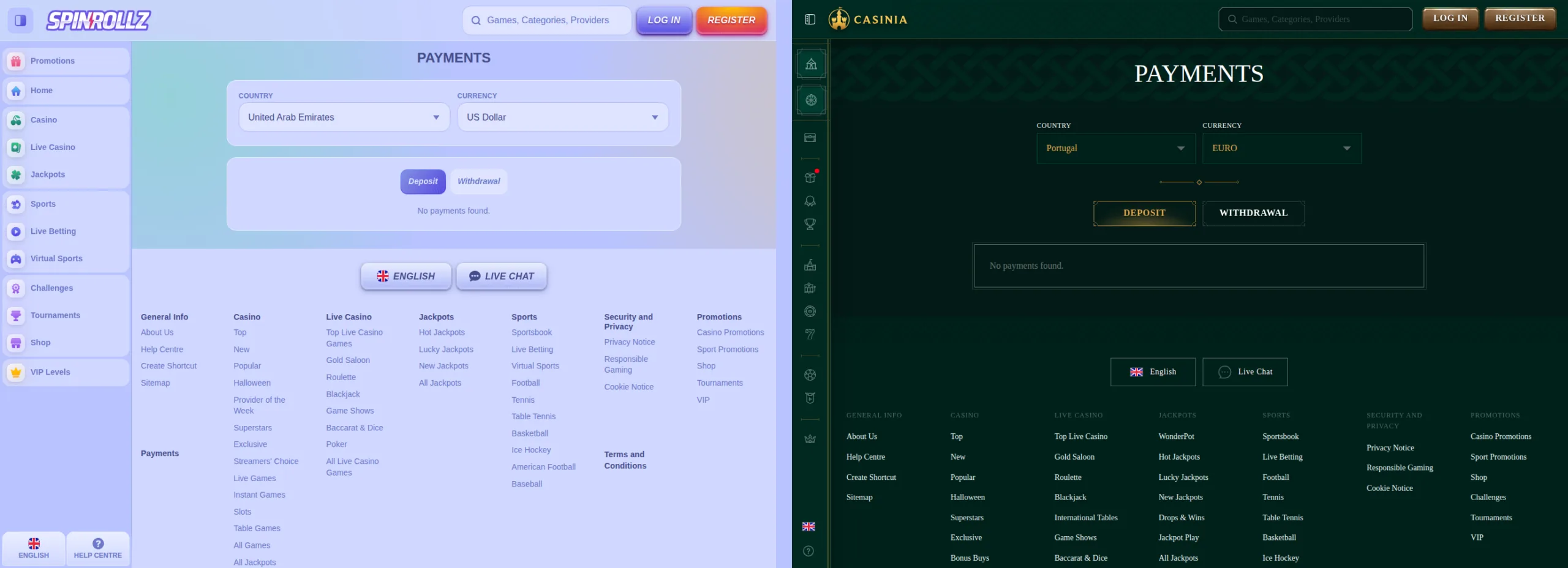
So it is not a UAE restriction. It is a fault or a change on the platform that serves all six brands, affecting every country we tested. We are telling you what we saw and not what it means, because we do not know what it means.
What it does mean for you is this: published disclosure is a state, not an attribute. Six brands that printed exact limits six weeks ago print nothing today, and a reader arriving now has no way to know they ever did. Any number you read in a comparison table — ours included — is a reading from a date, and the cashier in front of you is the one that governs. Our parent page on casino payment methods quotes those limits as of 8 October; they were accurate when read and they are not visible today.
“Accepts Crypto” Is Not “Licensed in the UAE”
These two things get run together constantly, including by sites that should know better, and they are not related at all.
| What it tells you | What it does not tell you | |
|---|---|---|
| Accepts cryptocurrency | That the operator has integrated a crypto payment processor and will credit your account when a transfer confirms. | Anything about who regulates it, where it is incorporated, or whether you have recourse. |
| Holds a UAE licence | That a domestic regulator has authorised it to offer gaming in this country. | Nothing about payment methods at all. |
The position in October 2026, stated plainly: the UAE now has a federal gambling regulator, the General Commercial Gaming Regulatory Authority, and a domestically licensed operator exists. None of the offshore brands on this page holds a UAE licence. They are licensed in Curaçao or Anjouan, and in one case we found no licence number and no verifiable licensing body during our review.
A crypto payment rail does not change that in either direction. It is a payments integration, not a regulatory status, and adding it is a commercial decision an operator takes in an afternoon. A site that takes twenty coins is exactly as licensed as it was before it took any.
Why it matters practically rather than as a point of pedantry: the licence is the thing that gives you somewhere to go when a withdrawal is refused, and crypto removes the one other route you might have had. There is no chargeback on a blockchain transfer and no issuer to dispute it with. Melbet, Stake, 10Bet and Roobet publish Curaçao numbers that resolve in the register, and the Curaçao Gaming Authority now accepts player complaints directly. At brands that publish no licence and name no company, there is no next step. Check the number before the first deposit, in the way we set out here, rather than after the first problem.
Crypto Against Cards, from Here
The honest comparison, with the numbers from this page and from the parent page side by side.
| Cryptocurrency | Visa / Mastercard | |
|---|---|---|
| Will it go through? | In our testing, consistently. | In our testing, the most frequently declined — the refusal happens at your bank, not at the casino. |
| Cost per movement | Under a cent to $2.15 depending on the network. | No casino fee as a rule, and a 2–4% conversion spread on a round trip, charged by your issuer and invisible in the operator’s figures. |
| Speed | Seconds to 25 minutes on-chain, plus the operator’s queue. | Instant to deposit; withdrawals often do not return to the card at all. |
| If it goes wrong | Nothing. No reversal, no chargeback. | A chargeback exists in principle, is difficult against a gambling merchant, and can close your bank account. |
| What you are exposed to | Exchange rate, your own custody, the wrong network. | Your bank’s policy, and the spread. |
Set the two cost rows against each other and the picture is clearer than either side usually admits. On a $200 round trip, a card conversion at 3% costs about $6. The same round trip on Ethereum today costs four cents, on Tron $4.31, on Solana a tenth of a cent. Crypto is cheaper on the fee and more expensive on the mistake, and the mistake is the one with no recovery.
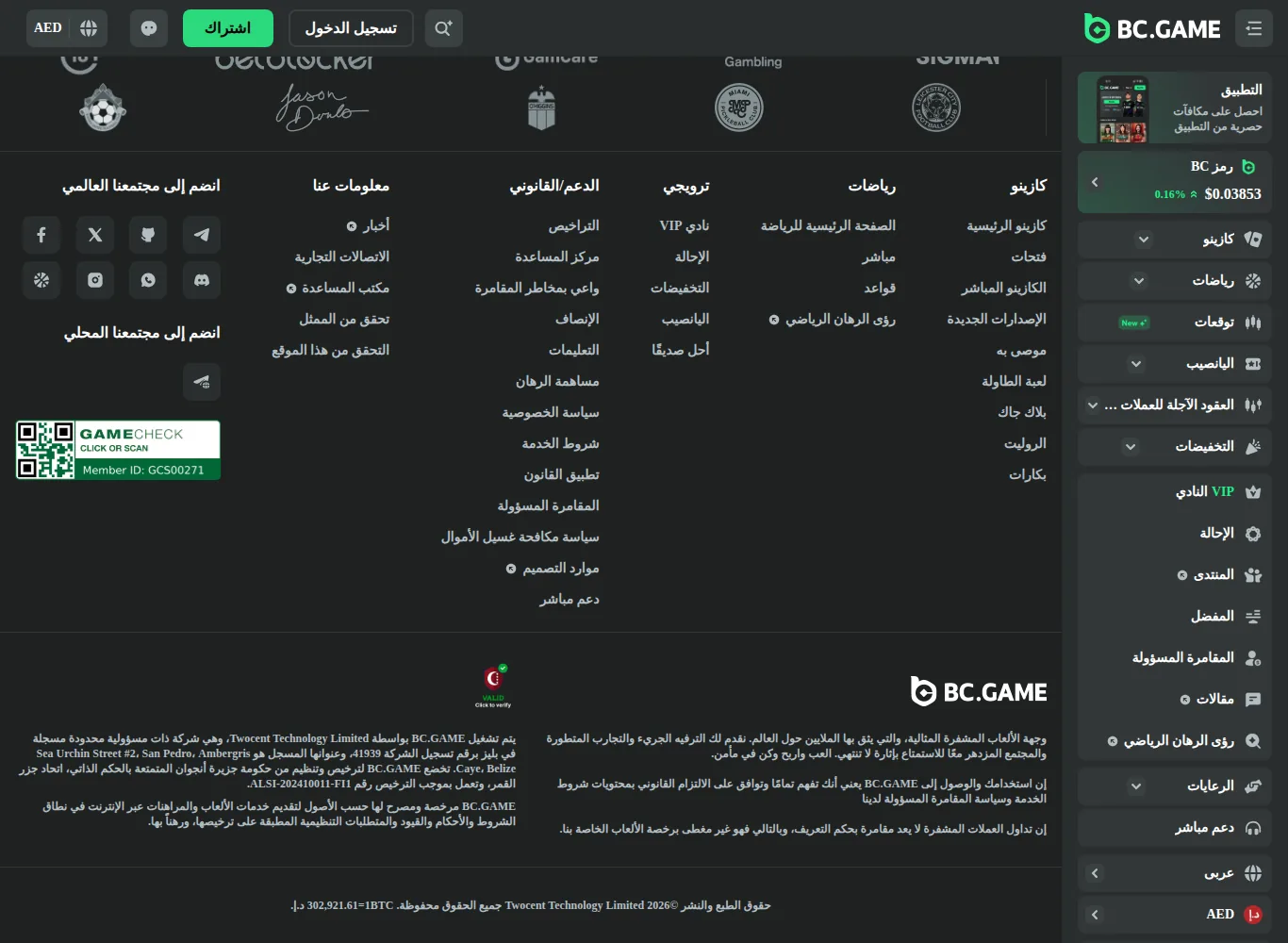
There is one route that avoids both, and it is rare: 888 Casino and BC.GAME hold balances in dirhams, which removes the conversion without requiring crypto. For a reader banking in AED that is worth more than most welcome bonuses, and it is covered on the parent payments page.
How We Test Crypto Payments
| Step | What we do | What it catches |
|---|---|---|
| Read the chains directly | Query each network for its current fee and the timestamps of its last 20 blocks, and price the result against the live coin price. | The gap between what guides repeat and what the networks charge today — such as TRC20 costing a hundred times ERC20. |
| Open the cashier from the UAE | Load the payments page from a connection inside the Emirates, without a VPN, and read the coins and networks offered. | Which coins are actually available here, and on which chains. |
| Control against another country | Open the same page from a second country when something looks country-specific. | The difference between “restricted in the UAE” and “broken everywhere” — which is exactly what it caught this time. |
| Read the withdrawal terms | AML playthrough, operator fees, limits, and the wrong-network clause. | The 1%, the 10–15%, and Betfinal’s written warning that a wrong network loses the funds. |
| Separate the licence from the rail | Check the licence number in the issuing register, independently of what the cashier accepts. | Brands that take twenty coins and publish no verifiable licensing body. |
What we do not do: publish a figure we have not measured. Every number in the fee and timing tables was read from the network itself at 9 October 2026, 08:05 UTC, and the method is written out above so you can redo it rather than trust it. Where a casino publishes no processing time, we say so instead of estimating one.
Network fees and confirmation times move, and these were measured on the date stated. If a figure here no longer matches what you are quoted at the cashier, tell us — corrections are published on the page itself, with the new date.
And a standing caveat on this page in particular. Network fees move by the hour, and the Ethereum figure especially is a snapshot of an unusually cheap morning. Treat the table as a worked example of the method and the 13-gwei threshold as the part that keeps working. Our full process is in how we test and rate casinos. Last measured: 9 October 2026.
Choosing: a Short Decision Guide
| If you… | Use | Why |
|---|---|---|
| have never used cryptocurrency | Roobet, or skip crypto entirely | Roobet sells the coin inside the cashier, which removes the exchange step that is the real barrier here. |
| are moving small amounts | A layer two or Solana, else Litecoin | Under half a cent and seconds, against $2.15 on Tron. |
| are carrying USDT and gas is low | ERC20 | Below about 13 gwei it is cheaper than Tron. Check before you send. |
| are carrying USDT and gas is high | TRC20 | Above that threshold the fixed Tron cost wins. This is where the usual advice is right. |
| hold a Binance account | Binance Pay, at Betfinal or Horus | No network fee and no address to mistype. |
| intend to leave a balance sitting | A stablecoin | A volatile balance moves more in a week than every fee on this page. |
| want the conversion gone without crypto | 888 Casino or BC.GAME | The only two that hold a dirham balance. |
| want recourse if it goes wrong | Check the licence first | Crypto removes the chargeback. The licence is the only route left. |
And the sentence this page comes down to: cryptocurrency is the rail most likely to work from the Emirates, and the one that punishes a mistake hardest. Those are both true at once, and a guide that gives you only the first half is selling you something. Decide the network before the amount, send a test transfer the first time, hold stablecoins rather than coins, and check the licence before any of it.
Set your deposit limits when you set up the payment method, not afterwards — our responsible gambling guide explains how, and what help is reachable from this region. Adults only. Check the laws and the legal age that apply where you live.
Frequently Asked Questions
No, and it is worth separating two different things. It is the method that works most consistently from the Emirates, because it does not pass through a UAE bank and no card issuer can decline it. That is availability, not safety. It carries risks a card does not: transfers are irreversible, a mistyped address cannot be recovered, sending on the wrong network loses the funds, and custody of the wallet is yours alone. Betfinal’s own terms state that a wrong network on a withdrawal loses the money with no recovery offered.
Measured on 9 October 2026: Solana at about $0.0006, Base at $0.001, Polygon and BNB Chain at around $0.002, and Arbitrum at $0.003. Of the networks most cashiers actually support, Ethereum ERC20 cost $0.02 and Tron TRC20 cost $2.15 — the reverse of the usual advice, because Ethereum gas was unusually low that morning. The rule that survives the volatility: below roughly 13 gwei, ERC20 beats TRC20; above it, TRC20 wins.
Because Tron prices energy at a fixed 100 sun per unit, and a token transfer burns about 65,000 units — roughly 6.5 TRX, which was $2.15 when we measured. That price does not spike, but it also does not fall. Ethereum charges a market gas price that has ranged from under 1 gwei to over 100; at 0.136 gwei an ERC20 transfer was two cents. The “use Tron, it is cheap” advice comes from periods when Ethereum gas was high, and it is correct again whenever gas goes back above about 13 gwei.
The on-chain part is block time multiplied by the confirmations the casino requires. From our measurements: Solana and Arbitrum under 10 seconds, BNB Chain about 7 seconds, Ethereum about 2 minutes, Polygon about 3 minutes despite fast blocks because it commonly needs 128 confirmations, Litecoin about 11 minutes, and Bitcoin about 25 minutes. Withdrawals add the operator’s own queue on top, which is usually the slower part — Spinrollz publishes three business days inside an 06:00–17:00 GMT weekday window, and most brands publish nothing at all.
In most cases the funds are lost and there is no procedure to recover them. Betfinal states this explicitly in its terms, with no recovery offered. Some operators can recover funds on an EVM-compatible chain if the address format matches, at their discretion and usually for a fee, but most cannot and will not. The prevention costs nothing: confirm the network in the cashier before you confirm the amount, and send a small test transfer the first time you use any new address. The address format being identical across networks is exactly why this mistake is common.
A stablecoin, unless you have a reason not to. A balance in Bitcoin or another volatile coin moves while you are not playing: a 5% week on $200 is $10, which is forty times the round-trip network fee and more than any operator charge in this comparison. USDT and USDC are pegged to the dollar and carried by every crypto cashier here, which reduces that exposure to near zero. Use a volatile coin to move money if that is what you hold; do not use one to park it.
No, and the two are unrelated. Accepting cryptocurrency is a payments integration an operator can add in an afternoon; a UAE licence is a regulatory status granted by the General Commercial Gaming Regulatory Authority. None of the offshore brands on this page holds one — they are licensed in Curaçao or Anjouan, and in one case we found no verifiable licensing body at all. This matters practically because crypto removes the chargeback, so the licence becomes the only recourse you have if a withdrawal is refused.
Yes. Every operator on this site requires identity and address documents before a first withdrawal, regardless of how you funded the account. Crypto removes your bank from the transaction; it does not remove your name from the account, and a public blockchain is a permanent public record of the transfer rather than a private one. Verify on the day you register rather than the day you want the money — Nomini and StoneVegas allow 30 days to supply documents, after which the terms permit closing the account.