






















The Short Answer for the UAE
Funding a casino account from the Emirates is harder than almost anywhere else, and the reason is not the casinos. UAE banks decline card payments to gambling merchants, which removes the method most people would reach for first and pushes the whole market onto rails that exist to work around it.
What we found opening cashiers from an Emirati connection, across every brand on this site:
| Method | Works from the UAE? | Deposit | Withdrawal | The catch |
|---|---|---|---|---|
| Cryptocurrency | The most consistently available | Yes, everywhere except EmirBet | Yes | Network fees, irreversible transfers, and one brand warns that the wrong network loses the funds |
| Visa / Mastercard | Often declined by the issuer | Listed almost everywhere | Sometimes — and not always back to the card | The decline happens at your bank, not at the casino |
| Skrill | Yes, at several | Often not | Yes | At BassBet, Legiano, Nomini and StoneVegas it pays out but cannot fund |
| Neteller | Yes, at several | Yes | Often not | Voids the welcome bonus at six brands we checked |
| Apple Pay | Rare — 10Bet, BDMBet | Yes | No | The fastest route from an Emirates phone that does not touch crypto |
| Bank transfer | Very limited | Rarely | Sometimes | No brand on this site publishes a UAE bank as a route; Melbet names five Emirati banks on its strip |
| AED balance | Almost nowhere | — | — | 888 Casino and BC.GAME only. Everywhere else you hold dollars or euros |
If you read nothing else: crypto is what works, cards are what fail, and the dirham barely exists. The rest of this page is the detail behind each of those three sentences, measured rather than assumed.
What Actually Appeared in the Cashier, Brand by Brand
The rule we apply, and the one the industry does not: we do not write that a casino accepts Visa. We write that Visa appeared in the cashier when we opened it from the Emirates — and where the cashier sits behind registration, we say that instead of repeating the operator’s marketing.
| Brand | What the cashier showed | Crypto | AED balance | Published limits and fees |
|---|---|---|---|---|
| Horus Casino | 46 methods in one table, with type, fee, processing time and per-transaction limits — before registration | 13 lines | No | Yes, all of it. Every method at a stated 0% fee |
| Stake | Crypto-native cashier | 22 coins across six networks | No | No maximum withdrawal, stated plainly |
| Roobet | Crypto plus a full fiat layer, with a Buy Crypto tab built in | 11 coins | No | Cards $10–$5,000, instant credit, up to 1 hour. No operator fee on crypto |
| BC.GAME | Crypto-first with a fiat layer | 251 assets | Yes — among 151 national currencies | 1% withdrawal fee. No minimum, maximum, ceiling or processing time published |
| 888 Casino | Cards and wallets, processed through SafeCharge (Nuvei) | One option | Yes — play, platform and payout ceiling all in AED | Withdrawal policy published, in Arabic, at /withdrawal-policy |
| 10Bet | Behind registration. Footer: MuchBetter, Apple Pay, Mastercard, Visa, LTC, USDT, ETH, BTC | 4 coins | No | €20,000 monthly ceiling, €5 on a second card withdrawal, €5/month dormancy after six months |
| Casinia | 20 deposit methods, 15 of them crypto | 15 lines | No | Cards and PlayID $15–$2,000; AMEX and crypto $15–$5,000; Bitcoin from $30. No processing time published |
| Spinrollz | 19 methods, 15 crypto. Per-country table without an account | 15 lines | No | $500/day and $7,000/month at level one, to $1,500/$20,000 at level five. Processing 06:00–17:00 GMT, Mon–Fri |
| Nomini / StoneVegas | Exact Emirati floor and ceiling per method | Yes, Bitcoin from $30 | No | Deposits from $15. Deposit list ≠ withdrawal list |
| Rabona | Full cashier before registration, with country and currency selector | Yes | No | Offers quoted in euros, cashier serves the UAE in dollars |
| Megapari | Visa, Mastercard, Google Pay, Skrill, Neteller, Jeton, Uzcard, a cash-agent network | 4 coins | In the system, given to nobody | Minimum withdrawal €10, 10,000/day, manual review above |
| EmirBet | 13 routes: cards, Skrill, Neteller, ecoPayz, MiFinity, paysafecard, Klarna, QIWI… | None at all | No | Nothing published outside an account |
| Betfinal | Six routes: Visa, Mastercard, Skrill, MuchBetter, crypto, Binance Pay | Yes | No | Nothing published anywhere. Wrong network on a crypto withdrawal = funds lost |
| RollingSlots | A row of logos in the footer and no payments page | Badge only | No | Nothing — no minimum, maximum or processing time for any method |
| Wazamba | — | Crypto bonus offered | No | Minimum withdrawal €10, maximum €20,000/month. 25 currencies, none from the Gulf |
Debit and Credit Cards
The method most readers will try first, and the one most likely to fail. This is worth understanding properly because the failure is not where people assume.
Why the payment is declined
The decline happens at your bank, not at the casino. Gambling merchants carry a specific merchant category code, and UAE issuers routinely block transactions to it. The casino never sees the money and often cannot tell you why; from its side the authorisation simply came back negative.
What follows from that: switching casinos rarely helps, switching cards within the same bank rarely helps, and no amount of support tickets at the operator will change it. It is a policy at your bank, applied to a merchant category.
There is a second layer underneath, and it explains why the pattern is inconsistent. A casino does not usually hold its own merchant account — it uses a processor, and the processor presents the transaction under whatever category its own arrangement carries. That is why the same card can fail at one brand and work at another on the same afternoon: you are not testing the casino, you are testing its processor. 888 runs through SafeCharge, part of Nuvei; Stake through Medium Rare Limited in Nicosia; BDMBet through Interdersoft of Limassol. Different entity, different banking relationship, different outcome at your issuer.
It also explains why a card that works today can stop without anything changing on your side. Processors get re-categorised, acquiring banks change policy, and the operator is often the last to know. If you are going to rely on a card, expect to need a fallback, and set it up before you need it rather than in the middle of a deposit.
When cards do work
They sometimes go through on smaller or newer brands whose processors have not been categorised yet, and then stop working without warning when they are. We have seen deposits succeed on brands that were declined a month later. Treat a working card as a convenience that may disappear, not as the route you build an account around.
What the cashiers actually show
Visa and Mastercard appear on almost every strip we read: Roobet ($10–$5,000 per transaction, instant credit, up to an hour for full processing), Casinia ($15–$2,000), 10Bet, 888, BetoStar (formerly BetOBet), Megapari, EmirBet, BDMBet and Betfinal. Nomini and StoneVegas print the exact Emirati floor and ceiling for cards.
The withdrawal side is not symmetrical
Several operators take card deposits and will not pay back to a card. 10Bet routes withdrawals back to the deposit method, in the account holder’s own name, and charges €5 on a second card withdrawal in a month. At Nomini and StoneVegas, cards fund the account and the money leaves by a different rail entirely.
Bank Transfer
The shortest section on this page, because there is almost nothing to report.
No brand on this site publishes a UAE bank as a deposit route. Bank transfer appears on several strips — BoaBoa, BDMBet by IBAN, Nomini and StoneVegas as a withdrawal rail — but the banks behind it are European. RollingSlots prominently features Zimpler, a Nordic pay-by-bank service with no presence in the Gulf, which says more about who that cashier was assembled for than any language setting does.
The exception worth naming: Melbet publishes five Emirati banks on its payments strip. That is the only genuinely local banking route we found across the whole comparison, and it comes with the caveat that Melbet publishes no withdrawal fee schedule and no processing times — we have not run a withdrawal through it, and we are not going to invent numbers for one.
Expect scrutiny either way. A transfer to or from an offshore gambling merchant is visible on your statement, which for some readers is the deciding factor regardless of whether it works.
Where bank transfer does appear as a withdrawal rail — Nomini, StoneVegas, BoaBoa, BDMBet by IBAN — the practical problem is the one this page keeps returning to: it pays out and cannot fund. So it is not an alternative to a card for getting money in; it is only an exit. And as an exit it is the slowest on offer: Need For Slots, the one brand that publishes times for it, quotes one to five business days against instant-to-a-few-hours for everything else.
There is also a reason to think twice that has nothing to do with the casino. A wire to an offshore entity carries the merchant name on your statement, may trigger a compliance question from your own bank, and is the least private method on this page. For a reader whose main concern is discretion rather than speed, bank transfer is the worst available choice — an odd thing to say about the most conventional method in the list, and specific to this market.
E-wallets
The middle ground, and the category with the most traps. Two of them are specific enough to this market that they deserve their own warnings.
Skrill
Widely accepted and, at four brands we checked, a withdrawal rail that cannot fund the account: at BassBet, Legiano, Nomini and StoneVegas, Skrill pays out and does not take money in. At Casinia it is not a deposit option at all while remaining a withdrawal option. Plan the direction before you plan the method.
Neteller, and the bonus trap
The mirror image: Neteller funds the account and frequently cannot pay it out. Worse, it is the single most common way to lose a welcome bonus in this market. Depositing with Neteller or Skrill voids the welcome offer at BassBet, Spinanga, Spinrollz, Casinia, Cadoola and BoaBoa — and at several of those, Neteller is one of only four or five non-crypto routes on offer in the first place.
The detail that makes this unfair rather than merely strict: at BassBet, nothing on the cashier screen warns you at the moment you pick it. The exclusion lives in clause 8 of the bonus terms, on a different page.
MuchBetter, AstroPay, MiFinity, Jeton
The second tier, and more useful here than their profile suggests. MuchBetter appears at 10Bet, 888, BetoStar and Betfinal. AstroPay at Roobet, 10Bet, BetoStar and BoaBoa. MiFinity at Nomini, StoneVegas, Spinrollz, EmirBet and BoaBoa. Jeton at BetoStar, Megapari and BDMBet.
None of these is issued in the Gulf, so each adds its own conversion layer. They are worth knowing because when cards fail and you do not want crypto, this is what is left.
Worth understanding how a wallet changes the picture, because it is not obvious. The wallet becomes the merchant your bank sees: you fund Skrill or MuchBetter from your card, and your issuer records a transaction to a payment company rather than to a gambling site. That is why wallets sometimes work when a direct card deposit does not — the merchant category code at the moment of the charge is different.
What it costs is a second set of fees and a second conversion. The wallet charges to load, may charge to send, and converts AED into its own holding currency on the way in and out again on the way back. On a round trip through a wallet you can cross three conversion points instead of two. For a one-off deposit that is noise; for a player moving money weekly it compounds into more than most of the fees in the table above.
One more practical note: the wallet must be in your own name and usually must match the casino account. Operators that route withdrawals back to the deposit method in the account holder’s name — 10Bet and Megapari say so explicitly — will refuse a payout to a wallet registered to somebody else, and that is a verification failure discovered at the worst possible moment.
The wallets that are not for this market
Several cashiers carry rails that no Emirates player can use: Klarna and Zimpler (Nordic), Interac (Canadian — and it appears at both 10Bet and BetoStar, two unrelated brands showing a UAE visitor a payment method from the wrong hemisphere), Blik and GiroPay (Polish and German), QIWI and Uzcard. A long payment strip is not the same as a long list of things you can use.
Apple Pay
Rare at this end of the market and genuinely useful where it exists, which makes it worth a section of its own.
10Bet carries Apple Pay on its footer strip, served to an Emirati connection, alongside MuchBetter, Mastercard, Visa and four cryptocurrencies. BDMBet lists Apple Pay and Google Pay in its cashier. Need For Slots shows Apple Pay and Google Pay in the footer strip, and this is where it gets strange: the brand maintains two payment lists that contradict each other — the marketing text at the bottom of the home page promises e-wallets the cashier page does not offer, and the cashier page offers two wallets the marketing text never mentions.
Why it matters here specifically: Apple Pay is the fastest route from an Emirates phone to a funded account without touching cryptocurrency. It inherits your card relationship, so it is not immune to the bank-level blocking described above — but where it works, nothing else is as quick.
The reason it is rare has nothing to do with the operators wanting it. Apple applies its own rules to what may be funded through Apple Pay, and gambling merchants sit awkwardly against them in markets without a domestic licence. An operator cannot simply decide to add it — the processor has to support it and the category has to be accepted. That two brands out of twenty-five manage it says more about the difficulty than about the others’ effort.
If it appears in your cashier, two things are worth knowing. The transaction still runs on your card underneath, so the bank-level block applies exactly as it would to the card itself — Apple Pay is a faster way to present the same card, not a way around the refusal. And it is a deposit rail only: no operator on this page pays a withdrawal back to Apple Pay, so you will still need a second method to get money out, and that method should be chosen before the first deposit rather than after the first win.
Cryptocurrency
This section covers what each cashier carries. For what a transfer actually costs and how long it takes — nine networks measured on-chain, and the gas price at which the usual advice flips — see crypto casino payments in the UAE. The largest section on this page, because it is the method that actually works here and because the search data agrees: in this market the volume sits on crypto casino, not on payment methods generally. When the banking system blocks the front door, the market moves to a different door.
What the cashiers carry
| Brand | Coins | Notable |
|---|---|---|
| BC.GAME | 251 assets | Plus 151 national currencies including the dirham |
| Stake | 22 coins | BTC, ETH, LTC, DOGE, BCH, XRP, EOS, USDT, TRX, BNB, USDC, APE, BUSD (withdrawals only), CRO, DAI, LINK, SAND, SHIB, UNI, POL, SOL, TRUMP |
| Casinia | 15 of 20 methods | Tether on four separate networks |
| Spinrollz | 15 of 19 methods | Tether on four chains, USD Coin on two |
| Roobet | 11 coins | Including Ethereum on Base and Arbitrum, plus SUI |
| Horus Casino | 13 lines | Bitcoin Cash capped €20–€10,000, Binance Pay €20–€5,000 |
| PlayFina | 11 as balance currencies | The coins are the account currency, not just a rail |
| 10Bet | 4 | LTC, USDT, ETH, BTC |
| Megapari | 4 | BTC, ETH, USDT, TRX — and an Emirati visitor is assigned Tether as base currency |
| EmirBet | None | Unusual for a 2026 offshore brand |
Networks, and the warning that matters most
A coin is not one thing. Tether runs on ERC20, TRC20, BEP20 and Polygon; the same USDT sent on the wrong one does not arrive. Stake documents its networks explicitly — stablecoins on ERC20, BEP20 and Polygon, TRX on TRC20, Solana and Bitcoin on their native chains.
Betfinal’s terms carry the warning in writing: pick the wrong network on a withdrawal and the funds are lost, with no recovery offered. That is the single most expensive mistake available on this page, it is entirely avoidable, and it takes five seconds: confirm the network in the cashier before you confirm the amount.
Fees
Roobet charges no operator fee on crypto withdrawals — you pay only the blockchain network fee, and it is displayed at the bottom of the cashier before you confirm. On a cheap network that is a fraction of a cent; on Ethereum mainnet at a busy hour it is not. Which network is cheapest moves with the hour, and the usual answer is not always right — we read all nine and published the numbers. Read the quoted fee against the amount you are moving.
BC.GAME charges 1% on withdrawals, waived for VIP members, and is explicit about why: converting digital currency costs money at both ends. It is the only percentage fee we found, and it is worse than a flat fee precisely because it scales.
If you do not already hold crypto
The usual objection to crypto casinos in the Gulf is the exchange step: you have to buy the coin somewhere else first. Roobet removes it with a Buy Crypto tab inside the cashier, which is the single most practical piece of design we found in this comparison for a reader who has never used cryptocurrency.
Why the crypto bonus is six times the fiat one
Not generosity. Card processing for gambling merchants is expensive where it works and frequently does not work here at all, while a crypto deposit costs the operator a fraction, carries no chargeback risk and settles immediately. Rabona, BassBet, Legiano and Spinanga all advertise around €500 on fiat and 3,000 USDT on crypto — six times the ceiling at the same rollover. Full detail in our guide to casino bonuses.
What crypto costs you that cards do not
Three things, and they are real. Exchange-rate exposure between deposit and withdrawal, which on a volatile coin can exceed any fee discussed on this page — stablecoins avoid it, which is why USDT dominates these cashiers. Irreversibility: a mistyped address or a wrong network is unrecoverable. And custody: the wallet is your responsibility, with no bank to call.
There is a fourth that nobody lists, and it is the one that bites people in this region: getting the coin in the first place. A crypto casino deposit is the last step of a chain that starts at an exchange, and that chain has its own verification, its own fees and its own bank relationship — the same bank relationship that declined your card. Buying crypto with an AED card can fail for exactly the reason a casino deposit fails, and then you have two problems instead of one.
This is precisely why Roobet’s in-cashier Buy Crypto tab matters more here than it would in Europe, and why Binance Pay at Betfinal and Horus is worth more than its profile suggests: both collapse the chain. If you already hold coin on an exchange, neither is necessary. If you do not, they are the difference between a ten-minute deposit and an afternoon.
And a note on holding: a casino balance denominated in a volatile coin moves while you sleep. Deposit 0.01 BTC, play nothing, withdraw a week later and the dollar value will have changed by more than most of the fees on this page. If you intend to leave a balance sitting, hold it in a stablecoin — which is the practical reason USDT appears on these cashiers more prominently than Bitcoin does.

Send a small test amount first, every time you use a new address or a new network. The network fee on a test transfer is under a cent on most networks and $2.15 on Tron. The cost of discovering the address was wrong with the full amount is the full amount, and no operator on this page offers recovery.
Which Coin to Use, and Why It Matters
A crypto cashier is not one method, it is ten or twenty. The coin you pick decides the fee, the speed and the exposure, and the differences are larger than between any two fiat methods on this page.
Tether (USDT) — the default, and usually the right one
The most widely carried coin in this comparison and the one most Gulf players should use. Casinia and Spinrollz both run Tether on four separate networks; it appears at Stake, Roobet, BC.GAME, 10Bet, Megapari, BDMBet, PlayFina and BassBet. Megapari goes further and assigns Tether as the base account currency to an Emirati visitor.
The reason it dominates is the one that matters: it is a stablecoin pegged to the dollar, so the exchange-rate exposure between deposit and withdrawal is close to zero. The network decides the fee, by a factor of a hundred or more — and not always in the direction the market repeats. Reading the chains directly on 9 October 2026, TRC20 cost $2.15 and ERC20 two cents; at a higher Ethereum gas price it reverses. We measured all nine networks ourselves. It is also the single most common place to send funds to the wrong chain.
USD Coin (USDC) — the same job, different issuer
A second dollar stablecoin, carried at Stake, Roobet, BC.GAME, Casinia and Spinrollz, with Spinrollz running it on two chains. Functionally interchangeable with Tether for this purpose. If your exchange holds one and not the other, use the one you hold rather than converting.
Bitcoin — accepted everywhere, worst for small amounts
On every crypto cashier here, and it carries two penalties for a casino player. The network fee is high relative to a small transfer, and several operators set a higher minimum for Bitcoin than for anything else — Casinia, Nomini and StoneVegas all start crypto deposits at $15 except Bitcoin, which starts at $30.
Horus Casino caps Bitcoin Cash at €20–€10,000 and Binance Pay at €20–€5,000, which is the kind of per-coin limit almost nobody else publishes.
Litecoin and Tron — the rails to check before you use
Both carried widely — Litecoin at Stake, Roobet, BC.GAME, 10Bet, Casinia and Spinrollz; Tron at the same set. Both are fast. Litecoin is reliably cheap — we measured $0.006. Tron is not: because it prices energy at a fixed rate, a TRC20 transfer came to $2.15 on 9 October 2026, the highest of the nine networks we read. Roobet’s own guidance recommends Tron or Litecoin for small withdrawals and tells you to check the quoted network fee against the amount you are moving — the second half of that advice is the part that matters, and our network-by-network measurements show why.
Ethereum — and the layer-two question
Universally accepted and expensive on mainnet at a busy hour. What is worth knowing is that Roobet accepts Ethereum on Base and Arbitrum as well as mainnet, which are layer-two networks with a fraction of the fee. Stake runs its stablecoins on ERC20, BEP20 and Polygon. If your cashier offers a layer two and your wallet supports it, the saving on a small transfer is most of the fee.
Solana, XRP, Dogecoin and BNB
The second tier, carried at the crypto-first brands: all four at Stake, Roobet, BC.GAME, Casinia, Spinrollz and PlayFina. Fast and cheap, and all four are volatile — which for a balance you intend to hold for an evening is a risk, and for one you move in and out of within minutes is not.
The long tail, and what it tells you
Stake carries 22 coins, including APE, CRO, DAI, LINK, SAND, SHIB, UNI, POL and TRUMP, with BUSD on withdrawals only. BC.GAME carries 251 assets. Beyond the top ten this is marketing rather than utility — nobody needs to deposit in SHIB — but it does tell you the cashier was built crypto-first rather than bolted on, which usually means the crypto side works properly.
Binance Pay, and the exchange-adjacent rails
Betfinal and Horus Casino both carry Binance Pay, which moves funds between Binance accounts without touching a public blockchain — no network fee and no address to mistype. If you already hold a Binance account it is the cheapest and safest crypto route on this page. If you do not, it is one more account to open.
The Cashier, Brand by Brand
What each one showed when we opened it from the Emirates, and what it would not show. Ordered by how much the operator is willing to publish.
Horus Casino — the best disclosure in this market
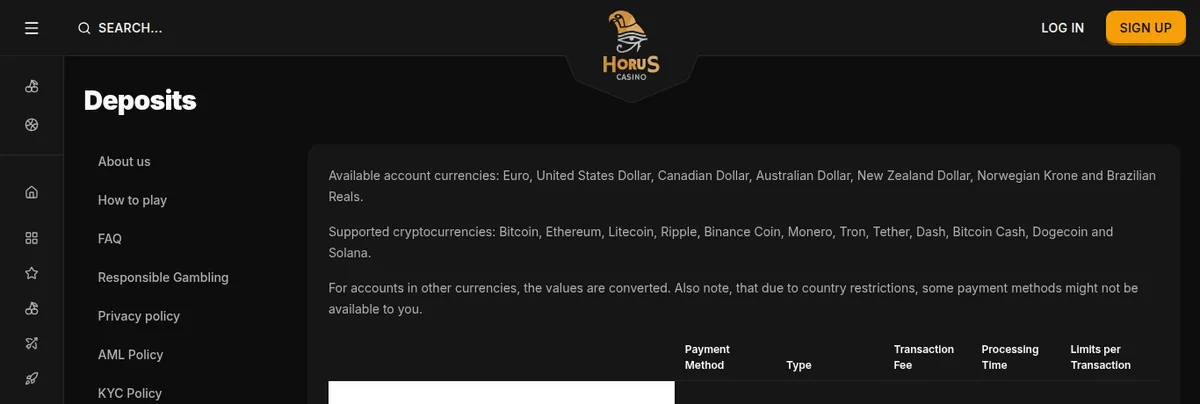
Forty-six methods in a single table, before registration, with type, fee, processing time and per-transaction minimum and maximum for every one. Every line states a 0% fee. We opened it from Dubai, Lisbon and Amsterdam and the table came back identical, which rules out the country-specific trimming most brands do quietly.
Thirteen crypto lines, including the per-coin caps almost nobody else prints. The qualification is severe and belongs here: nine of eleven requests from Dubai were blocked, so the best payments page in this comparison belongs to a site most readers cannot reach. There is also no dirham account and twelve Brazilian banks sit among the deposit routes, which says who the cashier was assembled for.
Stake — crypto-native, and the only “no maximum”
Twenty-two coins across six networks, documented by chain: stablecoins on ERC20, BEP20 and Polygon, TRX on TRC20, Solana and Bitcoin native. The help centre states plainly that there is no maximum withdrawal — you can withdraw as much as you hold, which no other brand here says.
Betting limits are published per category and differ between crypto balances, local-currency balances and third-party games, so the ceiling on a live table is not the ceiling on a house game. Payment processing runs through two wholly owned subsidiaries, Medium Rare Limited in Nicosia. No dirham.
Roobet — the fiat layer that actually works
Eleven coins including Ethereum on Base and Arbitrum, plus a full fiat side: Visa, Mastercard, bank transfer, AstroPay, Skrill and regional rails. Cards run $10 to $5,000 per transaction, credit instantly, with up to an hour quoted for full processing.
Two things set it apart. No operator fee on crypto withdrawals — only the network fee, displayed at the bottom of the cashier before you confirm. And a Buy Crypto tab built into the cashier, which removes the exchange step that keeps most Gulf players away from crypto casinos in the first place. The fee-free promise is a crypto promise: cash out to a card and read the number before confirming.
BC.GAME — the dirham, and a percentage fee
251 crypto assets and 151 national currencies, the UAE dirham among them, alongside the Saudi riyal, at a rate that tracked the real peg when we read it. For a reader banking in AED that removes both conversions, which is worth more than most bonuses on this site.
Against it: a 1% withdrawal fee, waived for VIP members, charged because converting digital currency costs money at both ends. And a silence that matters more because the fee is a percentage — no minimum or maximum withdrawal, no daily or monthly ceiling, no processing time. You know the rate and not what it applies to.
888 Casino — a regulated-style cashier
Processed through SafeCharge, part of Nuvei, with the methods displayed in the footer before registration: Visa, Mastercard, Skrill, Neteller, MuchBetter, CashtoCode, Voucherry and a cryptocurrency option. That is a card-and-wallet cashier of the kind a European-facing operator runs, and a genuinely different profile from the crypto-first sites around it.
And it holds dirhams. The bonus policy states play is offered in US dollars, euros and UAE dirham; the platform configuration lists AED; the withdrawal policy sets its payout ceiling in dirhams as well as dollars. What is quoted in dollars is calculated in dollars and converted to your account currency with the company’s margin on top of the mid-market rate — disclosed, and still a cost. The withdrawal policy lives at /withdrawal-policy and is written in Arabic.
10Bet — the most complete fee schedule
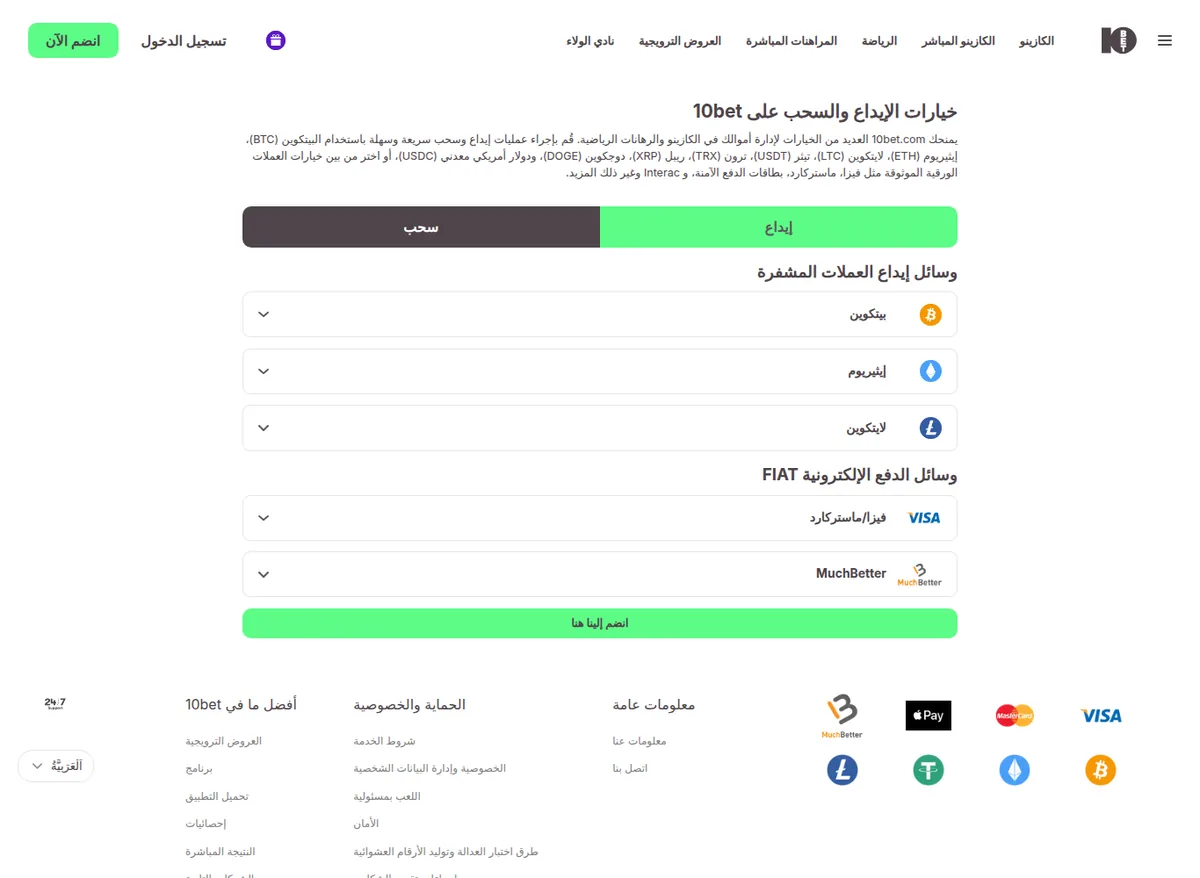
The cashier sits behind registration, so what we can report is the footer served to an Emirati connection — MuchBetter, Apple Pay, Mastercard, Visa, Litecoin, Tether, Ethereum and Bitcoin — plus Neteller, AstroPay and Interac named in the site’s own copy.
What makes 10Bet worth reading is that it publishes the withdrawal rules properly, and some of them cost money: a €20,000 monthly ceiling, €5 on a second card withdrawal, €5 a month dormancy from the end of the sixth month without a login, an AML playthrough of one times deposits, and withdrawals routed back to the deposit method in the account holder’s own name. Nothing on the list is local: no regional transfer, no dirham, no Gulf wallet.
Casinia — twenty methods, fifteen of them crypto
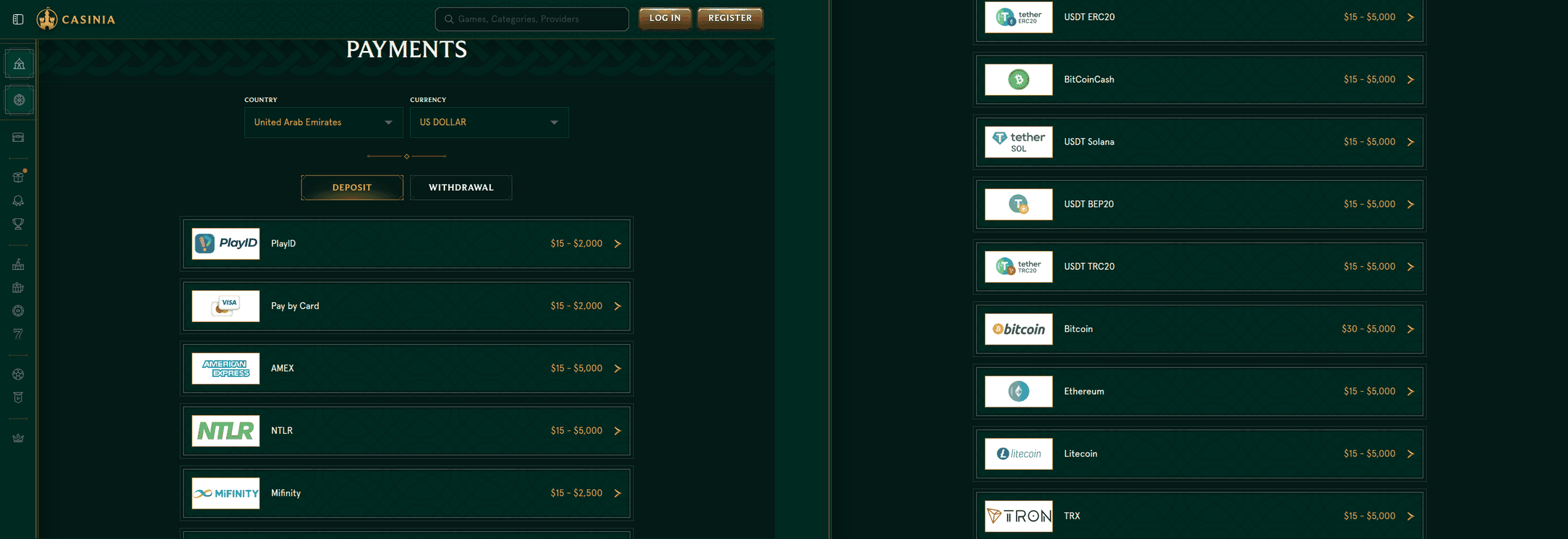
Cards and PlayID take $15 to $2,000; AMEX and every crypto rail $15 to $5,000, Bitcoin from $30; MiFinity to $2,500. Tether runs on four separate networks. Each method carries its own minimum and maximum, published.
Two gaps. No processing time for any method, and no dirham — an Emirati account runs in dollars or euros, so a card funded in AED is converted by your bank on the way in and again on the way out. Note also who is missing: Skrill is not a deposit option here at all, while Neteller is — and funding with it disqualifies you from the welcome bonus.
Spinrollz — the honest processing window
Nineteen methods, fifteen crypto, published per country without an account. The four fiat routes are Pay by Card, American Express, Neteller and MiFinity. Tether on four chains, USD Coin on two.
Withdrawal ceilings run the five-level VIP ladder: $500 a day and $7,000 a month at level one, to $1,500 and $20,000 at level five. And the line no other brand prints: processing is quoted at three business days and restricted to 06:00–17:00 GMT, Monday to Friday. A request made on Friday evening is not looked at until Monday afternoon Gulf time. Everyone has a window like this; Spinrollz is the only one that says so.
Nomini and StoneVegas — exact limits, clauses to reread
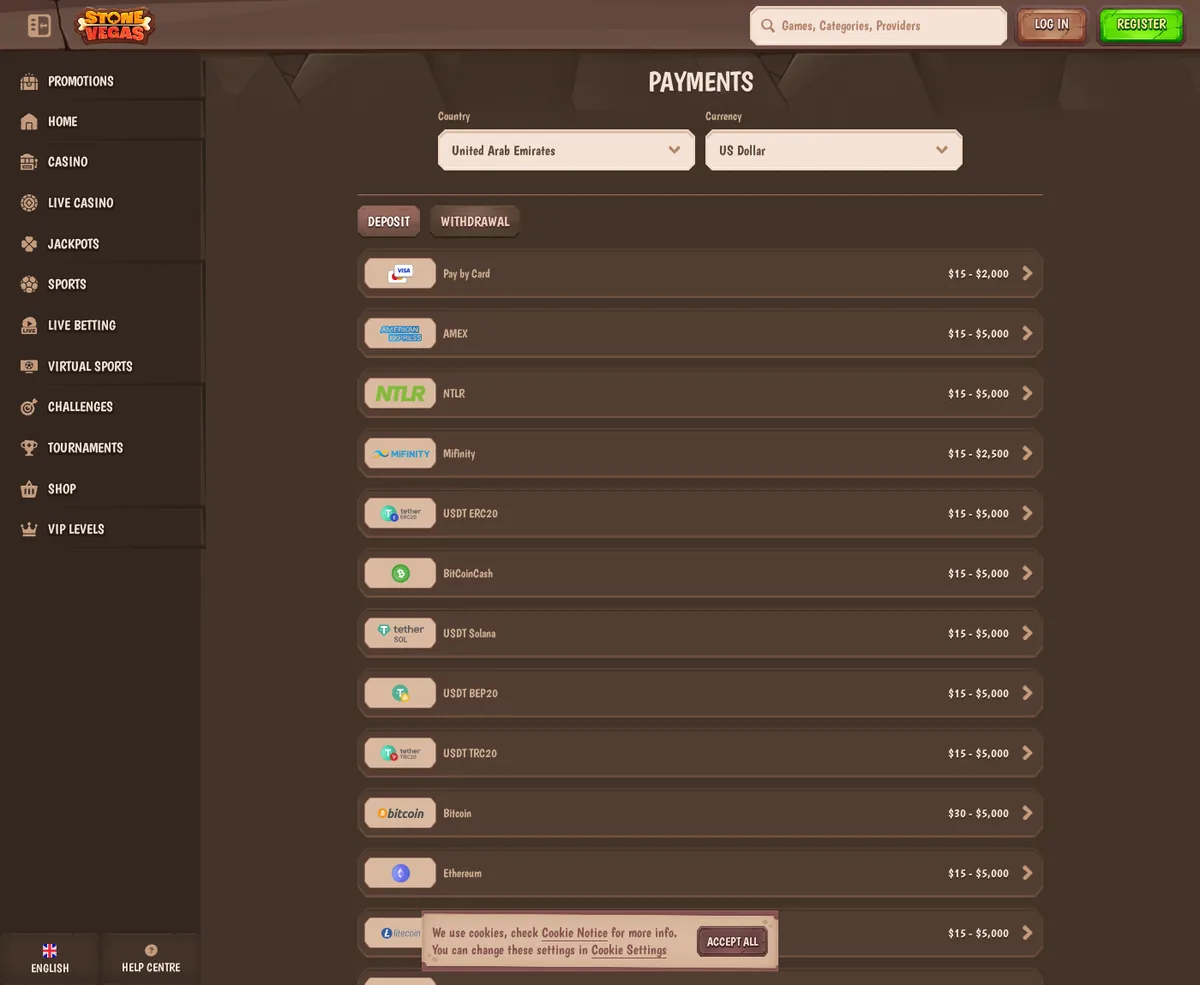
Both print the exact Emirati floor and ceiling for every method, which puts them ahead of most of this list. Deposits start at $15 for cards, AMEX, Neteller, MiFinity and every crypto rail except Bitcoin, which starts at $30.
And both carry the asymmetry that defines this page: AMEX and Neteller fund the account and cannot pay out; Skrill and bank transfer pay out and cannot fund. Plus the clauses: 10% kept if you withdraw without wagering once (15% by card or transfer), a withdrawal refusable unless you wagered €20 that calendar month, a 30-day document window, and — the one to read twice — asking to close an account that still holds funds or a pending withdrawal voids those funds.
Rabona — a public cashier with a currency mismatch
Publishes a full cashier before registration, with a country and currency selector at the top, which is better than most. The mismatch is that every offer is advertised in euros while the cashier serves UAE players in US dollars, and a card deposit will not trigger a crypto bonus — the offer attaches to the method, not to the account.
Megapari — the dirham that belongs to nobody
The footer of the working mirror carries Visa, Mastercard, Google Pay, Skrill, Neteller, Jeton, Uzcard, a cash-agent network, and crypto in Bitcoin, Ethereum, Tether and Tron. Withdrawals must return to the deposit method, the minimum is €10, and the standing daily limit is 10,000 with manual verification above it.
The curiosity is the currency table. The platform runs 63 active currencies and the UAE dirham is one of them — but the country table assigns it to no country at all, the Emirates included. An Emirati visitor is given Tether as the base currency, with nineteen alternatives that include dollars and euros and not the dirham. The currency exists in the system and is handed to nobody.
BetoStar — a cashier behind the account, and a Canadian tell

The cashier needs an account and the payment-methods page was one we could not open. The footer carries Visa, Mastercard, Skrill, Neteller, MuchBetter, Jeton, Voucherry and AstroPay, with Bitcoin for crypto. Nothing on the list is of any use in the Gulf: no regional transfer, no dirham, no Gulf wallet.
A detail worth noting because it recurs: Interac, a Canadian service, appears at both BetoStar and 10Bet — two unrelated brands showing a UAE visitor a payment rail from the wrong hemisphere. Cashiers in this market are assembled from a template and trimmed by country, and the trimming is not always done.
EmirBet — thirteen routes and not one crypto
The deposit strip runs Visa, Mastercard, Maestro, Skrill, Neteller, ecoPayz, MiFinity, paysafecard, Rapid Transfer, Klarna, Discover, WebMoney and QIWI. No cryptocurrency at all, which is unusual for a 2026 offshore brand and leaves an Emirati player with cards and wallets in a market where cards are declined.
No dirham, no local transfer, no regional wallet, and no minimum, maximum or processing time published for any of the thirteen outside a registered account.
Betfinal — six routes and a warning worth the whole section
Visa, Mastercard, Skrill, MuchBetter, cryptocurrency and Binance Pay. No minimum deposit per method, no minimum or maximum withdrawal, no processing time — not in the terms, not on a payments page, nowhere. Withdrawing funds you have not wagered attracts a 10% fee on the deposited amount, when it is permitted at all.
And the line that belongs in bold on any crypto page: the terms warn explicitly that picking the wrong network on a withdrawal loses the funds, with no recovery offered. Confirm the network in the cashier before you confirm the amount.
RollingSlots — nothing published, and a contradiction
No public payments page with a country selector, and no published minimum, maximum or processing time for any method. What the site shows is a row of marks in the footer: cards, bank transfer, Zimpler, MiFinity and a generic crypto badge. Zimpler is a Nordic pay-by-bank service with no Gulf presence, and its prominence says more about who the cashier was built for than any language list.
The contradiction: the anti-money-laundering section states funds may be received from players only by credit card, debit card, bank transfer or e-wallet — a list with no cryptocurrency in it — while the footer advertises a crypto mark. The AML section also requires wagering three times the value of deposits before any withdrawal, which is the heaviest we found.
Wazamba, Cadoola and BoaBoa — the currency problem
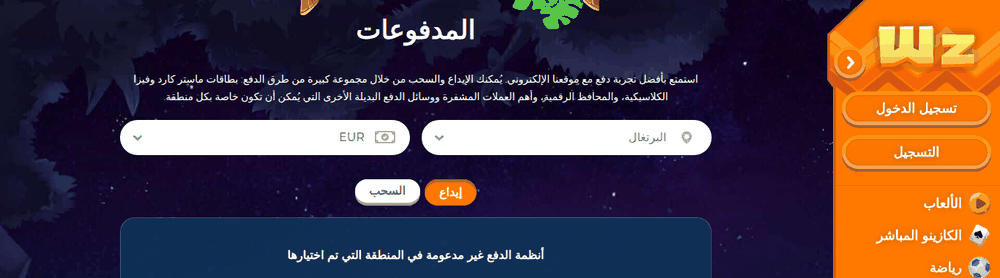
Three brands on related platforms, and between them the clearest picture of how little this market is served. Wazamba lists 25 currencies and no Gulf currency appears — no dirham, no riyal, no Egyptian pound; minimum withdrawal €10, maximum €20,000 a month. Cadoola runs 116 countries and 13 currencies, not one of them Arab. BoaBoa supports 21 currencies, none the dirham, with the US dollar as default in 73 of its 114 countries.
BoaBoa’s footer is the longest payment strip in this comparison — Visa, Mastercard, Skrill, Neteller, MiFinity, paysafecard, Klarna, bank transfer, AstroPay, Zimpler, STICPAY, Payz, Blik, GiroPay, QIWI, Bitcoin, Ethereum, Litecoin and Ripple — and the Gulf-usable subset of it is cards and crypto.
Need For Slots — two lists that contradict each other

The cashier page offers five methods: Visa, Mastercard, Apple Pay, Google Pay and cryptocurrency. The description block at the bottom of the home page publishes a different table listing e-wallets (Skrill, Neteller, Jeton) and bank transfers, with times and 0% fees for each.
So the brand maintains two payment lists that disagree: the marketing text promises routes the cashier does not offer, and the cashier offers two wallets the marketing never mentions. The published times are worth having even so — instant deposits; instant to a few hours for withdrawals on cards, wallets and crypto; one to five business days by bank transfer. Everything is priced in euros and there is no AED string anywhere in the operator’s own language files.
Spinanga, PlayFina and OscarSpin — crypto-first and quiet
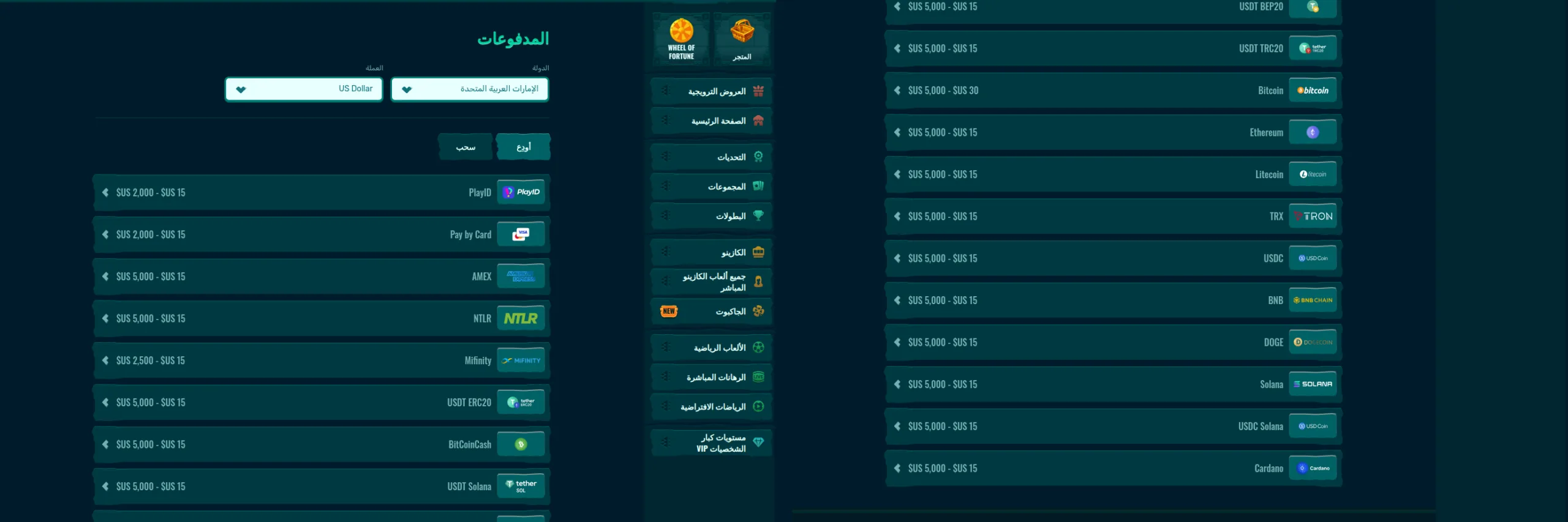
Spinanga gives the Emirates a noticeably different cashier: a card, an Amex and three wallets on the fiat side — one of which, Neteller, voids the welcome bonus — and crypto for everything else. Deposits from $15, withdrawal ceiling starting at $500 a day. The withdrawals tab exists beside the deposits tab and only opens from inside an account, which we say rather than guess at.
PlayFina defaults an Arabic-speaking account to US dollars and carries eleven coins as balance currencies rather than as a deposit rail — Bitcoin, Ethereum, Litecoin, Bitcoin Cash, Tether, USD Coin, Cardano, Dogecoin, Tron, BNB and XRP. No payments page without an account, so no published minimums. OscarSpin publishes no payment page at all and prices in euros, so every deposit and withdrawal crosses a conversion charged by your card issuer — and it never appears in a fee table because there is no fee table.
Deposit and Withdrawal Are Not the Same List
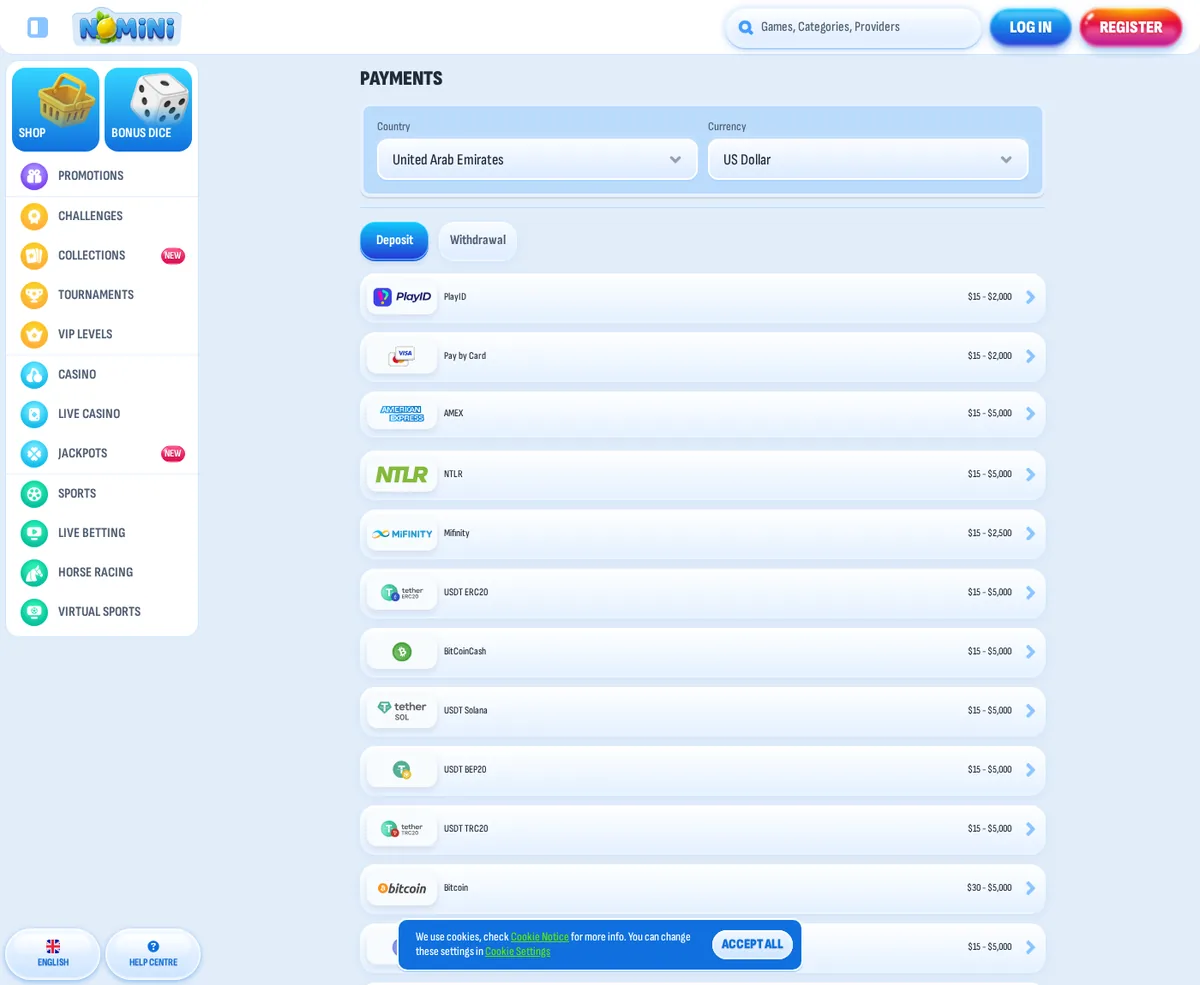
This is the finding that surprises people most, and it is published in plain sight at the brands that publish anything at all.
At Nomini and StoneVegas, AMEX and Neteller can fund an account and cannot pay it out. Skrill and bank transfer can pay out and cannot fund. The two lists overlap but are not the same list, and the cashier does not announce it — you discover it at the moment you try to withdraw, which is the worst possible moment.
The pattern repeats elsewhere in different shapes: at BassBet, Neteller is one of only two non-crypto deposit rails and Skrill one of only four non-crypto withdrawal rails. At Casinia, Skrill is a withdrawal method and not a deposit method. At Legiano the review states it plainly — the deposit list and the withdrawal list are not the same list.
Withdrawals usually return to the deposit method
Most operators route the money back the way it came, in the account holder’s own name. 10Bet and Megapari both state this explicitly. Combined with the asymmetry above, that creates a trap worth planning around: fund with a method that cannot pay out, and the operator must either break its own rule or route you somewhere you did not choose.
Practical consequence
Pick your withdrawal method before your deposit method, not after. Open the cashier, find the withdrawal tab, see what is on it, and fund with something that appears on both lists. Where the cashier sits behind registration — 10Bet, BetoStar, Spinanga — you cannot do this in advance, which is itself a reason to prefer the brands that publish openly.
And there is a worse version of the asymmetry, which is when the two lists overlap on paper and not in practice. A method can appear on both tabs and still refuse a withdrawal because the receiving account must be in your own name and must be the one that funded the deposit. A card in a spouse’s name, a wallet opened with a different email, a bank account held jointly — each of those passes at deposit and fails at withdrawal, and the failure arrives after the verification documents, which is to say after several days.
The cleanest defence costs nothing and takes a minute: fund the account with a method registered in exactly the name on your casino account, and confirm it appears on the withdrawal tab before you deposit a second time. The first deposit is the cheap experiment; the one to get right is the one after it.
Fees: Who Charges What
Most operators advertise free deposits and stay quiet about everything else. These are the charges we found written down.
| Brand | Charge | When it applies |
|---|---|---|
| Horus Casino | 0% on all 46 methods | Published in a table, before registration, identical from Dubai, Lisbon or Amsterdam |
| Roobet | No operator fee on crypto | You pay the network fee only, shown before you confirm |
| BC.GAME | 1% on withdrawals | Waived for VIP members. The only percentage fee we found |
| 10Bet | €5 | On a second card withdrawal within a month |
| 10Bet | €5 a month | Dormancy, from the end of the sixth month without a login |
| Nomini, StoneVegas, BoaBoa, Spinrollz | 10% of the last deposit | If you withdraw without wagering the deposit at least once |
| Nomini, StoneVegas, BoaBoa, Spinrollz | 15% | Same situation, if you funded by bank card or bank transfer |
| Betfinal | 10% of the deposited amount | Withdrawing funds you have not wagered, where it is permitted at all |
| Need For Slots | 0% published | On e-wallets and bank transfer, in the home-page table |
The 10–15% clause deserves emphasis because it applies whether or not you took a bonus. Deposit $500, change your mind before playing, and $75 is gone at the brands that charge the card rate. It is a charge for depositing and reconsidering, and it is the most expensive thing on this page that nobody expects.
And the silence is itself information. RollingSlots, EmirBet, Betfinal, OscarSpin and PlayFina publish no fee schedule at all — no minimum, no maximum, no processing time for any method. At BC.GAME the silence is worse than elsewhere because the fee is a percentage: you know the rate and not the ceiling it applies to.
Processing Times
Deposits are instant almost everywhere. Withdrawals are where the brands separate, and where most of them say nothing.
| Brand | Deposit | Withdrawal |
|---|---|---|
| Horus Casino | Published per method | Published per method, in the same table |
| Roobet | Instant credit on cards, up to 1 hour for full processing | Crypto at network speed |
| Need For Slots | Instant | Instant to a few hours on cards, wallets and crypto; 1–5 business days by bank transfer |
| Spinrollz | — | Three business days, and only 06:00–17:00 GMT, Monday to Friday |
| Melbet, BC.GAME, Casinia, YYY, RollingSlots, EmirBet, Betfinal | — | Not published |
The Spinrollz line is worth reading twice. A withdrawal requested on Friday evening is not looked at until Monday morning GMT, which in Gulf Standard Time is Monday afternoon. Three business days inside an eleven-hour weekday window is a different promise from “three days”, and Spinrollz is the only brand here honest enough to print the window.
The Dirham, and What Conversion Costs You

This is the gap that affects every reader of this page on every transaction, and it is in no fee table because the charge is made by your bank rather than by the casino.
Who actually offers a dirham balance
Two brands, and one near-miss:
- 888 Casino. The bonus policy states play is offered in US dollars, euros and UAE dirham; the platform configuration lists AED; and the withdrawal policy sets its payout ceiling in dirhams as well as dollars. An Emirati player can genuinely hold the balance in AED.
- BC.GAME. The dirham is one of 151 national currencies in the wallet, alongside the Saudi riyal, at a rate that tracked the real peg when we read it.
- Megapari — in the system, given to nobody. The platform runs 63 active currencies and the dirham is one of them, but the country table assigns it to no country at all, the Emirates included. An Emirati visitor is assigned Tether as the base currency, with nineteen alternatives that include dollars and euros and not the dirham.
Everywhere else, you hold dollars or euros
Casinia, StoneVegas, Nomini, Legiano, Spinrollz, Wazamba, Cadoola, BoaBoa, Need For Slots, EmirBet, PlayFina and OscarSpin all run Emirati accounts in USD or EUR. The numbers behind that are worth seeing: Cadoola supports 13 currencies across 116 countries and not one is Arab; BoaBoa supports 21 and none is the dirham, with the US dollar as default in 73 of its 114 countries; Wazamba lists 25 currencies and no Gulf currency appears. Need For Slots has no AED string anywhere in its own language files.
What the conversion actually costs
You pay a spread twice — once converting AED into the account currency, once converting back. On a round trip that is commonly 2% to 4% depending on the method, and on a card it is applied by your issuer, so it appears on your statement and in none of the operator’s figures.
Set that against a bonus and the comparison changes shape. A welcome match is paid once; the conversion applies to every deposit and every withdrawal for as long as you hold the account. Over a year of regular play the spread routinely exceeds the value of the welcome bonus that persuaded someone to open the account in the first place.
Worth putting a number on it, because “2 to 4%” sounds small. A player depositing $500 a month and withdrawing $400 crosses roughly $10,800 of conversion in a year. At 3% that is $324 in spread — more than three times a typical $100 welcome bonus, paid silently, and invisible in every comparison table on every affiliate site including, until this paragraph, ours.
Two ways to reduce it, and both have a catch. Hold the balance in dollars and fund from a dollar account if you have one, which removes one leg of the conversion but not the other unless you also withdraw to dollars. Or use a stablecoin end to end, which takes the bank out of the equation entirely and substitutes the exchange’s own spread — usually smaller, and paid to a different party.
A mismatch worth catching
Several brands advertise in one currency and transact in another. Rabona quotes every offer in euros while the cashier serves UAE players in US dollars. Cadoola opens the account in dollars while the welcome banner quotes euros. At 888, what is quoted in dollars is calculated in dollars and then converted to your account currency with the company’s own margin added to the mid-market rate — which is disclosed, and still a cost.
Security, Verification and the Clauses That Cost Money
Most money lost at the cashier is lost to a clause rather than a fee. These are the clauses, and the checks, that decide whether a withdrawal arrives.
KYC is not optional, and the timing is your choice
Every operator requires identity and address documents before a first withdrawal. Nomini and StoneVegas give a 30-day window to supply them, after which the terms allow the account to be closed. The practical advice is the same everywhere and almost nobody follows it: verify on the day you register, not on the day you want the money. Doing it early costs nothing; doing it late costs days with a balance you cannot reach.
The AML playthrough, which is not a bonus condition
A minimum turnover required before any withdrawal, applied whether or not you took a bonus. Roobet sets it at 100% of the deposit and publishes it. 10Bet sets it at one time deposits; RollingSlots at three times. The 10–15% commission at Nomini, StoneVegas, BoaBoa and Spinrollz is the same rule charged as a fee instead of enforced as a block.
It is a reasonable rule badly explained. The casino does not want to be used to move money, and requiring a single pass through the games is the cheapest way to prevent it. What varies is whether the operator tells you before you deposit.
Withdrawals Refused for Reasons Beyond Your Balance
At Nomini and StoneVegas, clause 6.7 allows a withdrawal to be refused unless you have wagered at least €20 within that calendar month. And clause 6.7 at both carries the harshest line we have read in this market: an account can only be closed with a zero balance and no pending withdrawal, and if you ask to close it while it still holds funds or a pending request, those funds are voided.
Read that twice before opening an account at either. Asking to leave while holding money is treated as forfeiting it.
Who processes the money
Worth knowing, because it tells you which legal entity actually holds your deposit. Stake processes through two wholly owned subsidiaries, Medium Rare Limited in Nicosia. 888 processes through SafeCharge, part of Nuvei — a mainstream processor and a genuinely different profile from the crypto-first offshore sites this market is full of. BDMBet uses Interdersoft Limited of Limassol. Where no entity is named, there is no one to address a complaint to.
One cashier that contradicts itself
RollingSlots states in its anti-money-laundering terms that funds may be received from players only by credit card, debit card, bank transfer or e-wallet — a list with no cryptocurrency in it — while its own footer advertises a crypto payment mark. Both cannot be true, and the one that governs is the one in the terms.
When a Payment Fails: What to Do, in Order
Five situations, and the sequence that resolves each. Most of the time the problem is not where people look for it first.
The deposit is declined
Start by establishing where the decline happened. If the casino shows an error immediately and your bank sends no notification, the authorisation was refused by your issuer — which is the common case in the Emirates and is not something the operator can fix. Support can confirm whether the attempt reached them at all, and that one question saves a long exchange.
What actually works, in order of likelihood: switch to cryptocurrency; try an e-wallet already funded from another source; try Apple Pay where it exists. What rarely works: a different card from the same bank, or the same card tomorrow.
The deposit left your account and did not arrive
Rare on cards and real on crypto. On a blockchain transfer, get the transaction hash from your wallet and check it on a block explorer before contacting anyone — it will tell you whether the funds left, how many confirmations they have, and which address received them.
If the hash shows the funds arriving at the casino’s address and the balance has not moved, that is a support ticket with evidence attached, which is a different conversation from one without. If the hash shows a different address, or no transaction at all, the problem is at your end.
The withdrawal is pending for longer than quoted
First, check whether a time was ever quoted. Melbet, BC.GAME, Casinia, RollingSlots, EmirBet and Betfinal publish no processing time at all, so “longer than quoted” has no meaning at those brands. Where a window exists — Spinrollz at three business days inside an 06:00–17:00 GMT weekday window — count against the window rather than against the calendar.
Then check the three things that hold a withdrawal regardless of the queue: verification complete? AML playthrough met? Monthly minimum wagered? At Nomini and StoneVegas the last of those is €20 within the calendar month, and a request can be refused without it.
The withdrawal is refused
Ask for the clause, in writing. The common grounds in this market are an unmet AML playthrough, incomplete verification, a withdrawal method that cannot receive, or a bonus condition breached. A refusal without a named clause is a delay, not a decision — and the clause is what makes everything after this possible.
Then escalate: internally first, with the clause cited and the evidence attached; then to the licensing authority if there is one. Melbet, Stake, 10Bet and Roobet publish Curaçao numbers that resolve in the register, and the Curaçao Gaming Authority now accepts player complaints directly. At brands that publish no licence and name no company, there is no next step, and that is the real cost of choosing one.
You sent crypto to the wrong network
There is no procedure, and that is why this is the last item. Betfinal’s terms state it plainly: pick the wrong network and the funds are lost, with no recovery offered. Some operators can recover funds on an EVM-compatible chain if the address format matches, at their discretion and usually for a fee. Most cannot and will not.
The prevention costs nothing: confirm the network in the cashier before you confirm the amount, and send a small test transfer the first time you use any new address.
How This Compares With a Regulated Market
Context for anyone who has funded a casino account under a UK, Danish or Ontario licence and is now reading a Curaçao cashier. The differences are structural.
The disclosure is voluntary
Under a domestic licence, publishing deposit and withdrawal limits, fees and processing times is a condition of operating. Here it is a choice, and the spread between brands is enormous: Horus Casino publishes 46 methods with every fee, limit and time before registration; RollingSlots, EmirBet, Betfinal, OscarSpin and PlayFina publish nothing at all. Both are compliant with their licences, because neither licence asks.
Your bank is on the other side
In a regulated market the payment rail is built to work: licensed operators hold local merchant accounts and cards go through. Here the local banking system actively declines the transaction, which is the single largest practical difference and the reason this market runs on crypto. No amount of operator quality changes it.
There is no payment ombudsman
A disputed transaction under a domestic licence goes to a regulator that can order payment. Here it goes to Curaçao, to Anjouan, or nowhere. Chargebacks against a gambling merchant are difficult and can close your bank account. The leverage you have is the licence you checked before depositing, which is why that check belongs before the first deposit rather than after the first problem.
What has not changed
The arithmetic of conversion, the mechanics of a blockchain transfer, and the fact that a method which cannot pay out is not a method. Everything on this page is checkable by you, on any cashier, in any market — open the withdrawal tab, read the limits, compare the two lists, find the currency. That habit travels further than any recommendation we could make.
Payment Terms, Defined
The vocabulary of a cashier, with what each term means in practice here.
| Term | What it means | Why it matters in the UAE |
|---|---|---|
| Merchant category code | The code that identifies what a business sells, attached to every card transaction. | Gambling has its own, and UAE issuers block it. This is why your card fails. |
| AML playthrough | Minimum turnover required before withdrawal, separate from any bonus. | Roobet 100% of deposit, 10Bet 1x deposits, RollingSlots 3x. Or charged as a 10–15% fee at four brands. |
| KYC | Identity and address verification before a first withdrawal. | Required everywhere. Nomini and StoneVegas allow 30 days to supply documents. |
| Stablecoin | A cryptocurrency pegged to a fiat currency, usually the dollar. | USDT and USDC remove the exchange-rate risk that makes volatile coins awkward for a casino balance. |
| Network / chain | The blockchain a transfer travels on. The same coin exists on several. | Tether runs on ERC20, TRC20, BEP20 and Polygon. Sending to the wrong one loses the funds. |
| Network fee / gas | What the blockchain charges to process the transfer, not the casino. | Ranged from $0.0006 to $2.15 across nine networks when we measured on 9 October 2026, and it moves by the hour. Roobet displays it before you confirm. |
| Layer two | A network built on top of a main chain to cut fees. | Roobet accepts Ethereum on Base and Arbitrum, which costs a fraction of mainnet. |
| Reverse withdrawal | Cancelling a pending withdrawal and returning the funds to your balance. | Convenient and the most common way players lose money they had already won. |
| Dormancy fee | A monthly charge on an inactive account. | 10Bet charges €5 a month from the end of the sixth month without a login. |
| Conversion spread | The margin applied when your currency is exchanged for the account currency. | 2–4% on a round trip, charged by your bank, invisible in the operator’s figures. |
| Processing window | The hours during which withdrawal requests are actually handled. | Spinrollz processes 06:00–17:00 GMT, Monday to Friday. Most brands have one and do not print it. |
| Payment processor | The company that actually moves the money, often not the casino. | Stake uses Medium Rare Limited, 888 uses SafeCharge (Nuvei), BDMBet uses Interdersoft. |
| Deposit-method return | The rule that withdrawals go back the way they came. | 10Bet and Megapari state it explicitly. It interacts badly with lists that are not symmetrical. |
| Per-transaction limit | The floor and ceiling on a single movement, distinct from daily or monthly caps. | Casinia: cards $15–$2,000, crypto $15–$5,000, Bitcoin from $30. |
How We Test Payment Methods
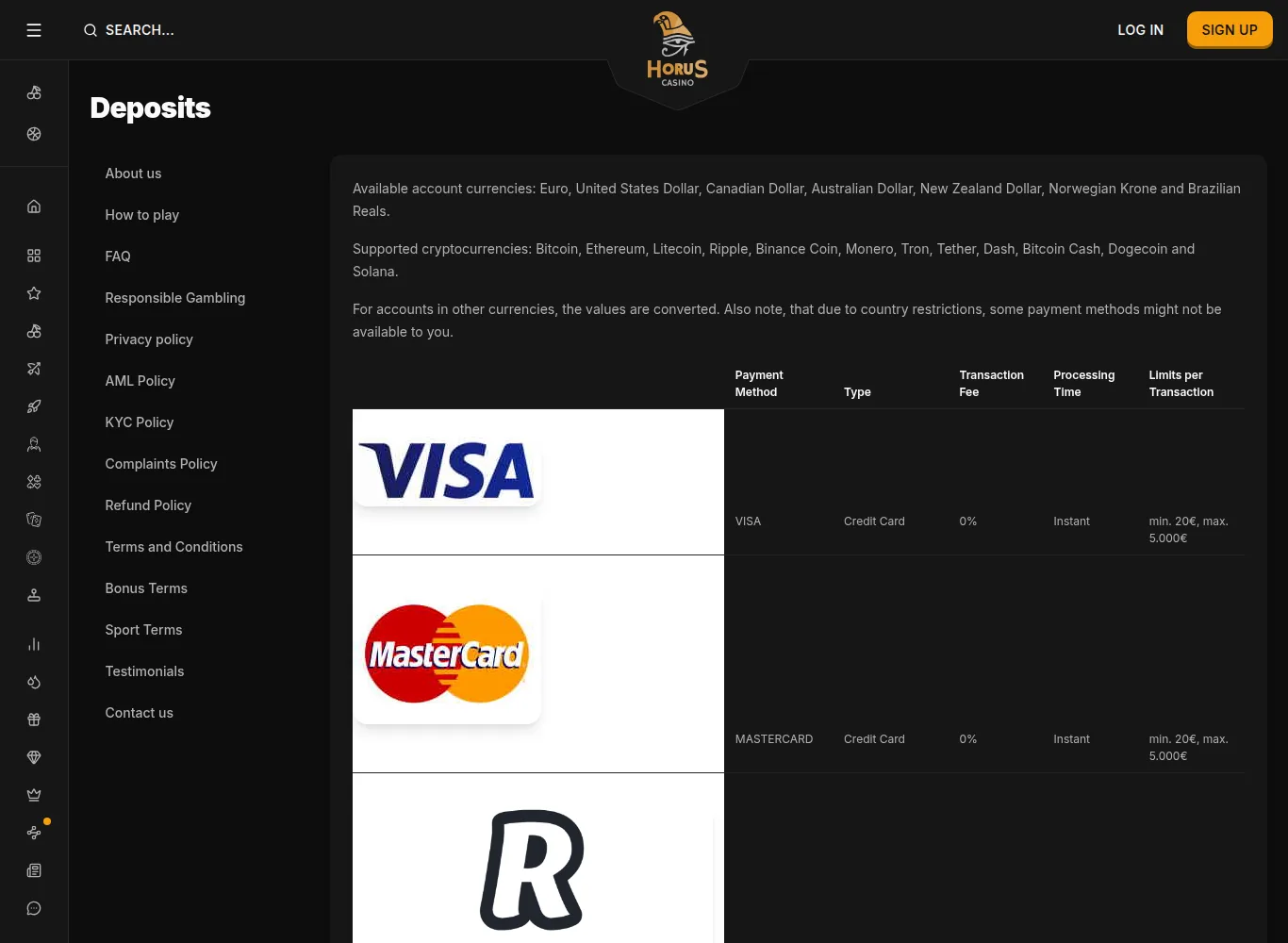
The image above is what good disclosure looks like, and it is the exception. Horus Casino publishes 46 methods with type, fee, processing time and per-transaction minimum and maximum, in one table, before you register — and the table came back identical whether we opened it from Dubai, Lisbon or Amsterdam. Everything else on this page is measured against that standard.
| Step | What we do | What it catches |
|---|---|---|
| Open the cashier from the UAE | Load the payments page from a connection inside the Emirates, without a VPN, and read what is served. | Methods that differ by country — and the brands that show a UAE visitor a Canadian or Nordic rail. |
| Say where the cashier sits | Record whether it is public, behind registration, or behind a country block. | 10Bet, BetoStar and Spinanga all hide it. We report that rather than repeating their marketing. |
| Compare deposit and withdrawal lists | Read both tabs separately and diff them. | AMEX and Neteller that fund and cannot pay out; Skrill that pays out and cannot fund. |
| Extract limits and fees per method | Minimum, maximum, fee and processing time, per method, as published. | The brands that publish nothing — and the 1%, the €5, the 10–15%. |
| Check the account currency | Open the registration form and the currency selector. | Whether the dirham exists at all, and what you will pay in conversion if it does not. |
| Read the withdrawal clauses | AML playthrough, monthly minimums, dormancy, account closure. | The €20-a-month rule, the 30-day document window, and the clause that voids funds on closure. |
What we do not do: publish a processing time we have not seen. Where we hold no account — Horus, EmirBet — we say the figure is unmeasured instead of estimating it. Melbet is the clearest example: we have not run a withdrawal through it, so we publish no times, minimums or fees for it, even though it would be easy to repeat what the industry says. Our full method is in how we test and rate casinos.
Last reviewed: 8 October 2026. Cashiers change faster than almost anything else we cover: methods appear and disappear by country, limits move, and a rail that worked last month can be gone. Treat this as a guide to what to check and read the cashier in front of you.
Choosing a Method: a Short Decision Guide
| If you… | Use | Why |
|---|---|---|
| have never used cryptocurrency | Roobet, or Apple Pay at 10Bet | Roobet sells crypto inside the cashier; Apple Pay avoids it entirely |
| want a dirham balance | 888 Casino or BC.GAME | The only two that genuinely hold AED |
| want every number before you commit | Horus Casino | 46 methods with fees, times and limits, published before registration — though nine of eleven requests from Dubai were blocked |
| are moving larger sums | Stake | No maximum withdrawal, stated plainly, and 22 coins |
| want the lowest fees | Roobet or Horus | No operator fee on crypto; 0% across the board |
| plan to withdraw by card | Check first | Several brands take cards and will not pay back to one |
| might change your mind after depositing | Avoid Nomini, StoneVegas, BoaBoa, Spinrollz, Betfinal | All charge 10–15% if you withdraw without wagering |
And the point that outlasts any list: the method decides more about your experience than the casino does. A good operator with a rail you cannot use is worth less than an ordinary one you can fund and cash out from. Set your deposit limits at the same time you set up the payment method — our responsible gambling guide explains how, and what help is reachable from this region. Adults only. Check the laws and the legal age where you live.
One last practical note, because it is the question support teams get most and almost nobody answers in advance. Keep a record of every deposit: the date, the amount, the method and, for crypto, the transaction hash. It takes a screenshot. Every dispute on this page — a deposit that did not arrive, a withdrawal refused, a bonus voided over a payment method — is resolved faster by the party holding evidence, and in a market with no ombudsman that party needs to be you. Operators keep their own logs and are under no obligation to show them.
The one sentence this page is built around
If everything above collapses into a single idea, it is this: in this market the payment method is not a detail of the account, it is the account. Everywhere with a domestic licence you choose a casino and the money follows. Here the money decides, and the casino comes second.
That inversion explains every finding on this page. It explains why the crypto welcome offer is six times the fiat one, because the operator is paying you to use the rail that works. It explains why four brands run a deposit list and a withdrawal list that do not match, because each rail was added for what it could do rather than designed as a pair. It explains why EmirBet can run thirteen payment routes and still be impractical here, and why Horus Casino can publish the best payments table in the comparison and still be unreachable from Dubai. And it explains why the dirham, the currency of the people this entire market is being sold to, appears at two brands out of twenty-five — and at a third it exists in the system and is assigned to nobody.
So the order of decisions should be the reverse of the usual one. Work out how you are going to get money in and out first; choose among the brands that support it second. A casino you rate highly and cannot fund is worth nothing, and a cashier you understand completely turns every other comparison on this site into a decision you can actually act on — the bonus terms, the sportsbook margins, the app that survives a domain change. All of it assumes the money can move.
Nine things to check before the first deposit
The whole of this page, compressed into what you would actually do. It takes about five minutes and it is the difference between a cashier that works and one that surprises you.
- Open the withdrawal tab first. Before you choose how to put money in, see what can take it out. At four brands here the two lists are different, and you only find out at the worst moment.
- Find the account currency. If there is no dirham — and at all but two brands there is not — you are paying a conversion spread twice on every movement, charged by your bank and invisible in the operator’s figures.
- Find the fee schedule, or note its absence. Six brands on this site publish no minimum, maximum or processing time for any method. That silence is itself a data point.
- Look for the 10% clause. Nomini, StoneVegas, BoaBoa, Spinrollz and Betfinal keep 10 to 15% if you withdraw without wagering your deposit once, bonus or no bonus.
- Check the AML playthrough. Roobet asks 100% of the deposit, 10Bet one times, RollingSlots three times. It applies whether or not you take a bonus.
- Confirm the name matches. The payment method must be registered in the same name as the casino account, or the withdrawal fails after verification.
- If you are using crypto, confirm the network. Then send a small test transfer. The wrong chain loses the funds and no operator here offers recovery.
- Verify your identity on day one. Not on the day you want the money. Nomini and StoneVegas allow 30 days to produce documents; doing it early costs nothing.
- Read what happens if you close the account. At Nomini and StoneVegas, asking to close while holding a balance or a pending withdrawal voids those funds.
None of that requires an account, a deposit or a support ticket at the brands that publish openly. At the brands that do not — and there are more of them than there should be — the inability to answer these questions before depositing is the answer to a different and more important question, which is whether to deposit at all.
Frequently Asked Questions
Because the decline happens at your bank, not at the casino. Gambling merchants carry a specific merchant category code and UAE issuers routinely block transactions to it. The casino never receives the money and usually cannot tell you why. Switching casinos or cards within the same bank rarely helps — it is a policy applied to a merchant category. Cryptocurrency is the route that works most consistently from here, which is why every cashier we opened leans on it.
Two, properly. 888 Casino offers play in dirhams — the bonus policy, the platform configuration and the withdrawal ceiling all reference AED — and BC.GAME holds the dirham as one of 151 national currencies in its wallet. Megapari has the dirham in its system but assigns it to no country, and an Emirati visitor is given Tether as the base currency instead. Everywhere else you hold dollars or euros and pay a conversion spread on the way in and the way out.
It is the most consistently available method from the UAE and it carries risks that cards do not. Transfers are irreversible, a mistyped address cannot be recovered, and sending on the wrong network loses the funds — Betfinal’s terms state exactly that, with no recovery offered. Stablecoins such as USDT avoid the exchange-rate exposure that volatile coins carry. Send a small test amount first whenever you use a new address or network.
Deposits are usually free. On withdrawals: BC.GAME charges 1%, waived for VIPs; 10Bet charges €5 on a second card withdrawal in a month and €5 monthly dormancy after six months without a login; Roobet charges no operator fee on crypto, only the network fee. The expensive one to know is the 10% — 15% if you funded by card or bank transfer — that Nomini, StoneVegas, BoaBoa and Spinrollz keep if you withdraw without wagering your deposit once. That applies whether or not you took a bonus.
Usually not. Most operators route withdrawals back to the deposit method in the account holder’s own name — 10Bet and Megapari both state this explicitly. This matters because the lists are not symmetrical: at Nomini and StoneVegas, AMEX and Neteller fund the account and cannot pay out, while Skrill and bank transfer pay out and cannot fund. Check the withdrawal tab before you choose how to deposit.
Most brands do not say. Of those that do: Roobet credits cards instantly and quotes up to an hour for full processing; Need For Slots quotes instant to a few hours on cards, wallets and crypto, and one to five business days by bank transfer; Spinrollz quotes three business days and restricts processing to 06:00–17:00 GMT, Monday to Friday. Melbet, BC.GAME, Casinia, RollingSlots, EmirBet and Betfinal publish no processing time at all.
At six brands we checked, yes — it voids the welcome offer entirely. BassBet, Spinanga, Spinrollz, Casinia, Cadoola and BoaBoa all exclude Neteller and Skrill deposits from the welcome bonus, and at several of them Neteller is one of only four or five non-crypto routes available. At BassBet nothing on the cashier screen warns you at the moment you choose it; the exclusion sits in clause 8 of the bonus terms.
Yes, at every operator on this site. Documents are identity and proof of address, and several brands give a limited window to supply them — Nomini and StoneVegas allow 30 days, after which the terms permit closing the account. Do it on the day you register rather than the day you want the money: it costs nothing early and costs days late. Note also that at Nomini and StoneVegas, asking to close an account that still holds a balance or a pending withdrawal voids those funds.