

Every figure on this site comes from somewhere, and this page says where. If a number here disagrees with a number on an operator’s homepage, it is because we counted and they advertised — and below you will find exactly how we counted, with the dates.
This matters more in this market than in most. An operator writing for the Gulf is describing a product that behaves differently depending on which country you open it from, under a licence issued thousands of kilometres away, with terms that are frequently published in a language the reader does not speak. Almost none of that is checkable from a press release.
Counting catalogues with a country code
Operators filter their lobbies by where you connect from, and the filtering is silent: the site advertises the full catalogue, the interface hands you a smaller one, and nothing explains the gap. We query the operator’s own catalogue interface with a country code and record what comes back, with the date. Where an interface will not answer, we publish no number rather than borrow one from a neighbouring country.

The screenshot above is the method in one image: the same casino, the same day, two connections. 98 providers to one, 91 to the other. Nothing on the site mentions it. Scaled across a whole catalogue, the gap stops being a detail:
| What we measured | The figure | What the operator says |
|---|---|---|
| Lobby count at 10Bet | 1,298 titles | Advertises “5,000+” |
| Studios blocking the UAE on one platform | 23 of 86, by name | Not mentioned anywhere on the site |
| Pragmatic Play to two Gulf countries | 620 slots to one, zero to the other | Same casino, same day, no notice |
| Live tables: outside the region vs from here | Casinia 785 → 453; Spinanga 780 → 450; BC.GAME 769 → 357 | The full figure is the one advertised |
| Oman vs UAE on the same platform | 8,450 games from 65 studios vs 7,590 from 61 | One catalogue is described |
The direction surprises people: a visitor in Oman is served more than a visitor in the Emirates, on the same brand. Nobody publishes this, which is why we count country by country instead of republishing marketing copy.
Reading licences in the register, not the footer
A licence badge in a footer is an image. Anyone can place one. We take the licence number an operator publishes and check it in the regulator’s own register — and that is how we found a licence displayed as current that had expired on 8 August 2026, with an assessment still in progress.
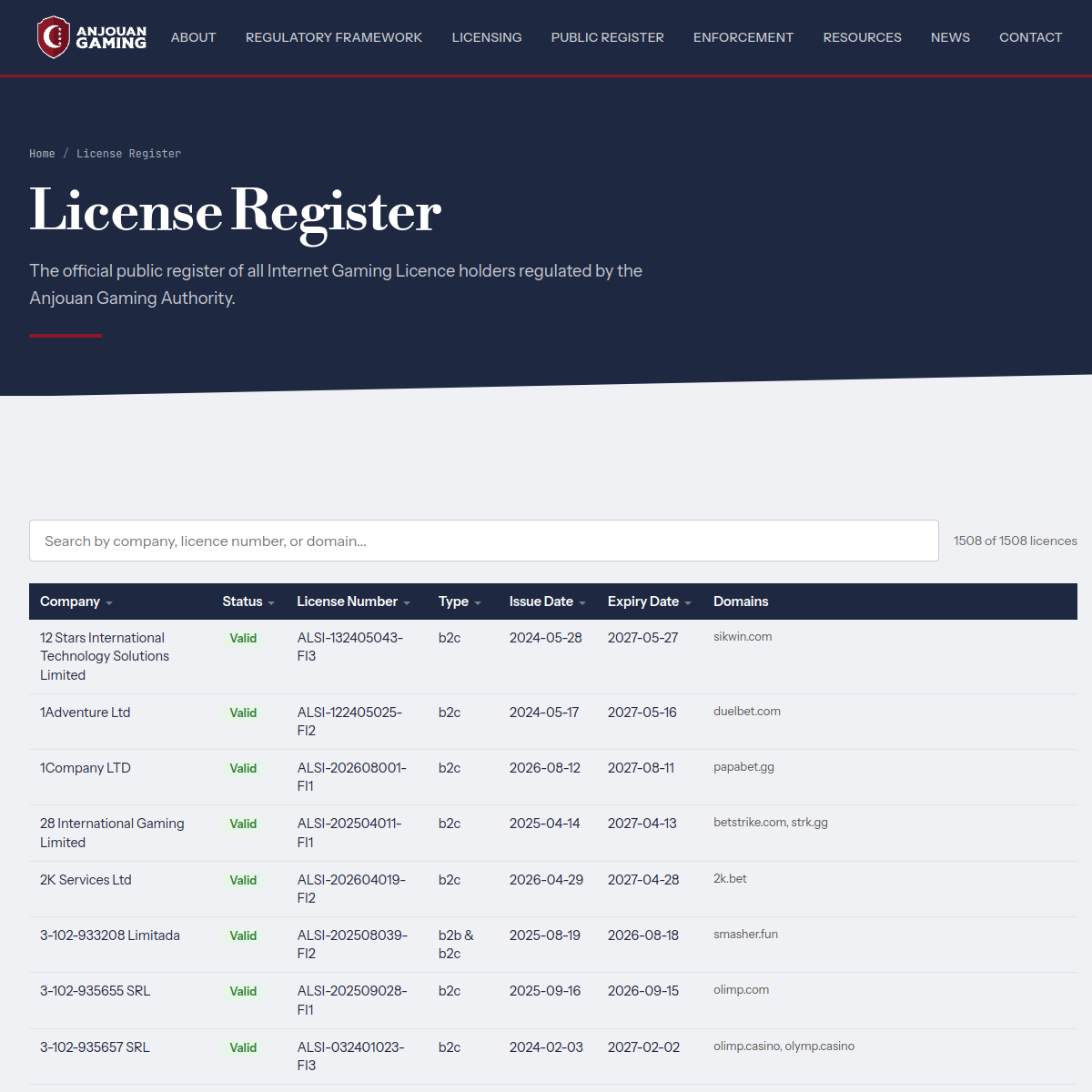
Where an operator publishes no licence at all, we say so plainly instead of leaving the row blank. Two of the largest catalogues we have counted — both above twelve thousand titles — are run by operators that publish none, and a reader deserves to know that before depositing, not after.
Why we separate three things most sites merge
- A GCGRA licence — issued inside the UAE, with a number you can check.
- An international licence — Curaçao or Anjouan, typically. It gives you a regulator to complain to; it is not a UAE licence.
- Availability from the UAE — means only that the operator accepts players from here. It says nothing about where it is licensed.
Those three are presented as one thing across most of this market. We never merge them, on any page, in either language.
Reading the terms, including the parts written to be skipped
Wagering requirements, game contribution tables, maximum stake while a bonus is live, withdrawal ceilings, and the clauses that make a payout discretionary. A bonus is worth what its terms allow you to withdraw, not what the banner says.
Two findings that only reading produces. At one operator the published contribution table puts slots at 100% and all roulette, blackjack, baccarat and live casino at 10% — which turns a $100 bonus at 35x into $35,000 of roulette to clear it. At another, live casino contributes zero, meaning no amount of it releases anything.

And sometimes the terms are not terms at all. The page above is a bonus policy served to Arabic readers as lorem ipsum placeholder text. We have also found Arabic bonus terms returning a 404, and “Arabic” sections where the contract stays in English. When a reader cannot read the contract in the language the site was sold to them in, that is a finding, and it goes in the review.
Reading the terms in the language they were sold in
An Arabic interface and an Arabic contract are different products, and the gap between them is one of the most consistent findings we have. We request the terms in Arabic, from the region, and read what comes back.
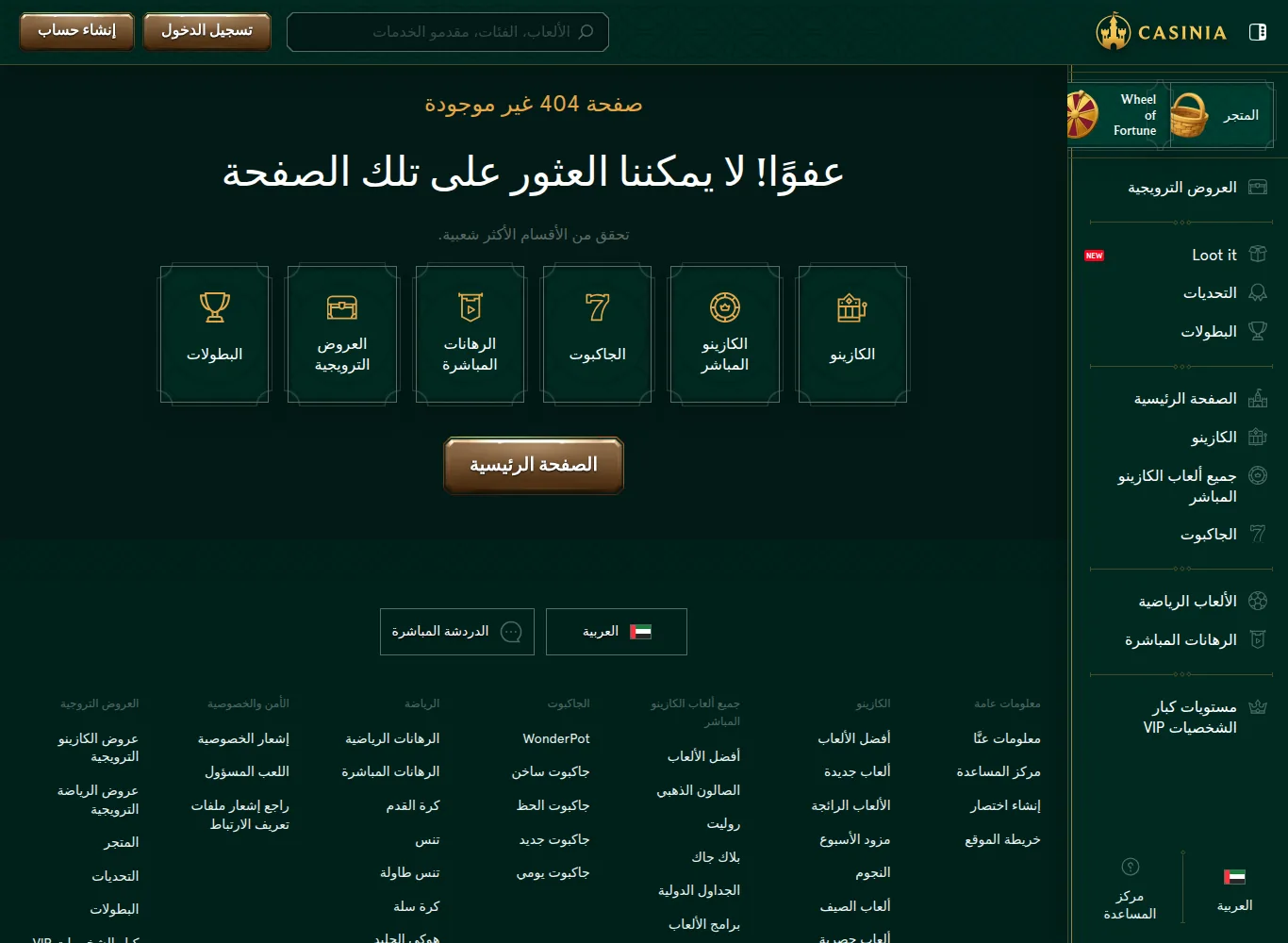
Above: a bonus whose terms page does not exist in the language the offer was advertised in. We have also found terms served as placeholder text, and sites where the interface translates but every game title, help article and contract clause stays in English. We record the interface, the contract and the support channels as three separate findings, because an operator can pass one and fail the others — and usually does.
Taking RTP from the people who made the game
Return-to-player figures are read on the game studio’s own page for that title, with the date. Where a studio does not publish one, we say that too, instead of copying a number from a database and presenting it as the manufacturer’s.
This produces results that contradict most of what is written about slots. Checking the studio pages for the best-known titles in this market, not one publishes a volatility rating — not Pragmatic Play, not Play’n GO, not Big Time Gaming. The volatility labels that fill comparison tables elsewhere are, at best, somebody’s estimate presented as the studio’s.
Licence numbers, reproduced in full
Every review carries the operator’s licence number written out, not summarised as “licensed in Curaçao”. That is deliberate: a jurisdiction name proves nothing, and a number lets you repeat our check in a minute.

Where a register lists a licence as under assessment rather than active, we write exactly that. “Expired” and “under review” are different situations with different consequences for someone holding a balance, and flattening them into one word would be easier to write and worse to read.
Testing from inside the region
Pages, lobbies and registration forms are opened from a connection in the market we are writing about. A site that loads in London and blocks Dubai is not “available in the UAE”, and we have the block pages to prove the difference matters.
This also catches the quieter failures: an interface that switches to English for an Arabic reader, a currency list that excludes the dirham, a payment page offering twelve Brazilian banks to an Emirati visitor.
What we do not do
- We do not test with real money. Where a claim needs a funded account to verify — payout speed, withdrawal experience, support on a live dispute — we say we have not verified it instead of implying we did.
- We do not rank by commission. The order of any table is set by what we measured, and each page states the criteria.
- We do not publish a number we did not get. An interface that fails to answer produces a gap in our data, not an estimate.
- We do not treat availability as licensing, in either direction.
- We do not publish guaranteed strategies, because none exist. Our game guides explain why no staking pattern changes a house edge.
How we are paid, and what it does not buy
We earn commission from some of the operators listed here when a reader opens an account through our links. That funds the testing, and you should weigh it when reading any recommendation on any affiliate site, including this one.
What it does not change is the figures. An operator cannot pay to have a catalogue count raised, a licence problem omitted, or a rating adjusted. The clearest evidence is in the reviews themselves: brands we earn from carry explicit warnings — an expired licence, no Arabic interface, 918 games hidden from UAE players, a catalogue a fraction of the advertised size. If commission wrote the content, those sentences would not survive the first draft.
Dates, and why everything carries one
This industry changes underneath you: domains move, licences lapse, studios withdraw from markets and catalogues shrink without announcement. Every count we publish carries the date it was taken. A figure without a date is not a measurement, it is a memory.
It also means our own pages age. Where you see a count from September that no longer matches what you see today, both can be true — and we would rather hear about it than not.
When we get it wrong
We will. When a reader or an operator shows us a figure is wrong, we check it and correct the page rather than defend it, and the correction is visible rather than silent. Write to contact@indexuae.com with the page, the figure and what you saw instead; a screenshot with a date settles it fastest.
What we check, page by page
Different page types need different evidence. This is the checklist each one has to satisfy before it is published, and it is the reason our reviews are longer than most:
| Page type | What has to be verified | What is never assumed |
|---|---|---|
| Operator review | Licence number checked in the public register; catalogue counted from a Gulf connection; terms read in full including the contribution table; payment methods and currencies listed from the cashier; Arabic interface and Arabic support tested separately | That the footer badge is current; that the advertised game count is the served one; that an Arabic interface means an Arabic contract |
| Country guide | The legal position from the law itself; which operators accept players from there; what the catalogue returns under that country code; which payment rails actually exist locally | That a site loading elsewhere loads from there; that neighbouring countries behave alike — they do not |
| Game guide | House edge and RTP derived from the rules of the game or read on the studio page; payout tables checked against the arithmetic; availability of the format in this region | Volatility ratings nobody publishes; strategy claims that survive contact with probability |
| Any page | Every number dated; every licence number reproduced in full so you can check it yourself | That last month’s measurement still holds |
Screenshots, and why they are ours
The images across this site are captures we took, from a connection in the market being written about, on the date shown. That is deliberate: a screenshot taken from the wrong country shows a different product, and in this market that difference is the story.
It is also why some of our images are unflattering. A block page, a licence badge with no number behind it, a terms page in placeholder text — these are findings, and showing them is more useful than another picture of a lobby.
When the operator and the register disagree
It happens more than you would expect, and we have a fixed order of priority. The public register wins. If a site displays a licence the regulator does not list as current, we publish both facts: what the site shows, and what the register says, with the date we checked.
We do not remove an operator for this, and we do not bury it either. The reader gets the licence number, the regulator’s name and the status we found, and decides. Where a regulator lists a licence as under assessment rather than active, we say exactly that, because “expired” and “under review” are not the same thing and the difference matters to a player with money on the platform.
What happens when we cannot measure something
Often enough that it deserves its own paragraph. A catalogue interface times out, an operator blocks automated requests, a terms page will not load in the language we need, or a claim simply cannot be settled without a funded account.
In every one of those cases the page says so, in the same sentence where the number would have been. “We did not count this one” and “this operator has few games” are very different statements, and collapsing them would make our tables look more complete at the cost of being wrong. The gaps you see in our data are deliberate, and they are the honest half of the method.
Domains that move
Operators in this market change domain regularly, usually because the previous one stopped resolving somewhere. We do not guess a domain from a pattern and we do not reuse one from an old article: we find the live one the way a reader would, by searching with the country’s IP and following where the links actually go.
A review pointing at a dead domain is worse than no review, because it sends a reader to a page that may now belong to someone else entirely.
More about who we are in our about page, the tools and limits worth knowing before you play in our responsible gambling guide, and the market itself in our UAE casino guide.